
Official statement
What you need to understand
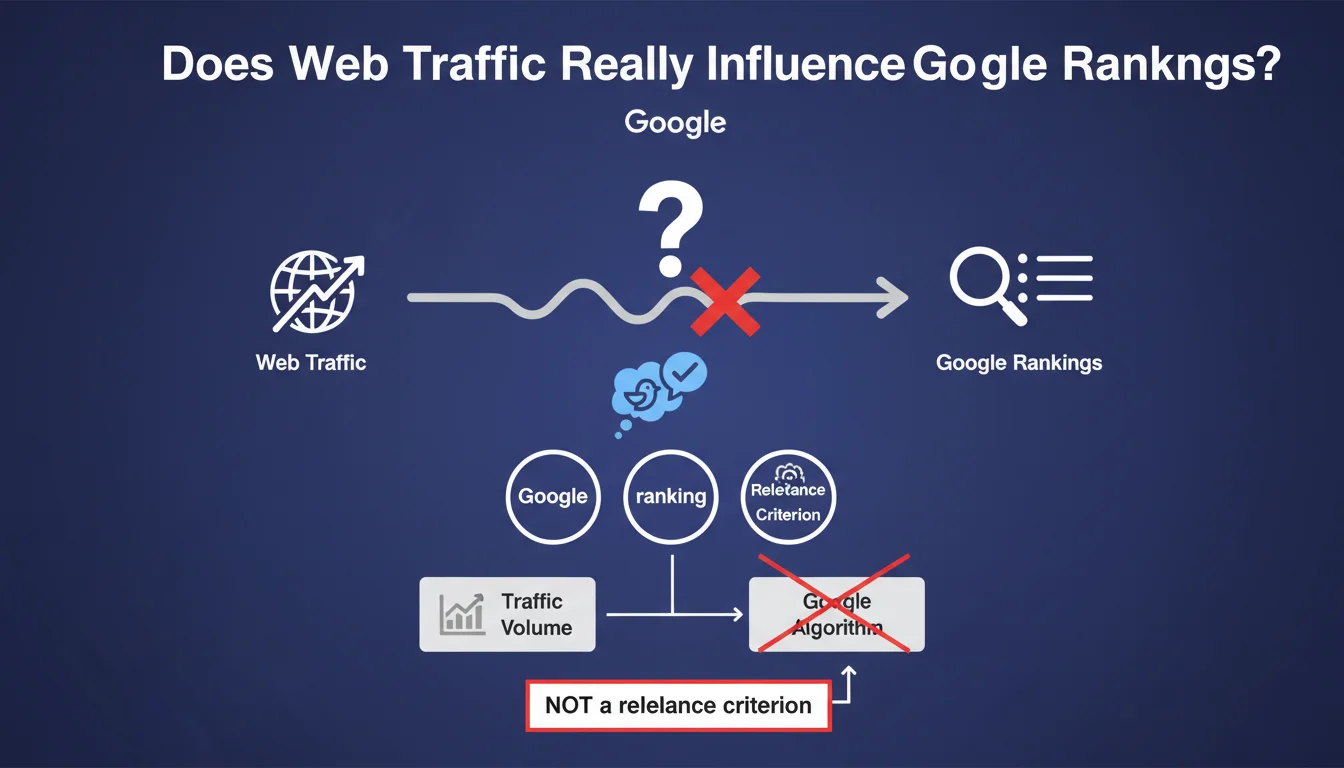
Google officially states that the volume of traffic to a website is not a direct ranking factor in its search algorithm. In other words, a site receiving 100,000 visitors per month would have no intrinsic advantage over a site receiving 1,000 visitors, all things being equal.
This statement may seem counter-intuitive to many SEO practitioners. It means that Google does not directly measure your Analytics traffic to determine the position of your pages in search results.
However, there is a fundamental difference between correlation and causality. While traffic is not a direct signal, it can generate indirect effects that do influence rankings:
- Behavioral signals: high traffic can generate more clicks, engagement, and time spent on the site
- Natural links: more visitors means more chances of obtaining organic backlinks
- Brand signals: significant traffic strengthens brand searches and awareness
- Content freshness: an active site with traffic is often updated more regularly
- User data: Chrome and Android can provide real usage signals to Google
SEO Expert opinion
As an SEO expert, I observe that this statement from Google is technically accurate but strategically incomplete. Traffic is indeed not a direct ranking signal, but its indirect impact is undeniable in practice.
Field observations consistently show that traffic spikes often coincide with ranking improvements. This phenomenon is explained by a cascade of secondary effects: an influx of visitors naturally generates more social interactions, more mentions, more spontaneous backlinks, and improves engagement metrics such as click-through rate and session duration.
The important nuance lies in the quality and origin of the traffic. Qualified organic traffic will have a positive indirect impact, while artificial or irrelevant traffic (bots, poor-quality purchased traffic) will provide no SEO benefit and could even harm behavioral signals.
Practical impact and recommendations
This clarification from Google invites us to adopt a holistic approach to SEO rather than trying to directly manipulate traffic metrics. Here are the concrete actions to implement:
- Don't buy low-cost traffic hoping to improve your SEO: it doesn't work and can degrade your behavioral metrics
- Invest in qualified traffic campaigns (paid search, social ads, partnerships) that generate real engagement and conversions
- Optimize user experience to transform existing traffic into positive signals: reduce bounce rate, increase time on site, improve internal linking
- Create viral or linkable content that naturally attracts referral traffic and generates spontaneous backlinks
- Develop your brand awareness through multi-channel campaigns to increase brand searches and organic CTR
- Monitor your engagement metrics in Search Console: click-through rate, average position, impressions
- Leverage traffic spikes (events, news) to maximize visibility and create natural link opportunities
- Improve loading speed and Core Web Vitals so that every visitor has an optimal experience
💬 Comments (0)
Be the first to comment.