
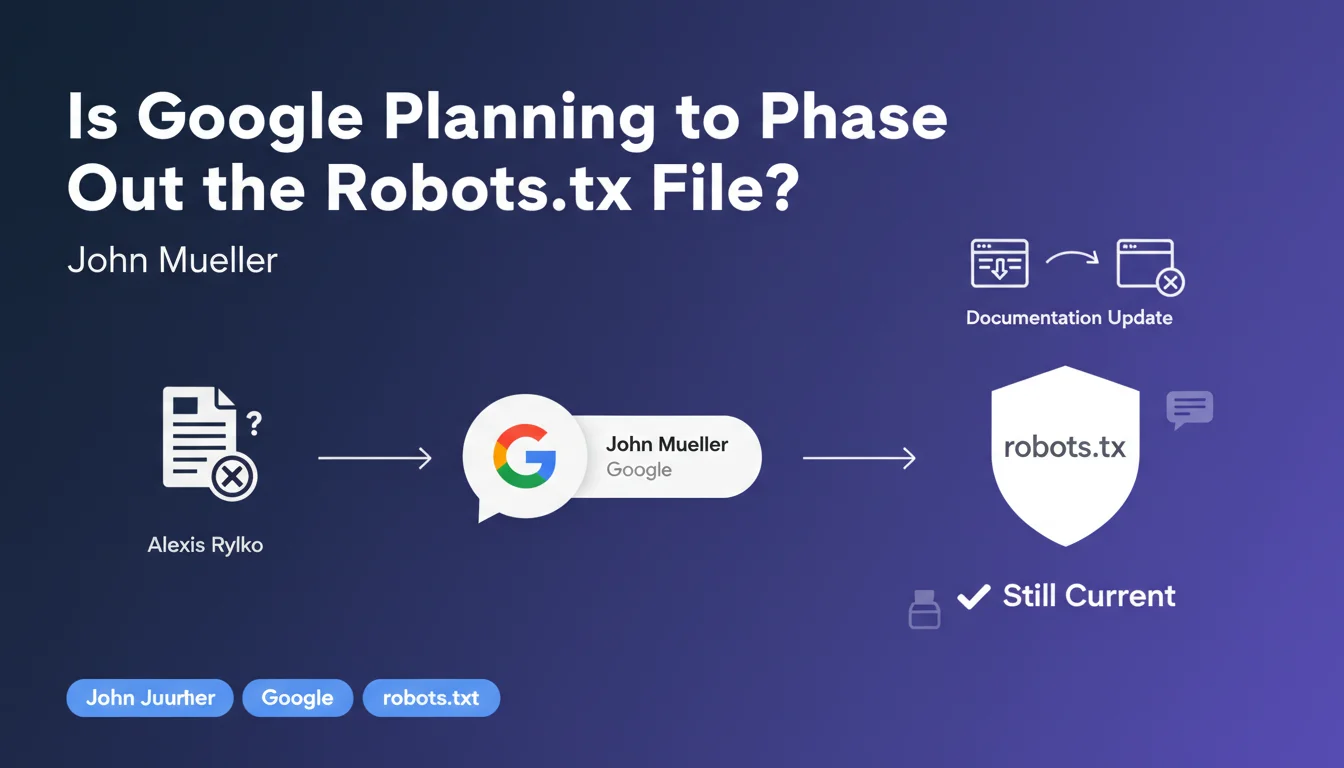
Official statement
What you need to understand
Why Did This Documentation Removal Worry the SEO Community?
Google recently removed its dedicated help page for robots.txt from its official documentation. This sudden disappearance naturally raised legitimate questions within the SEO community.
The robots.txt file has remained a fundamental element of search engine optimization for decades, allowing webmasters to control how robots crawl their websites. Its documentation was a reference point for countless professionals.
What Does This Documentation Update Really Mean?
John Mueller clarified the situation by explaining that this is simply a documentation reorganization, not an abandonment of the protocol. Google regularly updates its resources to improve their structure.
The robots.txt file retains all its strategic importance for SEO. Google even encourages the community to report any missing elements in the new documentation organization.
What Are the Key Takeaways from This Statement?
- The robots.txt file remains fully current and will not be discontinued by Google
- The help page removal is part of a comprehensive documentation overhaul
- Google remains open to community feedback on how its resources are organized
- No functional changes are planned regarding robots.txt usage
- Current best practices for robots.txt remain valid
SEO Expert opinion
Is This Statement Consistent with Evolving SEO Practices?
Absolutely. John Mueller's statement fits into a logical continuity of observed practices. Google has never shown signs of abandoning the robots.txt protocol—quite the opposite, in fact.
Google's crawlers continue to scrupulously respect robots.txt directives, and this file remains one of the few means of direct control over crawling. The documentation reorganization changes nothing about this technical reality.
What Important Nuances Should Be Considered Regarding This Position?
It's important to distinguish between robots.txt and meta robots tags. While the former remains indispensable for managing crawling, meta robots tags are growing in importance for controlling indexation and search result display.
Furthermore, Google modernized the protocol with the REP specification (Robots Exclusion Protocol) in 2019, proving its commitment to maintaining this tool's longevity. The removal of a documentation page therefore indicates no technical obsolescence whatsoever.
When Is Robots.txt No Longer Sufficient Today?
Robots.txt only blocks crawling, not indexation. Pages blocked via robots.txt can still appear in search results if they're referenced by external links, albeit with limited information.
For granular indexation control, you need to combine robots.txt with meta robots tags, X-Robots-Tag HTTP headers, and potentially Search Console for emergency removals. A mature SEO strategy requires a multi-layered approach.
Practical impact and recommendations
What Should You Do Concretely Following This Clarification?
First action: verify that your robots.txt is correctly configured. Use the robots.txt testing tool in Search Console to ensure there are no syntax errors or unintentional blocks.
Next, take this opportunity to audit your current directives. Many sites maintain obsolete rules that unnecessarily block important resources like CSS or JavaScript files, harming rendering and SEO performance.
What Critical Mistakes Should You Absolutely Avoid?
The most common mistake: blocking crawling while using noindex. If Googlebot cannot crawl a page, it cannot see the noindex tag, which can cause indexation problems.
Another frequent pitfall: blocking resources necessary for rendering. Since Google executes JavaScript, blocking CSS, JS, or image files can prevent the search engine from properly understanding your content.
Also avoid relying solely on robots.txt for protecting sensitive content. This file is public and precisely indicates what you wish to hide. Instead, use server authentication for truly confidential data.
How Can You Optimize Your Robots.txt Strategy in 2024?
- Regularly test your robots.txt file via Search Console
- Document each directive to understand its origin and purpose
- Use XML sitemaps in robots.txt to facilitate discovery of your priority content
- Audit server logs to identify crawl patterns and adjust your rules
- Combine robots.txt with a coherent meta robots tag strategy
- Monitor crawl errors in Search Console related to robots.txt blocks
- Implement a quarterly review process for your crawl directives
💬 Comments (0)
Be the first to comment.