
Official statement
Other statements from this video 2 ▾
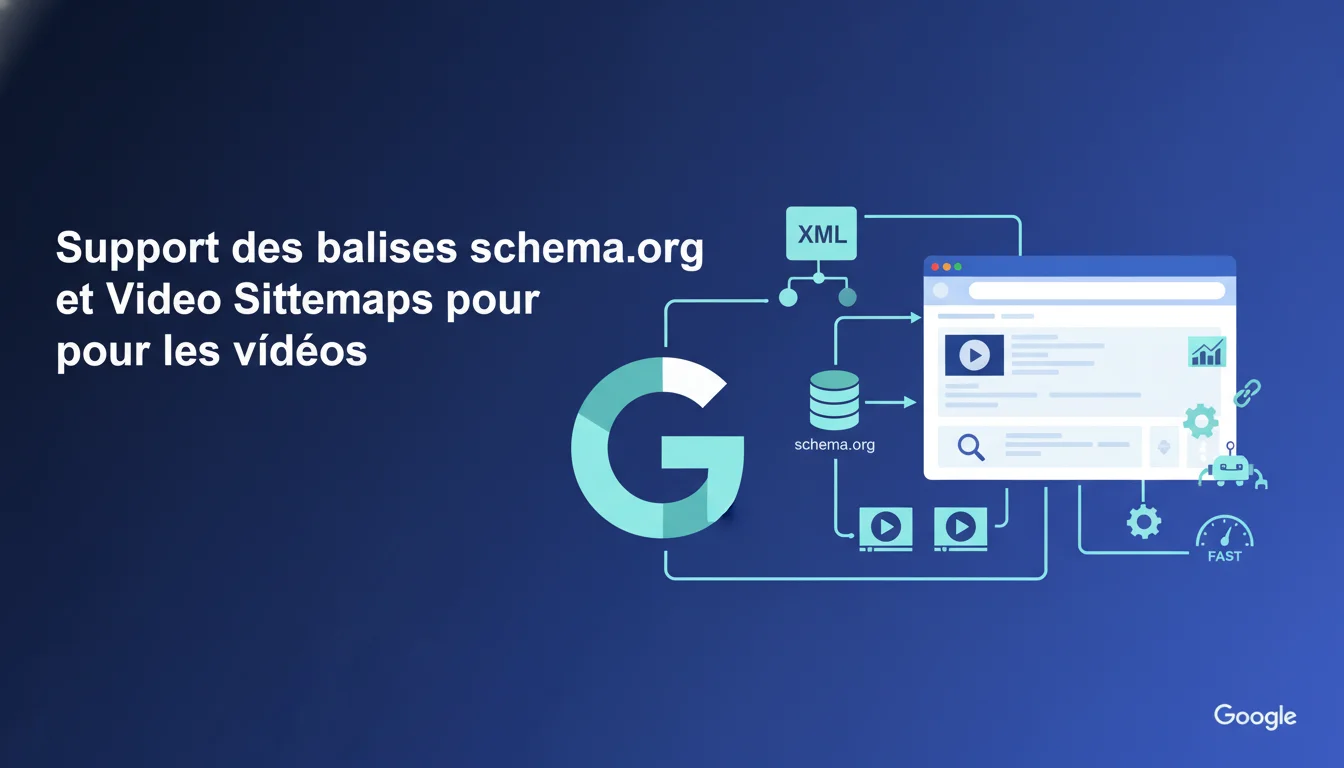
Google claims to support multiple video markup formats simultaneously: schema.org, Video Sitemap, Facebook/OpenGraph tags, Yahoo RDFa, and Media RSS. This means you are not limited to a single standard for your videos to be understood by the engine. However, Google explicitly recommends schema.org and Video Sitemap, suggesting a hierarchy in recognition quality.
What you need to understand
Why does Google support so many different formats?
The answer is more about the reality of the web than a technical preference. Platforms have developed their own standards: Facebook imposed its Open Graph tags, Yahoo pushed RDFa through SearchMonkey, Microsoft extended Media RSS with Bing mRSS. Google cannot afford to ignore these formats if it wants to properly index the billions of videos already published.
This multi-format tolerance also serves as a safety net for publishers. An e-commerce site can use schema.org for its products, Open Graph for social display, and Video Sitemap for video indexing without fear of conflict. Google extracts data from all these silos simultaneously.
What is the difference between schema.org and a Video Sitemap?
The schema.org VideoObject markup is embedded directly in the page's HTML. It describes the video in situ: title, description, thumbnail URL, duration, publication date. This is structured markup that Googlebot reads during the crawl of the page itself.
The Video Sitemap is a centralized XML file, submitted via Search Console, that lists all your videos with their metadata. It's a declarative approach: you are explicitly telling Google, "Here are my 500 videos, their URLs, their metadata." More efficient when you manage a large volume or your videos are embedded via iframe.
Are the other formats really recognized or just tolerated?
Google says it "automatically recognizes" these tags, but there's a nuance. Recognizing does not mean prioritizing. Open Graph tags are optimized for social networks, not for a search engine. Their structure is poorer than schema.org in terms of specific video metadata (duration, timestamp of key scenes, geographical restrictions).
In practice, if you only use Open Graph without schema.org or Video Sitemap, Google will probably index your videos, but you lose granularity of control. Video rich snippets, key moment previews, and advanced search filters depend on metadata that only schema.org or Video Sitemap provide completely.
- schema.org and Video Sitemap are the recommended formats by Google to maximize video understanding
- Open Graph, RDFa, Media RSS are tolerated to ensure compatibility with existing systems, not for their SEO performance
- Automatic recognition means Google parses all these formats, but it does not guarantee optimal indexing
- Overlapping multiple formats is not a problem: Google merges the data if they are consistent
- A Video Sitemap remains essential for sites with large video catalogs or iframe videos
SEO Expert opinion
Is this statement consistent with field observations?
Yes, but with variations in indexing quality. I have audited dozens of sites that only used Open Graph: their videos appeared in generic results, but rarely in Google's Video tab or with a rich snippet. As soon as schema.org VideoObject was added, rich snippets typically appeared within 3 to 7 days.
The weak point of this statement? Google does not specify priority order when multiple formats coexist with contradictory data. If your schema.org indicates a duration of 5 minutes and your Video Sitemap indicates 10 minutes, which one prevails? Tests show that schema.org in the HTML seems to take priority, but Google does not officially state this. [To verify]
What common mistakes does this multi-format flexibility encourage?
The first mistake is to think, "Since Google accepts everything, I will just use Open Graph and move on." Technically, it may work. But you leave 60 to 70 % of the performance on the table: no indexed key moments, no duration filters, no "Direct" or "Recent" badge in the SERP.
The second trap is inconsistent duplication. I've seen sites with one title in schema.org, another in Open Graph, and a third in the Video Sitemap. Google attempts to merge them, but if the discrepancies are too significant, it may ignore certain metadata or misinterpret the video. It's better to be consistent than redundant.
In what cases is a single format really enough?
If you publish fewer than 50 videos per year, hosted on your own server or YouTube/Vimeo, and you have direct access to the HTML, a well-implemented schema.org VideoObject covers 90 % of needs. Add a Video Sitemap if you want to speed up discovery and have clean tracking in Search Console.
On the other hand, for a media outlet, an e-learning platform, or a VOD site, the Video Sitemap becomes essential. It allows you to declare bulk metadata without touching every HTML page, signal restricted access videos, and specify geographical licenses. Open Graph alone is insufficient in these contexts, even if Google "recognizes" it.
Practical impact and recommendations
What should be prioritized for a site with videos?
Start with schema.org VideoObject on every page containing a video. This markup provides the most added value for a reasonable effort. Title, description, thumbnail URL, duration, upload date, URL of the video itself: these fields are all crawlable and exploitable by Google to enrich the SERP.
Next, create a Video Sitemap if you manage more than 20 videos or if your videos are embedded via iframe (thus invisible to standard HTML crawl). The Video Sitemap also allows you to declare paid videos, specify geographical restrictions, and track indexing in Search Console. It's a worthwhile time investment as soon as you exceed hobby-level volume.
How to manage the coexistence of multiple formats without creating conflicts?
The golden rule: one source of truth, multiple access points. Ideally, your video metadata lives in your CMS or database, and you automatically inject it into schema.org, Open Graph, and Video Sitemap via templates. Zero manual double entry, zero risk of discrepancies.
If you have to manage manually, prioritize strict consistency: same title, same description, same duration everywhere. Open Graph can have a slightly catchier description for social sharing, but the title and factual metadata must be identical. Google tolerates multiple formats but punishes inconsistency by ignoring suspicious data.
What tools can validate and monitor these markups?
Google's rich results testing tool remains the mandatory starting point. Paste the URL of your video page, check that schema.org VideoObject is detected without errors. Note: the tool does not test Video Sitemaps, only on-page markup.
For the Video Sitemap, submit it in Search Console (Sitemaps section), then monitor the Video report. Google tells you how many videos have been discovered, how many are indexed, and what errors are blocking indexing. If you see a significant gap between "detected" and "indexed," it's often a matter of incomplete metadata or restricted content without the appropriate tag.
- Implement schema.org VideoObject on each page containing a video with the required fields (name, description, thumbnailUrl, uploadDate, contentUrl)
- Create and submit a Video Sitemap via Search Console if you manage more than 20 videos or iframe videos
- Ensure strict consistency across all markup formats: title, description, duration, URL must be identical everywhere
- Validate on-page markup with Google’s rich results testing tool before publication
- Monitor the Video report in Search Console to detect indexing errors and adjust metadata
- Avoid manually duplicating metadata: automate via templates to ensure consistency
❓ Frequently Asked Questions
Dois-je obligatoirement utiliser schema.org ET Video Sitemap, ou puis-je choisir l'un ou l'autre ?
Si j'utilise déjà Open Graph pour le partage social, est-ce suffisant pour Google ?
Que se passe-t-il si mes métadonnées divergent entre schema.org et mon Video Sitemap ?
Les vidéos YouTube embarquées sur mon site nécessitent-elles un balisage schema.org ?
À quelle fréquence dois-je mettre à jour mon Video Sitemap ?
🎥 From the same video 2
Other SEO insights extracted from this same Google Search Central video · duration 1 min · published on 05/12/2011
🎥 Watch the full video on YouTube →
💬 Comments (0)
Be the first to comment.