
Official statement
Other statements from this video 8 ▾
- 1:33 Does Google really evaluate each page individually, or does it still consider domain authority?
- 3:08 Is your web host really dragging down your organic search rankings?
- 5:21 Should you really limit yourself to one H1 tag per page?
- 17:41 Should you really geographically target your .com domain in Search Console?
- 21:35 Does Google's index really update continuously with no set schedule?
- 38:04 Is it really safe for SEO to overhaul your design without touching the content?
- 44:04 Should you limit category and tag pages to avoid an SEO penalty?
- 45:42 Should you really use 301 redirects for every permanent URL change?
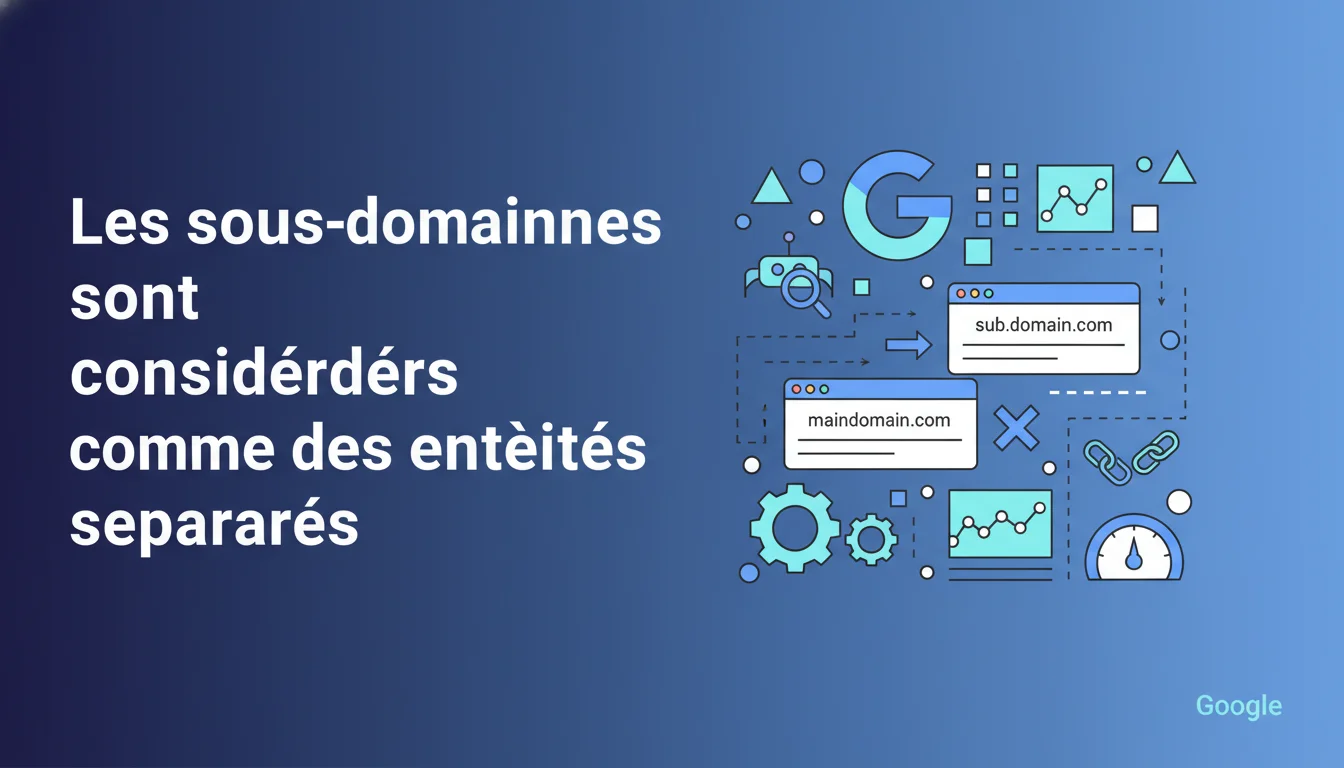
Google technically treats each subdomain as a distinct entity from the root domain, but this separation is not absolute. If subdomains are heavily linked to the main domain, the algorithm may recognize that they belong to the same site. For an SEO practitioner, this means that a subdomain architecture inherently fragments crawl budget, authority, and ranking signals, unless strategic links compensate for this technical separation.
What you need to understand
Why does Google differentiate between subdomains and directories?
From a technical perspective, a subdomain (blog.example.com) is treated by DNS servers as a distinct host, while a directory (example.com/blog/) remains an extension of the main domain. This DNS distinction carries over into how Googlebot operates.
Specifically, each subdomain has its own crawl budget, its own initial domain authority, and its own trust signals. A backlink to blog.example.com does not automatically pass SEO juice to example.com, unlike a link to example.com/blog/.
What constitutes a "strong" link between subdomains in Google's view?
Google remains vague on what constitutes a strong link. It can be assumed that the algorithm analyzes the bidirectional internal linking between the main domain and subdomains, the thematic consistency of the content, mentions in canonical or hreflang tags, and perhaps the configuration of Search Console (unified or separate properties).
In practice, an isolated subdomain without incoming links from the root domain will be treated as a completely independent site. Conversely, a subdomain integrated into the main navigation, with substantial reciprocal links, may partly benefit from the authority of the main domain.
Does this separation really affect ranking?
The answer is yes, but the extent varies depending on the implementation. A subdomain starts with a clean slate in terms of authority: it does not automatically inherit PageRank, quality history, or E-E-A-T signals from the main domain.
For sites with strong brand authority, Google may partially compensate via brand signals (navigational searches, external mentions). But for average or newer domains, fragmentation into subdomains significantly dilutes SEO power.
- A subdomain requires its own backlink profile to perform
- The crawl budget is segmented: Google allocates separate quotas to each subdomain
- Algorithmic penalties may remain isolated to a subdomain without contaminating the root domain
- The dilution of authority is the main risk of an unjustified subdomain architecture
- Strategic internal linking remains the primary lever to mitigate separation
SEO Expert opinion
Is this statement consistent with field observations?
Yes and no. Google is truthful regarding the technical principle of separation but downplays the actual impact on small and medium sites. In practice, a poorly managed subdomain behaves exactly like a new site without a history: mediocre rankings, slow indexing, absence of authority benefits.
Exceptions involve web giants (Amazon, Wikipedia, Reddit) whose subdomains gain authority through massive brand signals. For an average site, the statement "Google may recognize that they belong to the same site" is wishful thinking. [To verify] how much this recognition translates into effective authority transfer.
When does a subdomain architecture really make sense?
Technically, subdomains are justified for self-contained sections with distinct technical needs: a web application (app.example.com) on a different stack, a foreign language blog (en.example.com), a separate SaaS service (platform.example.com). Separation becomes advantageous for isolating security risks or managing distinct server environments.
From a pure SEO perspective, the question is simple: do you have the link-building capacity to independently build authority for each subdomain? If the answer is no, a directory architecture (example.com/app/, example.com/blog/) automatically transfers authority from the main domain. No fragmentation, no loss.
What pitfalls should be avoided with this statement?
The main pitfall is assuming that internal linking is enough to offset the technical separation. In reality, even with thousands of internal links between the domain and subdomain, Google's algorithm maintains an invisible boundary: signals do not flow with the same fluidity as within a unified domain.
Another common mistake: creating subdomains for hosting convenience ("it's easier to deploy") without measuring SEO impact. Technical time savings often come at the cost of months of ranking delays. [To verify] through real A/B tests how many additional backlinks a subdomain requires to achieve the performance of an equivalent directory.
Practical impact and recommendations
What concrete actions should you take if you're already using subdomains?
First action: audit the internal linking between the main domain and subdomains. Each subdomain should receive links from the site's overall navigation (header, footer) and contextual links from the root domain's content. The aim is to create an artificial PageRank flow to compensate for the technical separation.
Second lever: develop a specific backlink strategy for each important subdomain. Do not rely on automatic authority diffusion from the main domain. Treat each subdomain as an independent site regarding external link acquisition.
How do you choose between a subdomain and a directory for a new project?
The empirical rule is simple: if the new content shares the same theme and the same audience as the main site, always favor a directory. You instantly capitalize on the existing authority without fragmentation.
Reserve subdomains for cases where separation adds real technical value: multilingual with geolocated servers, web application needing a distinct server environment, or deliberately different branding (acquisition of another company). In all other cases, the SEO cost far exceeds the technical benefits.
What mistakes should you absolutely avoid?
The most common mistake is creating subdomains by content category (products.example.com, services.example.com, blog.example.com) when a simple directory architecture (example.com/products/) would have performed better. This free fragmentation dilutes authority without any gain.
Another pitfall: failing to properly configure Search Console properties. Each subdomain requires either a separate property (for separate monitoring) or to be included in a global domain property (property set) for a consolidated view. Without proper configuration, you lose visibility on actual performance.
- Audit the internal linking between the domain and subdomains (minimum 10 bidirectional contextual links)
- Ensure that each subdomain has its own external backlink strategy
- Configure Search Console properties (global domain or separate subdomains based on strategy)
- Analyze server logs to understand how Googlebot crawls each subdomain separately
- Measure the indexing rate of each subdomain (often slower than an equivalent directory)
- Document the technical justification for each subdomain to avoid anarchic proliferation
❓ Frequently Asked Questions
Un sous-domaine hérite-t-il automatiquement de l'autorité du domaine principal ?
Faut-il créer une propriété Search Console séparée pour chaque sous-domaine ?
Les backlinks vers un sous-domaine profitent-ils au domaine principal ?
Peut-on migrer un sous-domaine vers un répertoire sans perte de trafic ?
Le crawl budget est-il partagé entre domaine principal et sous-domaines ?
🎥 From the same video 8
Other SEO insights extracted from this same Google Search Central video · duration 47 min · published on 10/02/2015
🎥 Watch the full video on YouTube →
💬 Comments (0)
Be the first to comment.