
Official statement
What you need to understand
What does Google's statement about subdomains actually mean?
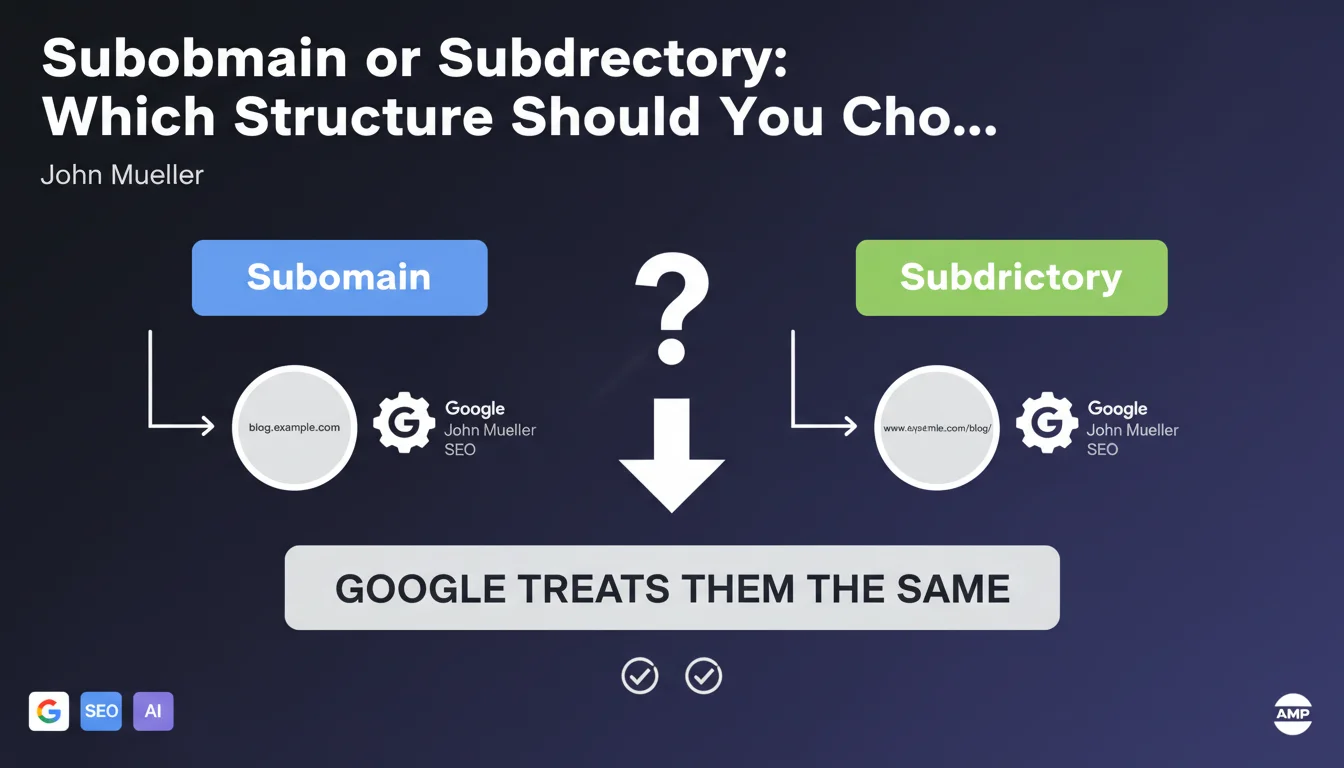
Google officially states that subdomains and subdirectories are treated identically by its ranking algorithm. Concretely, this means that blog.example.com and www.example.com/blog/ receive the same algorithmic treatment.
This statement puts an end to a historic debate in the SEO community. For years, practitioners have questioned the potential impact of this technical decision on domain authority transfer and PageRank consolidation.
Why does this technical structure question matter in SEO?
The choice between subdomain and subdirectory directly influences how Google perceives and organizes your site's architecture. Historically, there was a concern that subdomains would be considered separate entities, thus diluting the overall authority of the main domain.
This structure also impacts how trust and relevance signals propagate between different sections of your site. A poor decision could theoretically fragment your online presence.
What are the key takeaways from this confirmation?
- No algorithmic difference between subdomains and subdirectories for ranking purposes
- The choice should be guided by technical and organizational considerations rather than SEO ones
- Domain authority transfers equivalently in both cases
- Backlinks and trust signals are treated similarly regardless of the structure
- This official position is consistent with field observations over the past several years
SEO Expert opinion
Is this statement consistent with practices observed in the field?
In my daily practice over the past 15 years, I indeed observe that Google treats these structures similarly in most cases. Well-optimized sites perform regardless of this architectural choice, provided the structure is consistent and logical.
However, there are important nuances. Subdomains can sometimes be crawled with separate budgets, which can slow indexation on massive sites. Signal consolidation also seems slightly more direct with a subdirectory structure.
In what contexts might this equivalence rule show limitations?
Multilingual or multi-country sites represent a special case where subdomains can exhibit specific behaviors. Google may treat fr.example.com as a more geographically distinct entity than a simple /fr/.
For very large sites with millions of pages, crawl budget management becomes critical. In these situations, I've observed that subdirectories facilitate a more predictable distribution of crawl budget, even though Google claims to treat both cases identically.
What concrete advantages can still be identified for each option?
Subdirectories offer undeniable management simplicity: single SSL certificates, consolidated analytics, centralized administration. The URL structure remains consistent and facilitates user understanding.
Subdomains retain technical relevance for isolating distinct applications (e.g., shop.example.com for an e-commerce platform on separate infrastructure). They also allow for more flexible DNS delegation for geographically distributed teams.
Practical impact and recommendations
What should you actually do when choosing your structure?
Base your decision on technical and organizational criteria rather than hypothetical SEO considerations. Default to subdirectories for their simplicity, unless specific technical constraints justify a subdomain.
Evaluate your needs in terms of technical infrastructure: do you need to host certain sections on different servers? Are your teams organized in a way that justifies technical separation?
What mistakes should you avoid when implementing this strategy?
Don't create subdomains without valid reasons. Each subdomain requires its own SSL configuration, its own Search Console settings, and complicates overall analytical tracking.
Absolutely avoid mixing approaches without clear logic. For example, having blog.example.com AND www.example.com/resources/ creates architectural inconsistency that confuses users, even if Google technically handles both.
Don't neglect the importance of internal linking between sections. Whether you choose subdomains or subdirectories, ensure that internal links create a coherent structure allowing PageRank flow.
How can you optimize your existing structure based on this recommendation?
- Audit your current structure: identify subdomains and subdirectories in use
- Verify that each existing subdomain has a valid technical or organizational justification
- Properly configure Search Console for each subdomain (separate properties)
- Ensure that internal linking effectively connects all sections
- Consolidate unnecessary subdomains into subdirectories if possible
- Document your structure choice to ensure future consistency
- Implement appropriate 301 redirects in case of migration
- Monitor indexation and crawling in Search Console after any changes
💬 Comments (0)
Be the first to comment.