
Official statement
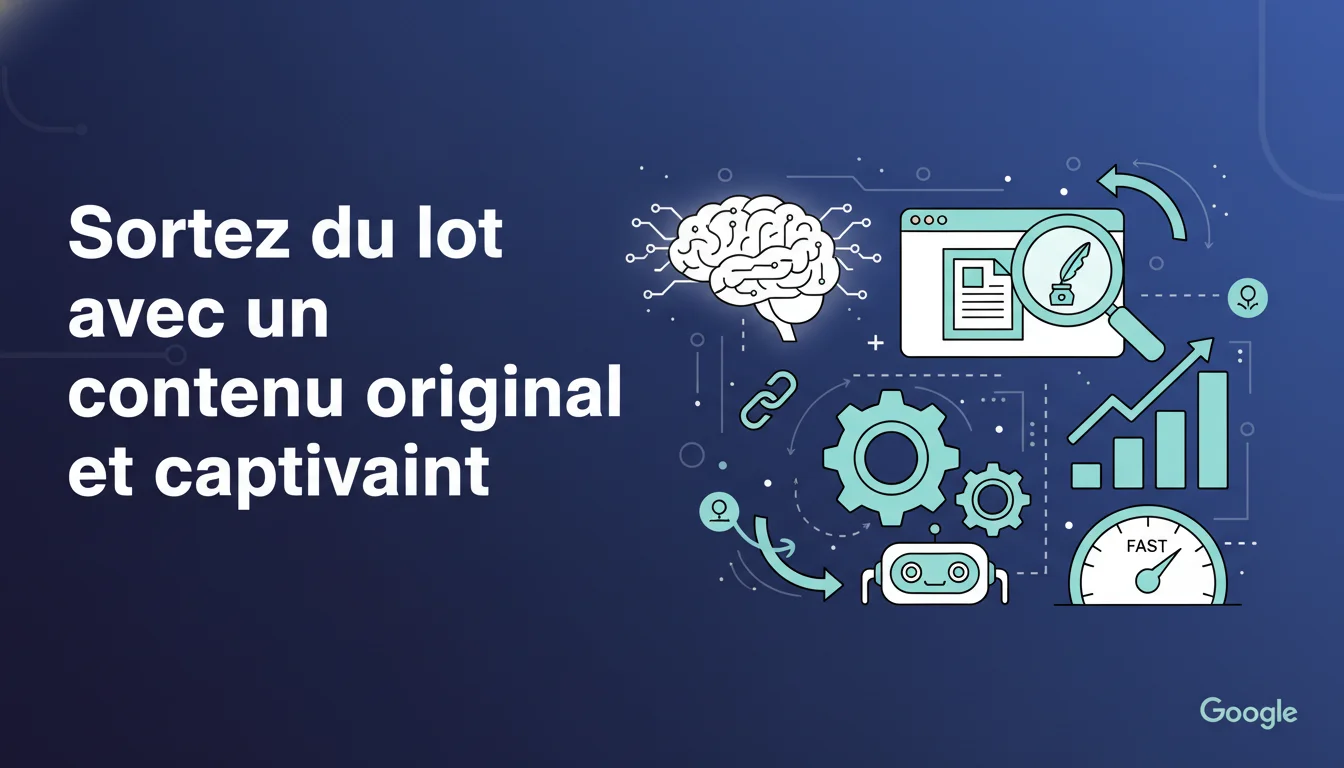
Google emphasizes that unique and engaging content remains a key factor in obtaining natural backlinks and making a lasting impression. For SEO, this means investing in a distinct editorial angle rather than replicating what already exists. The nuance: originality alone is not enough if it is not aligned with search intent and the strategic distribution of content.
What you need to understand
Why does Google emphasize content originality in an SEO context?
This statement directly targets a real issue: the proliferation of generic content that merely rephrases the same information. Google encourages sites to create a recognizable editorial identity, as this naturally generates quality signals (engagement, shares, inbound links).
Specifically, the algorithm values content that brings distinctive added value. This can come from a specific tone, exclusive data, or an innovative format. The goal is to avoid SERPs becoming a succession of personality-less clones.
What does a unique angle really change for SEO?
An original angle facilitates the acquisition of organic backlinks, as other sites have a concrete reason to cite your content over a competitor's. Links remain a major ranking factor, even if Google regularly downplays their importance publicly.
Memorable content also generates branded searches, an indirect signal that Google monitors to assess authority and user satisfaction. A blog with a distinctive voice creates a loyal audience that returns directly to the site, reducing dependence on pure organic traffic.
How can I measure if my content is truly differentiated?
Ask yourself this question: if we remove the logo and the site name, can the author be identified through style and tone? If the answer is no, you're in the generic. A practical test: compare your last 5 articles with those of 3 competitors on similar topics. If the structures and arguments look alike, there is a lack of editorial footprint.
Metrics to watch: time on page, return visitor rate, natural mentions of the site name on social media. Original content creates distinct user behaviors that the algorithm picks up via Chrome and Analytics data.
- Distinctive voice: a tone, style, an angle that immediately sets you apart from the competition
- Diverse formats: videos, infographics, original case studies rather than recycled text
- Exclusive data: internal studies, surveys, field tests that no one else has published
- In-depth analysis: going beyond the surface level that everyone is already addressing
- Memorability: content that people spontaneously quote or recommend without prompting
SEO Expert opinion
Is this statement consistent with what we observe in practice?
Yes, but with a major caveat: originality does not compensate for a poor understanding of search intent. We frequently see brilliantly original content stagnate on page 3 because it does not truly address what users are really looking for. The algorithm prioritizes relevance first, then differentiation.
Successful sites combine both: they target the dominant intent while adding a unique angle that sets them apart. For example, a standard technical guide enriched with exclusive client case studies with numbers. Google remains vague about the exact weighting between relevance and originality. [To be verified]
What are the limits of this advice in certain sectors?
In YMYL niches (finance, health, legal), originality is constrained by accuracy and compliance requirements. You cannot have a "distinctive voice" if it means oversimplifying medical concepts to the point of being imprecise. Here, factual credibility takes precedence over creativity.
Another limit pertains to basic transactional queries. Someone searching for "buy iPhone 15 cheap" wants an efficient price comparison tool, not a blog with a quirky tone. Originality then relates to UX, data presentation, not editorial substance. Google never specifies these sector nuances, making its advice too generic.
The risk of overinterpretation: how far should differentiation go?
Beware of the trap: seeking originality at all costs can lead to overly experimental formats that the algorithm cannot interpret. For instance, a 100% video site without transcription, or content so metaphorical that target keywords disappear. Originality must remain crawlable and indexable.
Another pitfall: originality that isolates your audience. If your tone is too niche, you risk losing the search volume needed to justify the investment. A balance is required: distinctive enough to create links, accessible enough to capture traffic. Data is lacking to accurately trace this line. [To be verified]
Practical impact and recommendations
What should be concretely modified in my content strategy?
Start with an editorial audit: identify content where you merely rephrase what 10 competitors are doing. Prioritize rewriting those that have traffic potential but are stagnating in positions 8-15. Add proprietary data, quantitative feedback, or an analytical angle that no one else is addressing.
If you produce a lot of content, create an editorial guideline that defines your tone, recurring angles, and signature formats. This ensures coherence and helps the writing AI (if you use one) avoid falling into the generic. The goal is for a familiar reader to recognize your content without seeing the logo.
How can I validate that content has the potential for natural link baiting?
Before publication, ask yourself: why would someone link to this instead of a competitor? If the answer is vague ("because it is well-written"), it is insufficient. Good linkable content provides exclusive data, an unprecedented ranking, a clear visualization of a complex subject, or a well-argued position.
Test internally: send the content to 3 people in your industry without context. If they spontaneously find a reason to share or cite it, you have something valuable. Otherwise, refine the angle before publishing. The engagement time in the first 48 hours is a good indicator: if people read to the end, it means the content stands out.
What mistakes should be avoided in the quest for originality?
Never sacrifice clarity for originality. A title that is too cryptic or an overly artistic format can repel users and generate a poor click-through rate in the SERPs. The algorithm quickly detects these negative signals. Stay original in substance, but conventional in structure (Hn tags, meta, internal links).
Another trap: originality that requires too much maintenance. A weekly video format is excellent, but if you cannot keep up with the pace, it is better to opt for a high-quality monthly blog. Consistency matters just as much as differentiation in building a loyal audience and sending freshness signals to Google.
- Audit the 20 most visited contents and identify those lacking differentiation
- Create an editorial guideline defining your tone, angles, and signature formats
- Incorporate proprietary data (studies, surveys, quantified customer feedback) into at least 30% of new content
- Test each piece of high-potential content with an internal panel before publishing to validate its distinctiveness
- Monitor engagement time and return visitor rates as indicators of memorability
- Avoid overly experimental formats that sacrifice crawlability or search intent
❓ Frequently Asked Questions
L'originalité du contenu impacte-t-elle directement le ranking ou seulement indirectement via les backlinks ?
Peut-on être original tout en utilisant de l'IA générative pour la rédaction ?
Comment évaluer si mon concurrent a vraiment un contenu plus original que le mien ?
L'originalité est-elle aussi importante pour les pages produits e-commerce que pour le contenu éditorial ?
Combien de temps faut-il pour qu'un contenu original commence à générer des backlinks naturels ?
🎥 From the same video 3
Other SEO insights extracted from this same Google Search Central video · duration 1 min · published on 29/06/2009
🎥 Watch the full video on YouTube →
💬 Comments (0)
Be the first to comment.