
Official statement
Other statements from this video 5 ▾
- 0:32 Comment se débarrasser définitivement des traces de spam sur un domaine racheté ?
- 0:32 Comment se débarrasser vraiment d'une pénalité spam quand on rachète un domaine toxique ?
- 1:07 Faut-il vraiment éviter les domaines expirés avec un historique de spam ?
- 1:47 Faut-il vraiment se méfier d'un nom de domaine qui a servi au spam ?
- 2:08 Faut-il vraiment racheter un domaine expiré avec un historique de spam ?
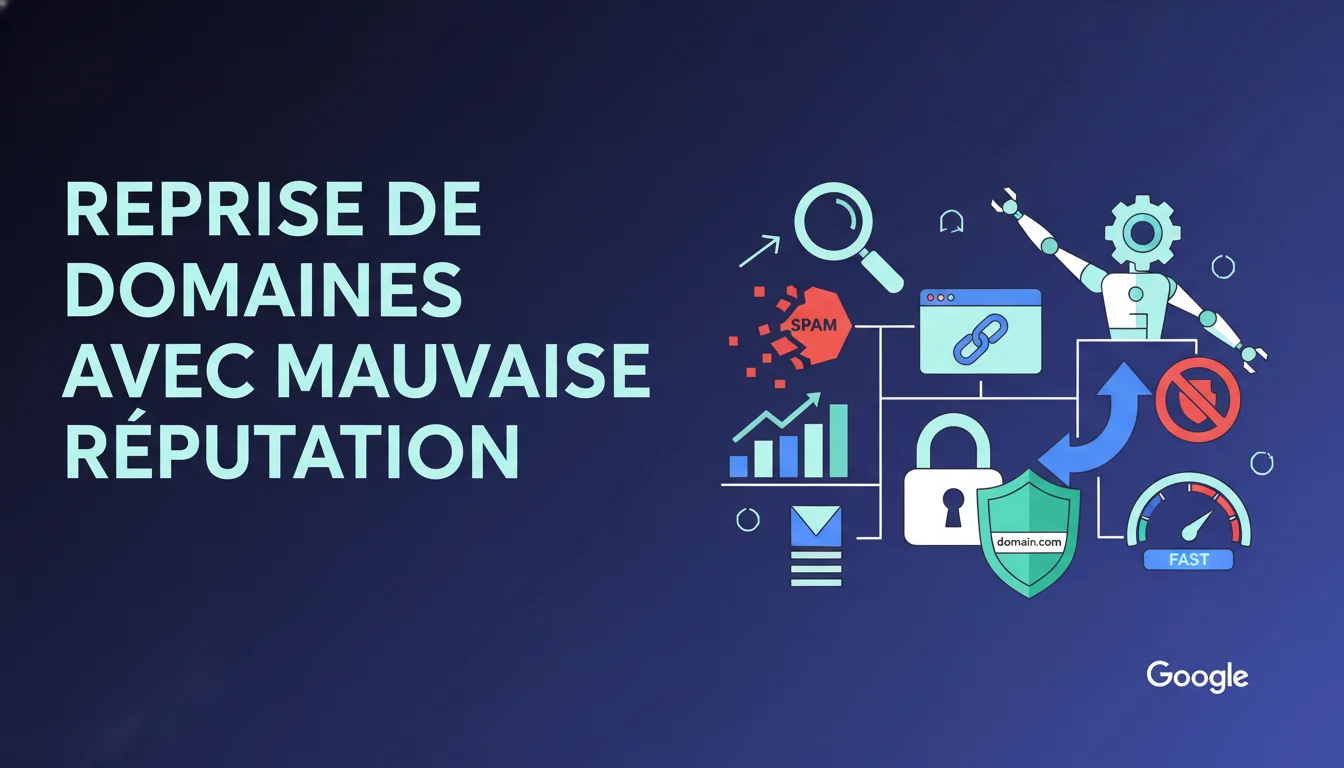
Google is cautious about the acquisition of previously spammed domains and states that a change of ownership alone does not erase a bad reputation. Review requests are scrutinized rigorously, and rehabilitating a degraded domain requires substantial groundwork. Reputation extends beyond search engines, affecting blacklists, anti-spam services, and registrars.
What you need to understand
Why is Google so cautious about domain acquisitions?
Buying an expired or abandoned domain is a common practice in SEO. Some purchase these names hoping to benefit from historical backlinks or residual authority. The problem? Google has seen too many schemes where a spammed domain artificially changes hands in an attempt for a fresh start.
Google's official position is clear: a declared change of ownership does not automatically trigger a reset of reputation. Spam search teams review request submissions with skepticism, looking for tangible evidence of a break from past practices. A simple modified whois is not enough.
What does a "bad reputation" really mean?
Google does not solely analyze on-site behavior. A domain can appear on external blacklists: SURBL, Spamhaus, anti-phishing databases, malware registries. These signals carry weight, as they reflect a multidimensional degradation of trust.
Reputation also extends to behavioral metrics. If a domain has generated years of suspicious traffic, massive bounce rates from SERPs, or negative user signals, these traces persist in the logs. Google keeps a long history, sometimes longer than one might expect.
Under what circumstances might acquiring a penalized domain still be feasible?
Some scenarios allow for a fresh, constructive approach. A domain that has undergone a manual penalty (visible manual actions in Search Console) can potentially be cleaned up if the new owner disavows toxic links, removes spam content, and documents their process in a well-argued reconsideration request.
Context matters. A domain of a legitimate brand temporarily degraded by a negligent former owner presents a different profile from a domain created solely for pharmaceutical spam. Google knows how to distinguish, but concrete evidence of a change in strategy and content must be provided.
- A mere change of ownership never suffices to reset a domain's reputation in Google's eyes.
- A bad reputation transcends the SEO scope: external blacklists, anti-spam signals, behavioral metrics.
- Rehabilitation demands a documented and substantial effort: cleaning toxic backlinks, revamping content, detailed review request submission.
- Legitimate brand domains have a better chance of rehabilitation than historically spammed generic domains.
- Google maintains a long history of a domain's past behaviors, even after several years of inactivity.
SEO Expert opinion
Does this statement accurately reflect observed practices on the ground?
Yes, and it aligns with years of observations. Attempts to acquire expired domains to capitalize on their link profile often result in silent failures. The domain may index but never ranks, or worse, it carries an invisible algorithmic penalty that undermines any new strategy.
However, Google remains vague about the thresholds of severity. How many spam backlinks does it take for a domain to dive into the red zone? How long does the negative imprint last? [To be verified]: no public data quantifies these parameters. It's a guessing game, making the decision to purchase a domain particularly risky.
What signals does Google use to assess continuity or break?
The exact answer remains opaque, but several hints emerge from field feedback. Google seems to correlate published content (thematic similarity with the old site), the structure of inbound links (retaining or disavowing toxic backlinks), and traffic patterns (suspicious influx post-acquisition).
A domain that shifts from pharmaceutical spam to a legitimate travel blog while disavowing 90% of existing links sends a signal of break. Conversely, retaining the same spam anchors, the same malware-laden CMS, and posting scraped content confirms the continuity of practices. Google reads these behavioral micro-signals to make decisions.
When is it truly worth the gamble?
Acquiring a penalized domain can be justified if its brand value significantly exceeds the cost of rehabilitation. An exact match domain with a legitimate brand history, a memorable name in a competitive sector, or an expired domain from a real business that temporarily closed: these cases merit investment.
On the other hand, buying a generic spam-filled domain just for its backlinks is a risky bet. The ROI is uncertain, the cleaning effort is monumental, and there's no guarantee that Google will ever lift the algorithmic filter. Often, starting with a new domain and building a clean authority is preferable, even if it takes longer.
Practical impact and recommendations
How can you evaluate a domain's real reputation before acquisition?
Before investing, check the domain's presence on major blacklists: MXToolbox, Google Safe Browsing, Spamhaus. An entry on these registries signals a deep degradation that transcends simple SEO. Also, consult the Wayback Machine history to identify past content.
Analyze the backlink profile using various tools (Ahrefs, Majestic, SEMrush) and look for suspicious patterns: over-optimized anchors, links from link farms, PBN footprints. If more than 50% of the links smell like spam, run. Cleaning will cost more than the acquisition.
What strategy should you adopt if you inherit a degraded domain?
First instinct: Search Console. Check for manual actions. If a manual penalty is present, you have a clear recourse path. Document each cleaning step (disavowing links, removing duplicate content, fixing technical issues) before submitting a detailed reconsideration request.
If no manual actions appear but the site isn't ranking, you're probably facing an algorithmic filter. Here, there's no magic button. You must rebuild trust through original quality content, gradually acquiring clean backlinks, and patience. Expect a minimum of 6 to 12 months before seeing an impact.
When should you consider abandoning the domain altogether?
If after 6 months of rigorous work (new content, massive disavow, technical fixes) you see no progress in rankings, even on brand queries, the domain is likely unrecoverable. Google sometimes applies filters so deep that they amount to a definitive judgment.
In this case, it might be better to migrate to a new domain by implementing selective 301 redirects (only from clean pages) and clearly communicating the change to existing users. You will lose some equity, but you'll be starting afresh on solid ground rather than burning budget on a dead domain.
- Check the presence of the domain on anti-spam blacklists (MXToolbox, Spamhaus, Google Safe Browsing).
- Analyze the content history via Wayback Machine to identify past usages.
- Audit the complete backlink profile and calculate the ratio of toxic links to legitimate links.
- Create a Search Console account immediately to detect any potential manual actions.
- Implement a massive disavow of suspicious links before any content launch.
- Document each cleaning action in a dashboard to prepare for a possible reconsideration request.
❓ Frequently Asked Questions
Un domaine expiré avec un bon DR est-il forcément une opportunité SEO ?
Combien de temps Google conserve-t-il la mémoire des pratiques spam d'un domaine ?
Une demande de réexamen peut-elle aggraver la situation d'un domaine pénalisé ?
Le désaveu de liens suffit-il à réhabiliter un domaine spammé ?
Peut-on racheter un domaine concurrent pénalisé pour nuire à sa marque ?
🎥 From the same video 5
Other SEO insights extracted from this same Google Search Central video · duration 3 min · published on 10/04/2013
🎥 Watch the full video on YouTube →
💬 Comments (0)
Be the first to comment.