
Official statement
What you need to understand
The rel="sponsored" attribute was introduced by Google in September 2019 to specifically identify links resulting from commercial partnerships, advertising, or sponsored content. It complements the rel="nofollow" and rel="ugc" attributes.
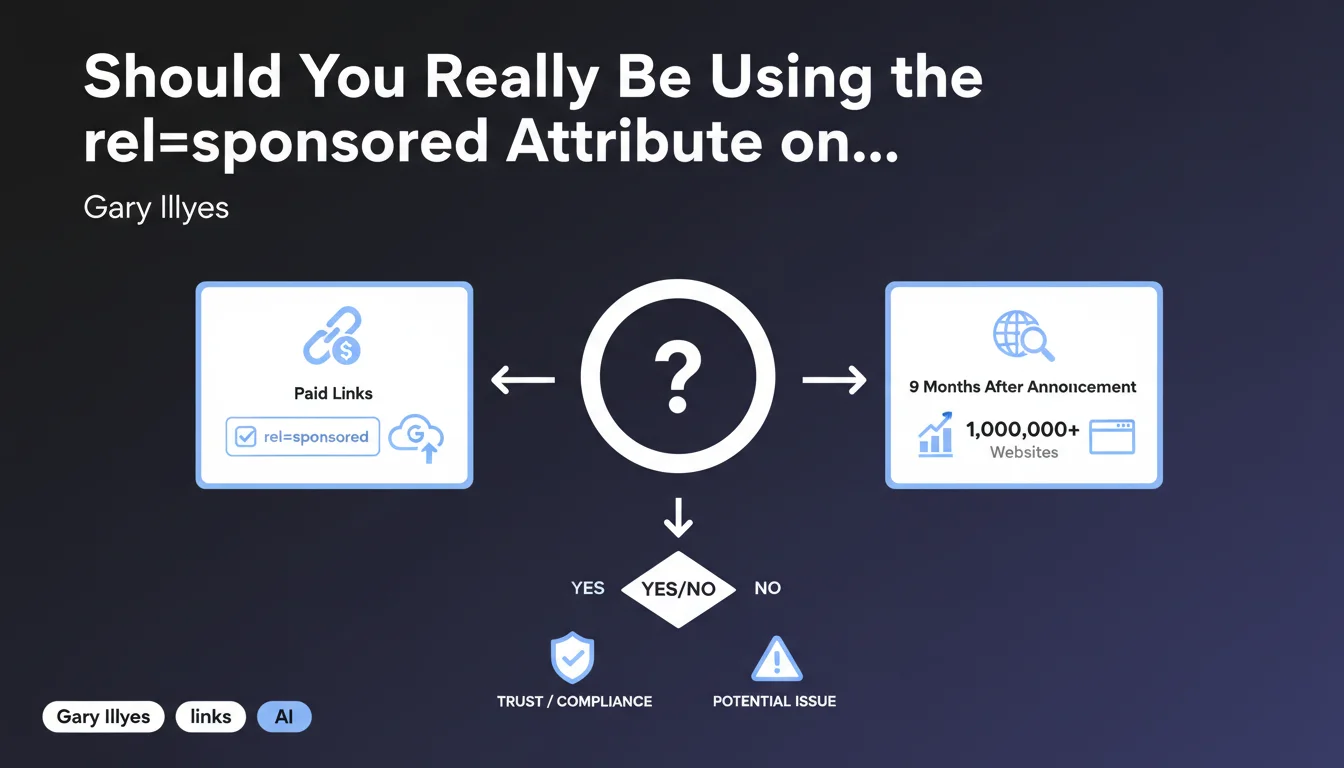
Nine months after its launch, only one million sites are using it according to Gary Illyes. This figure may seem low considering the total number of websites and the quantity of sponsored content published daily.
This limited adoption raises a crucial question: is this a lack of awareness among webmasters or a reluctance to clearly identify commercial links? The distinction between what should be marked and what actually is remains unclear.
- The rel="sponsored" attribute allows Google to better understand the commercial nature of a link
- It replaces or complements rel="nofollow" for paid links
- Its adoption remains modest despite official recommendations
- Google can theoretically penalize sites that don't use it correctly
SEO Expert opinion
This low adoption of rel="sponsored" isn't surprising for an SEO expert. In practice, many sites continue to use only rel="nofollow" for all their external links, out of habit or for ease of implementation.
The reality on the ground shows that Google hasn't massively penalized sites that haven't adopted this new nomenclature. The algorithm seems tolerant, probably because rel="nofollow" remains accepted. However, this tolerance could evolve.
There's also a gray area: are certain links really "sponsored" or simply editorial with an indirect commercial interest? This ambiguity partly explains webmasters' hesitation to massively adopt this attribute.
Practical impact and recommendations
- Audit all your outbound links to identify those from paid partnerships or sponsored content
- Replace or complement rel="nofollow" with rel="sponsored" on all commercial links
- Use the combination rel="nofollow sponsored" if you want to combine both signals
- Document your link policy in your editorial guidelines to maintain consistency
- Train your editorial and technical teams on the correct use of these attributes
- Regularly verify that new sponsored content follows these best practices
- Don't try to hide the commercial nature of your links: transparency is always preferable
In summary: Adopting rel="sponsored" remains optional in theory, but highly recommended for all commercial links. It demonstrates your compliance with Google's guidelines and reduces future risks.
Full compliance for a site can prove time-consuming, especially with a substantial content history. Precise identification of all relevant links and their correct qualification require in-depth technical and editorial expertise. To ensure flawless implementation adapted to your specific context, support from a specialized SEO agency can save you valuable time while securing your link strategy over the long term.
💬 Comments (0)
Be the first to comment.