
Official statement
What you need to understand
What is a reconsideration request and in what context does it occur?
A reconsideration request is a formal procedure allowing you to contest a manual action applied by Google on a website. This action occurs when anti-spam teams detect practices contrary to the guidelines.
The process first requires correcting the identified issues, then submitting a detailed request via Search Console. Google then manually examines whether the corrections are satisfactory before lifting the penalty.
Why are processing times so variable?
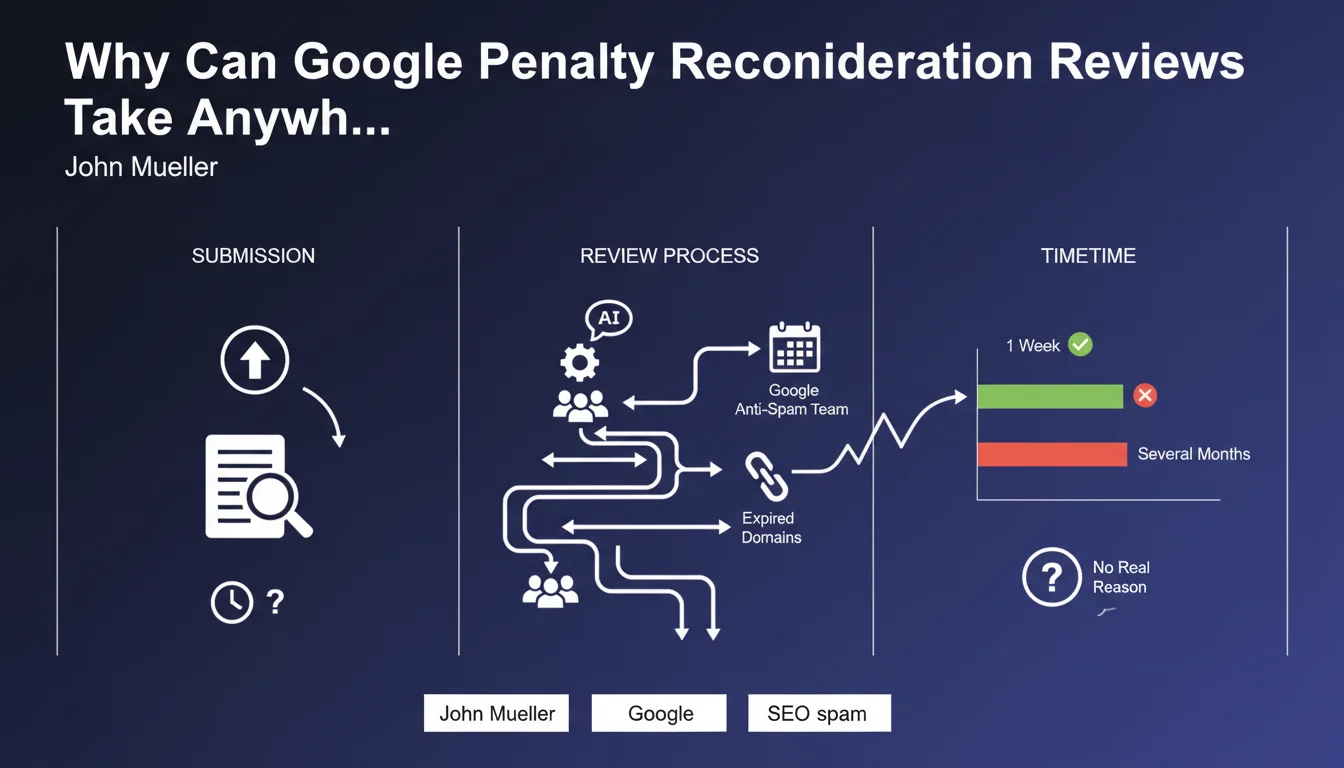
Google officially confirms that there is no standardized timeframe for processing these requests. The range can go from one week to several months, with no apparent logic.
This variability depends neither on the type of penalty, nor on the domain's age, nor even on the perceived quality of the corrections. It is essentially a matter of the processing capacity of human teams at Google.
What does this statement reveal about expired domains?
Google indicates that it observes many attempts at SEO abuse via expired domains. This clarification constitutes a clear warning signal for practitioners.
Buying an expired domain with a backlink history to exploit its authority is a practice now clearly monitored. This doesn't mean all expired domains are problematic, but that Google pays particular attention to them.
- Reconsideration timeframes vary between 1 week and several months without any predictable reason
- The observed average remains around 2 weeks in practice
- The volume of manual actions has considerably decreased recently
- Google actively monitors abuses related to expired domains
- The domain's age does not influence processing time
SEO Expert opinion
Is this statement consistent with field observations?
The announced range does indeed correspond to feedback from SEO practitioners. However, the observed median timeframe remains around 2 weeks for well-constructed requests.
Cases exceeding one month generally concern complex situations: multiple penalties, insufficient corrections, or domains with a heavy problematic history. The absence of a guaranteed timeframe reflects the manual nature of the process.
What nuances should be made regarding expired domains?
Google's warning doesn't mean all expired domains are toxic. There is a fundamental difference between legitimately recovering a domain for a coherent project and artificially exploiting its link profile.
Warning signs include: radical thematic change, massive injection of content unrelated to the history, massive redirects to another site. On the other hand, taking over a domain within its original theme remains legitimate.
In which cases can the reconsideration timeframe significantly lengthen?
Incomplete or insufficiently documented requests often require multiple iterations, which mechanically extends timeframes. A first rejected request implies correcting again and then resubmitting.
Sites with a history of recidivism or serious infractions (massive spam, hacking, illegal content) are subject to more thorough examination. Periods of high activity at Google can also create bottlenecks.
Practical impact and recommendations
What should you do concretely to speed up the processing of a reconsideration request?
The quality of your request directly influences your chances of quick validation. Document precisely each identified problem and the corrections made with concrete examples.
Use a professional and factual tone in your request. Avoid emotional justifications or vague promises. Include specific URLs showing the before/after of your corrections.
- Exhaustively identify all problems mentioned in the manual action
- Correct all infractions, not just the examples cited by Google
- Document each correction with tangible evidence (screenshots, URLs)
- Write a clear, structured, and professional request
- Wait until everything is corrected before submitting (no premature request)
- Keep a record of all changes made
What mistakes should you absolutely avoid when submitting a reconsideration request?
The main mistake is submitting a request when corrections are incomplete. Google examines the entire site, not only the examples provided in the notification.
Also avoid generic requests like "I've fixed everything". Be specific about each action taken. Don't attempt to justify or minimize infractions: acknowledge the problem and demonstrate its resolution.
How can you prevent penalties rather than having to contest them?
Proactive compliance remains the best strategy. Regularly audit your link profile to identify toxic backlinks and disavow them if necessary.
Regarding expired domains, only use this strategy if you have a legitimate project in thematic continuity with the domain's history. Always prioritize natural authority building over the long term.
💬 Comments (0)
Be the first to comment.