
Official statement
What you need to understand
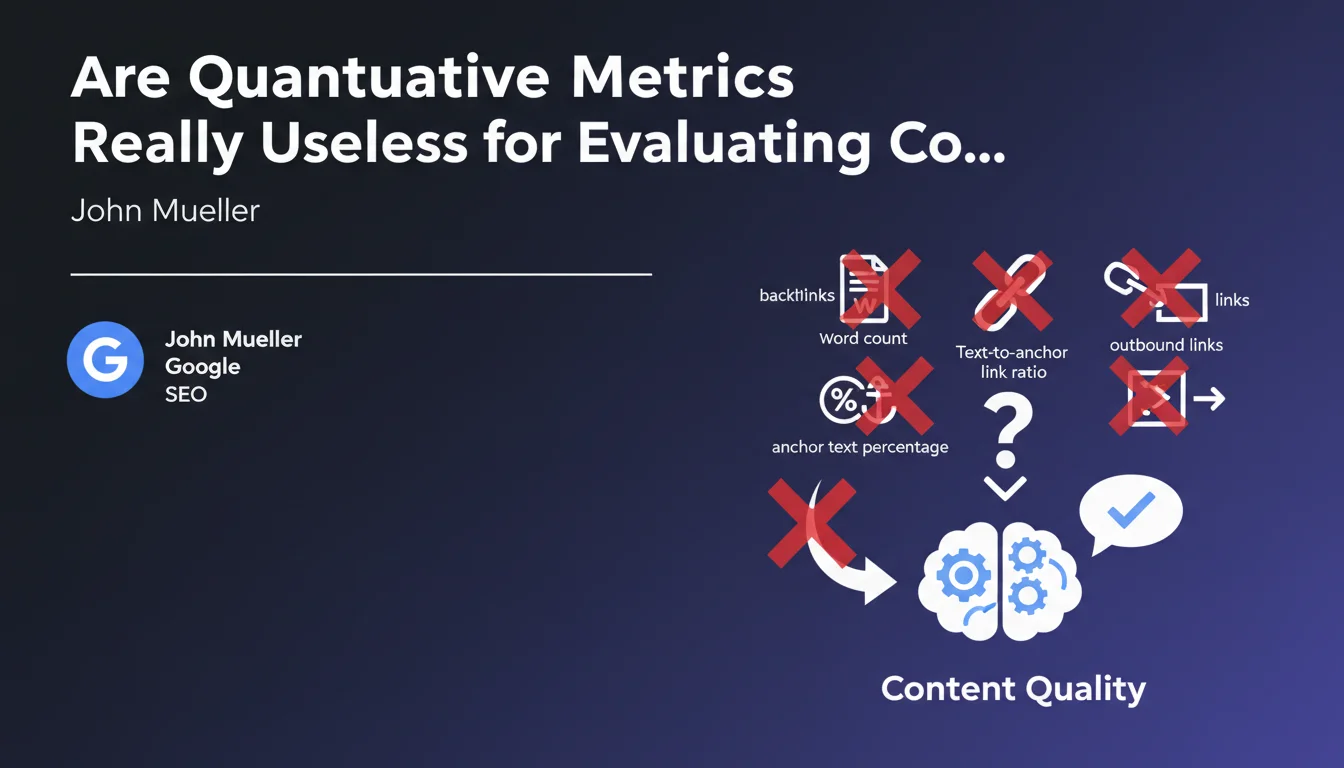
Google has officially stated that several quantitative metrics commonly used in SEO are not direct criteria for evaluating content quality. These metrics include word count, number of backlinks, text-to-anchor link ratio, number of outbound links, and anchor text percentage.
This clarification aims to demystify certain dogmatic SEO practices that have developed over the years. Many practitioners have indeed transformed these metrics into absolute rules, thinking there was a "magic number" of words or a perfect ratio to follow.
What you need to remember is that Google uses much more sophisticated quality signals than simple counts or mathematical ratios. The algorithm seeks to understand whether the content truly addresses the user's search intent.
- Quantitative metrics are not direct ranking factors
- Google evaluates quality through behavioral and contextual signals
- Focusing on ratios or counts is an obsolete approach
- Search intent and user satisfaction are priorities
- Magic formulas in SEO do not exist
SEO Expert opinion
This statement is consistent with the observed evolution of search results in recent years. In practice, we can indeed see that short pages can outperform long content if they better answer the query. Similarly, pages without massive backlinks can rank well in less competitive niches.
However, an important nuance must be made: while these metrics are not direct criteria, they can be indirect indicators of quality. A 200-word article will generally struggle to cover a complex topic in depth. Backlinks, although not mechanically counted, remain a signal of popularity and authority.
Warning: Do not confuse "is not a direct criterion" with "has no importance". Content length, for example, can naturally result from comprehensive treatment of a subject. Backlinks remain a fundamental pillar of PageRank, even if their raw number alone is not the decisive factor.
The real message here is to stop mechanical and formulaic optimizations. A 2000-word content stuffed with keywords will never match an 800-word content that is perfectly targeted and useful. The quantitative approach must give way to a qualitative approach centered on the user.
Practical impact and recommendations
In summary: Abandon magic formulas and arbitrary numerical targets. Focus on creating content that precisely meets your users' needs, with depth appropriate to each topic.
- Stop imposing a minimum word count on your writers by default
- Stop mechanically counting your backlinks as the sole success indicator
- Abandon text-to-anchor ratios and other obscure mathematical formulas
- Instead, analyze engagement rate, time spent, and bounce rate
- Create content whose length naturally flows from the depth of the topic covered
- Evaluate quality by relevance and comprehensiveness, not by volume
- Obtain natural backlinks by creating truly useful resources
- Test different approaches and measure actual performance in your SERPs
- Train your teams to prioritize search intent over metrics
- Review your editorial guidelines to remove arbitrary quantitative constraints
This transition to a more sophisticated qualitative approach can represent a significant cultural shift for your teams. Evaluating actual content quality, analyzing search intents, and optimization based on user behaviors require sharp expertise and constant monitoring. For businesses that want to implement this modern SEO approach without fumbling for months, support from a specialized SEO agency can significantly accelerate this transformation by providing the field experience and proven methodologies necessary for this strategic repositioning.
💬 Comments (0)
Be the first to comment.