
Official statement
Other statements from this video 2 ▾
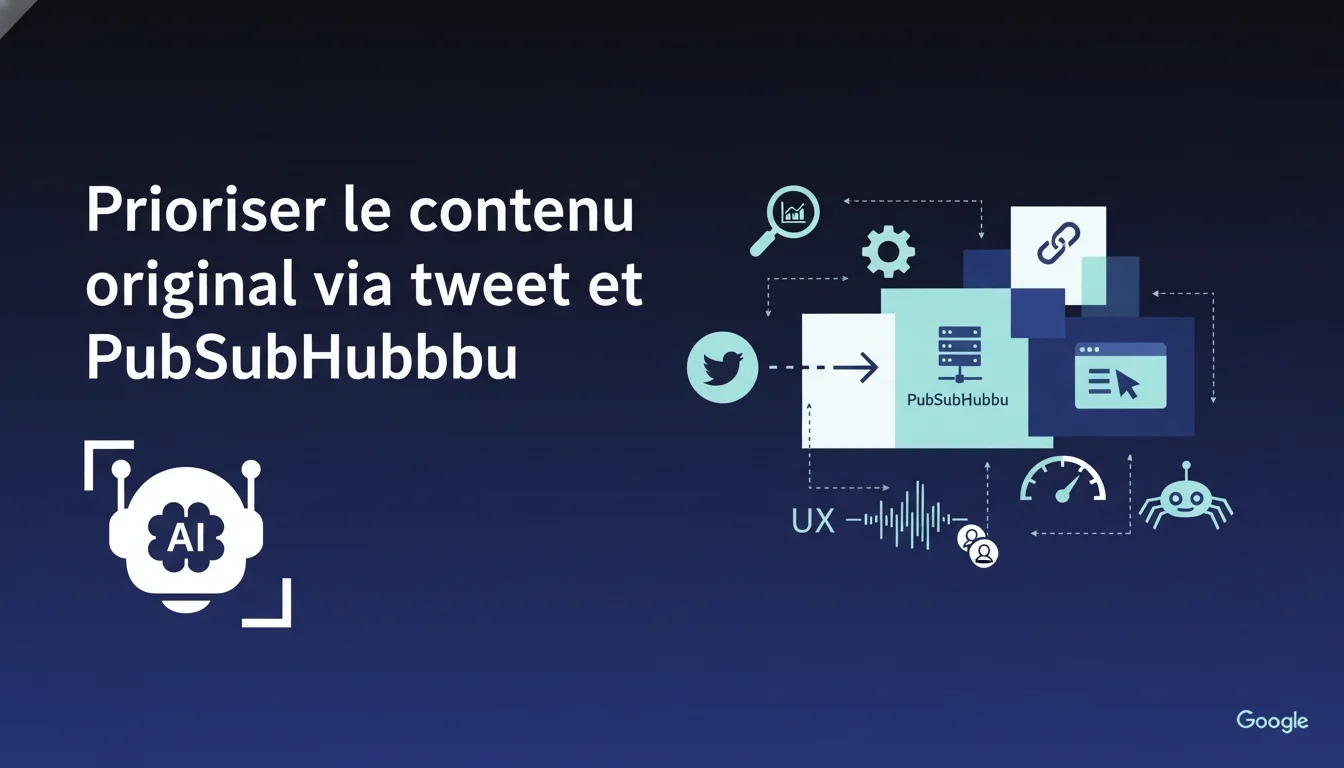
Google states that <strong>tweeting content</strong> and using <strong>PubSubHubbub</strong> can help it discover and crawl original posts more quickly. The idea is that these external signals alert the engine that new content exists even before it gets copied elsewhere. Specifically, this suggests that Google actively monitors these channels to prioritize indexing, a hypothesis that remains vague and difficult to verify in practice.
What you need to understand
Why does Google mention Twitter and PubSubHubbub in this context?
The statement is based on a simple observation: original content is often overshadowed by aggregators or sites that republish it faster or with more authority. Google is looking for signals to identify the original source.
Twitter (now X) acts as an instant broadcaster: posting a link creates a public timestamped record. PubSubHubbub (now WebSub) is a protocol that sends a ping to third-party servers as soon as an RSS feed is updated, potentially alerting Google in real time.
How are these signals supposed to influence crawling?
The hypothesis is that Google detects the tweet or the PubSubHubbub ping, visits the content faster, and can thus timestamp the original before the copies. This would allow it to recognize the legitimate source and favor it in the results.
The issue is that Google is extremely vague about the actual mechanics. Does it use the Twitter API? Does it actively monitor WebSub hubs? No public data confirms the measurable impact of these practices.
What is the relationship between these signals and the notion of authenticity?
Content authenticity hinges on Google's ability to identify who published first. A tweet or a ping does not prove intellectual ownership, but they create an external timestamp marker.
This becomes relevant if two sites publish the same text: the one that tweeted or pinged first could theoretically be prioritized. But this logic assumes that Google assigns weight to these signals, which is not documented anywhere factually.
- Twitter / X: public timestamped record, potential freshness signal
- PubSubHubbub / WebSub: active ping to hubs, instant update alert
- Stated goal: accelerate the discovery of original content, reduce the advantage of aggregators
- Limitation: no guarantee that Google systematically uses these signals
SEO Expert opinion
Is this statement consistent with field observations?
Frankly, empirical evidence is lacking. Many SEOs have tested PubSubHubbub for years without seeing a clear improvement in indexing speed. As for Twitter, its influence on Google's crawling remains a mystery: the API has changed several times, and there is no indication that Google is still actively accessing it.
The only tangible element: external links naturally accelerate discovery. If a tweet generates traffic and shares, Google can detect those behavioral signals. But that is not the same as saying, "Google monitors Twitter to prioritize indexing."
What nuances should we add to this recommendation?
Google uses cautious conditional language: "may sometimes use". Translation: this is neither systematic nor guaranteed. [To verify]: the actual impact of these signals remains undocumented, and Google provides no metrics to evaluate it.
Another point: PubSubHubbub / WebSub was popular ten years ago, but its adoption has dropped. WordPress supports it natively through some plugins, but few sites still use it actively. The relevance of this recommendation is diminishing over time.
In which cases does this approach not help at all?
If your site is already crawled several times a day, these signals are redundant. Google discovers your content through XML sitemap, internal linking, or traditional RSS feed tracking. There's no need to add a layer of complexity.
Similarly, if you publish non-time-sensitive content: an evergreen guide does not need to be indexed in 30 seconds. This tactic only makes sense if you are in direct competition with aggregators that steal your traffic by immediately republishing your information.
Practical impact and recommendations
Should you really implement PubSubHubbub today?
If your CMS supports it natively (WordPress via plugin, for instance), there's no harm in activating it. The default hub is superfeedr.com or pubsubhubbub.appspot.com. Configure your RSS feed to send a ping with every post.
However, if it requires custom development, think twice. The impact is unproven, and you would be better off investing that time in optimizing your XML sitemap or crawl frequency via Search Console.
How can you use Twitter / X as a freshness signal?
Always tweet each new post with a direct link to the final URL, not a redirector. Use an account in your name or your brand’s name, with a real audience. A tweet seen by no one generates no useful signal.
The point is not that Google “monitors” your account, but that the tweet generates initial traffic and potentially quick backlinks. These signals are observable and usable by Google.
What mistakes should you avoid with these techniques?
Do not expect a miracle. These tactics have never replaced a good XML sitemap, a healthy crawl budget, and a clean architecture. If Google takes three days to index your content, the issue lies elsewhere: crawl depth, perceived quality, lack of internal links.
Also, avoid believing that tweeting is enough to “prove” that you are the original author. Google has other methods (textual similarity analysis, publication history, domain authority). A tweet is a clue, not a legal proof.
- Activate PubSubHubbub / WebSub if your CMS allows it without technical friction
- Tweet every important publication with a direct URL and editorial context
- Monitor indexing via Search Console (URL Inspection Tool) to measure the real effect
- Do not neglect the fundamentals: updated XML sitemap, optimized crawl budget, consistent internal linking
- If you are competing with aggregators, complement these signals with canonical tags and DMCA if necessary
❓ Frequently Asked Questions
PubSubHubbub est-il toujours d'actualité ou est-ce une technologie obsolète ?
Tweeter un lien garantit-il une indexation plus rapide par Google ?
Ces signaux aident-ils à lutter contre le content scraping ?
Faut-il tweeter depuis un compte personnel ou un compte de marque ?
Comment vérifier si PubSubHubbub fonctionne correctement sur mon site ?
🎥 From the same video 2
Other SEO insights extracted from this same Google Search Central video · duration 3 min · published on 05/04/2011
🎥 Watch the full video on YouTube →
💬 Comments (0)
Be the first to comment.