
Official statement
What you need to understand
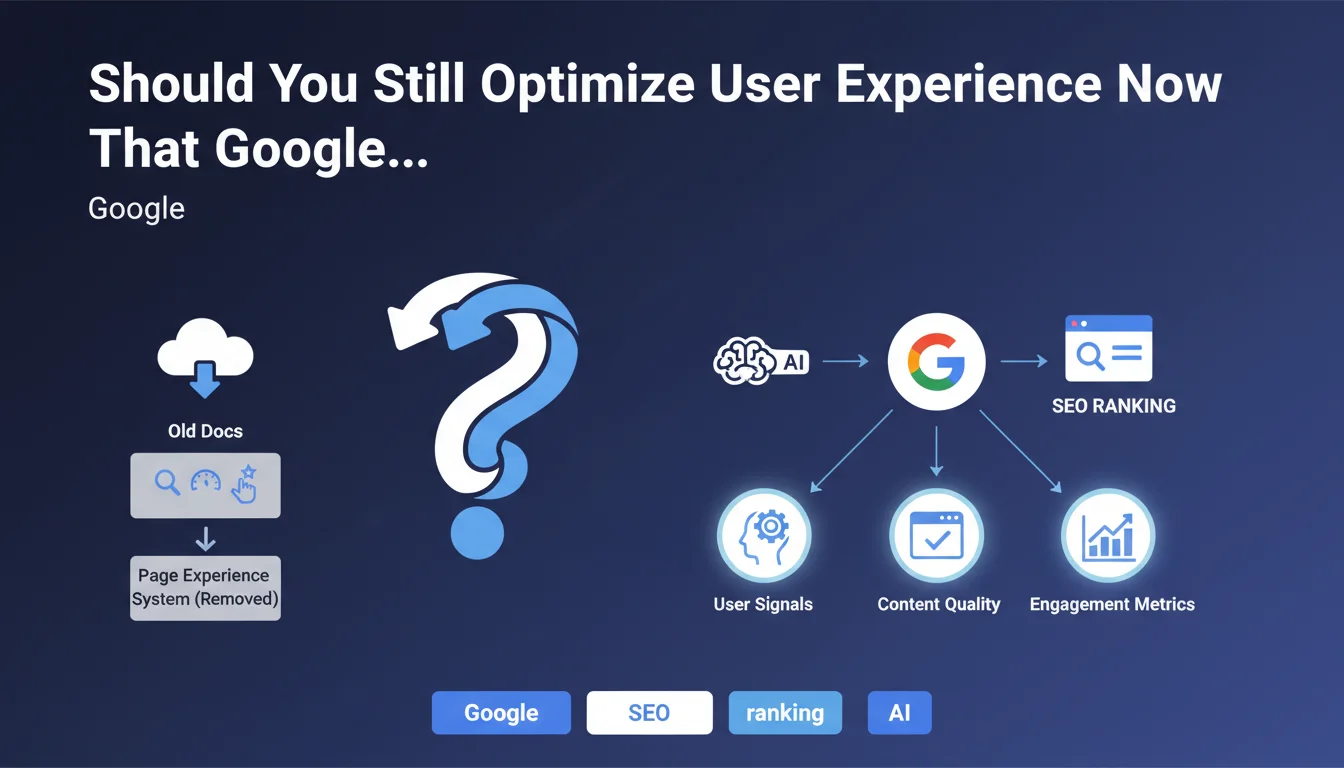
Google has just clarified a major confusion in the SEO community by explaining the difference between ranking systems and ranking signals. The firm removed the "Page Experience System" from its official documentation, but this absolutely does not mean that user experience is losing importance.
In reality, page experience has never been a standalone system within the algorithm. It is rather a set of signals that feed different ranking systems. This semantic distinction is crucial to understanding how Google actually works.
Concretely, all indicators related to user experience remain active ranking factors:
- Page loading speed (Core Web Vitals)
- Mobile adaptability (Mobile-Friendly)
- HTTPS security
- Absence of intrusive interstitials
- Overall navigation and ergonomics
The removal of this documentation therefore changes nothing about the optimization practices you should continue to apply. Google simply wanted to clarify its internal terminology to avoid any confusion between algorithmic architecture and ranking factors.
SEO Expert opinion
This clarification from Google is consistent with what we've been observing in the field for years. User experience has never functioned as a binary filter (good/bad) but rather as a continuum of signals that integrate into the overall evaluation of a page.
Sites that neglect these aspects continue to see their performance gradually decline, especially on mobile where Core Web Vitals play an increasingly determining role. We also note that Google is placing growing importance on users' actual interaction with search results.
The important nuance to understand is that these signals work in synergy with content quality. An ultra-fast page with mediocre content will never outrank excellent content that's slightly slower, but with equal quality, experience makes the difference.
Practical impact and recommendations
This announcement should trigger no changes in your optimization priorities. Here are the concrete actions to maintain in your strategy:
- Continue optimizing Core Web Vitals (LCP, FID/INP, CLS) and monitor them regularly via Google Search Console
- Maintain flawless mobile compatibility with frequent testing on different devices
- Ensure all your pages are served over secure HTTPS
- Eliminate intrusive interstitials that degrade the browsing experience
- Regularly test loading speed with PageSpeed Insights and WebPageTest
- Optimize image weight and implement lazy loading when relevant
- Monitor user engagement metrics (bounce rate, time on page) in your analytics
- Never sacrifice user experience for the sake of other SEO optimizations
💬 Comments (0)
Be the first to comment.