
Official statement
What you need to understand
What Does This Google Statement Actually Mean?
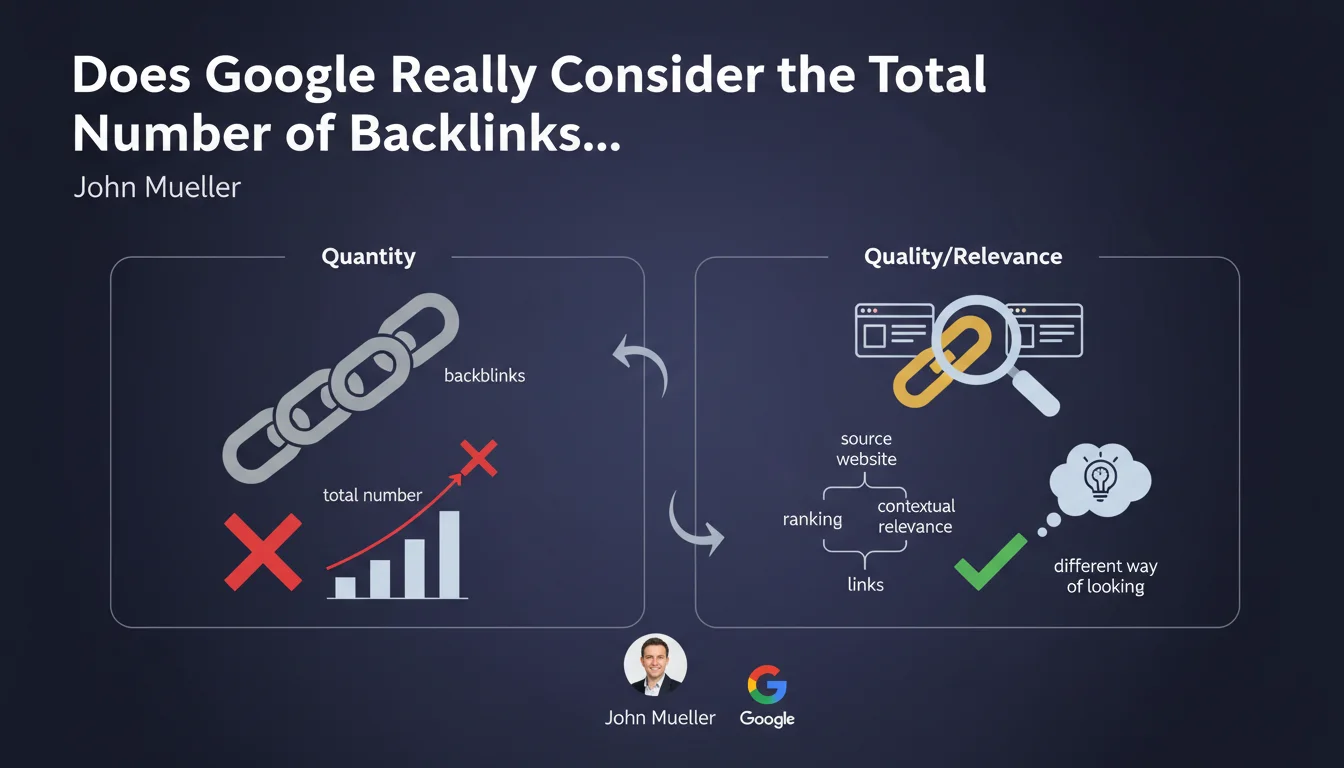
Google clearly states that the total number of backlinks pointing to a page or domain is not a reliable indicator of its popularity. This position challenges a widely held belief in the SEO community.
Google's algorithm analyzes links based on complex qualitative criteria rather than simply counting their volume. This approach has existed since the earliest versions of PageRank, but it has become considerably more sophisticated over the years.
Why Doesn't Google Rely on Raw Link Count?
Search engines quickly understood that quantity could be easily manipulated. Creating thousands of artificial links is technically simple, but these links provide no real value to users.
Google now prioritizes contextual relevance, source authority, and link naturalness. A link from an authoritative site in your niche will carry infinitely more weight than hundreds of links from low-quality directories.
What Are the Real Criteria for Evaluating Backlinks?
The algorithm examines the semantic context of the link, its position on the page, the anchor text used, and the thematic coherence between the two sites. Source diversity and acquisition timing are also taken into account.
- Quality trumps quantity in backlink evaluation
- Google uses multidimensional criteria to analyze each link
- A single high-quality link can outperform thousands of mediocre links
- Third-party metrics based on link volume don't accurately reflect Google's algorithm
- Volume-based manipulation is ineffective and potentially penalizing
SEO Expert opinion
Is This Statement Consistent with Observed Practices in the Field?
My experience completely confirms this position. I've observed countless cases where sites with modest but high-quality link profiles outperform competitors with tens of thousands of backlinks. The correlation between link volume and ranking is not linear.
Commercial SEO tools create confusion by emphasizing volumetric metrics like Domain Rating or Authority Score. These simplified indicators capture only a tiny fraction of Google's algorithmic complexity and can mislead less experienced practitioners.
What Important Nuances Should Be Added to This Statement?
However, be careful: claiming that quantity doesn't matter at all would be an over-interpretation. In ultra-competitive sectors, it's rare for a site with 10 backlinks to surpass a competitor with 10,000, even quality ones.
The truth lies in balance: you need a sufficient volume of quality links. A single excellent link generally won't suffice in competitive niches. The goal is to progressively build a diversified portfolio of relevant and natural links.
In What Contexts Does This Rule Apply Differently?
For new sites or unknown domains, even medium-quality links can have a positive initial impact to escape the "sandbox." The acquisition strategy must adapt to the site's maturity.
In highly specialized niches with little competition, a few targeted links are indeed sufficient. Conversely, in mass-market e-commerce or finance, the battle is fought through continuous accumulation of quality links at scale.
Practical impact and recommendations
What Should You Actually Do to Optimize Your Backlink Strategy?
Immediately abandon any approach centered on volume accumulation. Focus your efforts on identifying relevant sources in your niche that can legitimately reference your content.
Invest in creating remarkable content that naturally deserves to be cited: original studies, exclusive data, comprehensive guides, free tools. The best link is one you didn't have to solicit.
Develop authentic relationships with players in your sector: journalists, bloggers, professional associations. Links resulting from genuine relationships have superior qualitative value and increased durability.
What Critical Mistakes Must You Absolutely Avoid?
Never rely solely on third-party tool metrics to evaluate a link's value. A site with a DA of 30 but highly thematically relevant is worth more than a generalist DA 70 unrelated to your business.
Avoid mass link buying platforms, PBN (Private Blog Network) networks, and systematic exchange schemes. These practices are detectable by Google and can result in severe manual or algorithmic penalties.
Don't over-optimize your anchor texts with commercial keywords. A natural profile contains mostly branded anchors, naked URLs, and generic variations like "click here" or "learn more."
How Do You Audit and Improve Your Existing Backlink Profile?
Conduct a thorough qualitative audit of your current backlinks by evaluating thematic relevance, editorial quality, and the context of each link. Identify toxic links from spammy sites or link farms.
Use Google Search Console to obtain the official list of your detected backlinks. Cross-reference this data with tools like Ahrefs or Semrush, but always maintain a critical eye on their automated recommendations.
- Analyze the thematic relevance of each backlink source
- Evaluate the editorial quality of referring sites rather than their SEO metrics
- Check the diversity of referring domains and IP addresses
- Control the naturalness of anchor texts (no over-optimization)
- Identify and disavow toxic links via Search Console
- Prioritize contextual links naturally embedded in content
- Monitor the acquisition pace to avoid suspicious spikes
- Document your strategy and quality partnerships
💬 Comments (0)
Be the first to comment.