
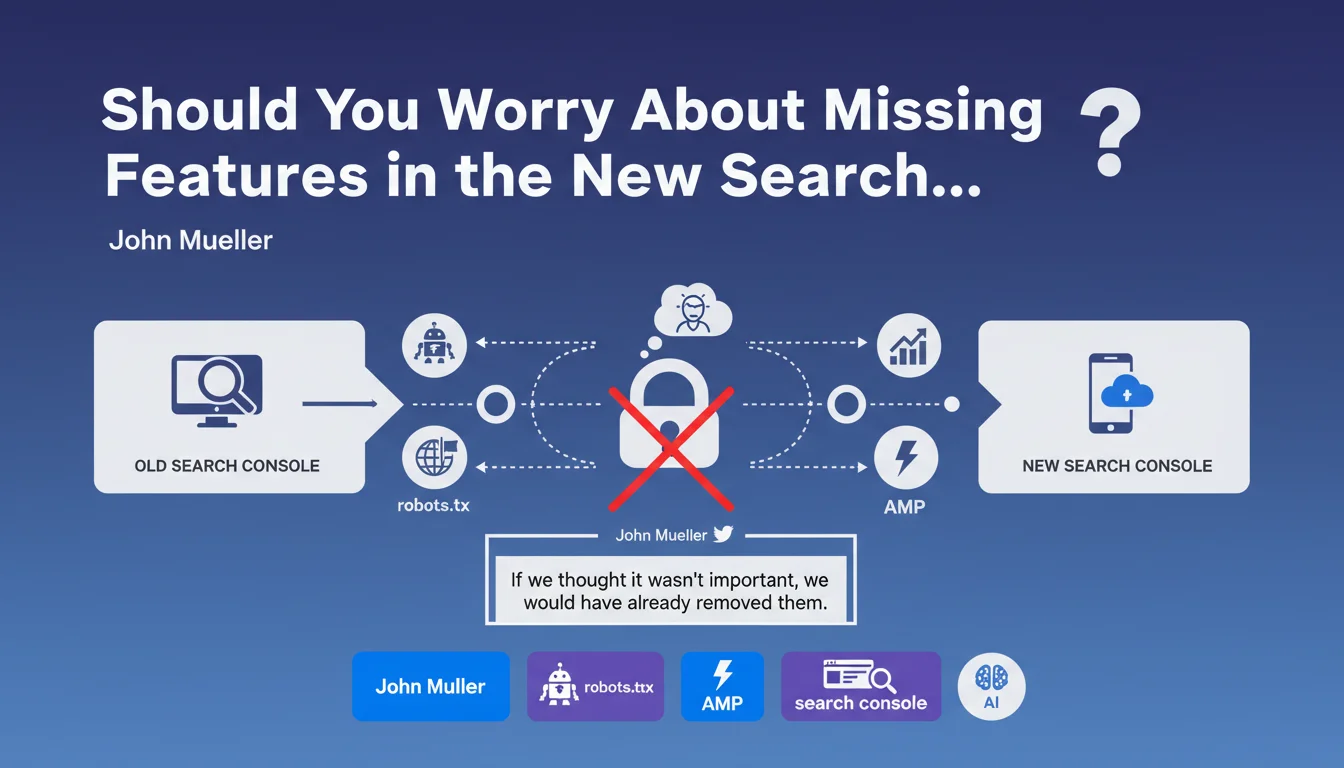
Official statement
What you need to understand
What happened with the Search Console migration?
Google launched a new version of Search Console that is progressively replacing the old interface. However, some essential features like international targeting or the robots.txt file tester have still not been migrated to the new version.
Faced with concerns from webmasters, John Mueller reassured the SEO community by explaining that these tools will not be abandoned. According to him, if Google considered these features obsolete, they would have already been removed.
Why does this statement raise questions?
The slow pace of migration poses problems for SEO professionals who must juggle between two interfaces. Some critical tools remain accessible only in the old version, which creates confusion.
Moreover, Google recently removed the preferred address change feature (www or non-www), which partially contradicts the reassuring discourse about preserving old features.
Which features are still stuck in the old version?
- International targeting (hreflang tags and geolocation parameters)
- The robots.txt file tester with the ability to test specific URLs
- Some detailed crawl reports that don't have an exact equivalent in the new version
- Link disavow tools with a more complete interface
- The history of certain URL parameters and advanced configurations
SEO Expert opinion
Is this statement really reassuring for SEO practitioners?
John Mueller's discourse aims to be soothing, but it mainly reveals an organizational problem at Google. After several years, the absence of complete migration suggests either a lack of resources allocated to the project or major technical difficulties.
For SEO practitioners, this situation creates operational uncertainty. We depend on tools that can disappear overnight, as was the case with the preferred address. The abrupt removal of this feature directly contradicts the argument that "everything important will be preserved."
What risks does this prolonged transition pose to our work?
The main danger lies in the loss of historical data and the break in tracking continuity. SEO teams have built workflows and reporting based on the old interface.
There is also a risk that some features will be oversimplified during their migration. Google tends to favor mainstream interfaces at the expense of advanced parameters that we need.
How should we interpret Google's development pace?
The slowness of this migration reveals that Search Console is probably not a strategic priority for Google. Teams seem focused on other projects, which explains why essential features remain in limbo.
This situation reminds us that we must always have alternative monitoring solutions. Total dependence on Google tools can create dangerous blind spots in our SEO strategy.
Practical impact and recommendations
What should you do concretely about this situation?
Continue using the old Search Console as long as it remains accessible for non-migrated features. Don't assume it will be available indefinitely and prepare for sudden changes.
Regularly export your critical configurations: international targeting settings, disavow rules, tested robots.txt files. Keep up-to-date documentation of all your settings.
What alternatives should you implement right now?
Diversify your data sources by using third-party tools like Screaming Frog, Sitebulb, or professional SEO analysis platforms. Don't rely solely on Google to diagnose crawl issues.
For the robots.txt file, use external validators and test it with multiple tools to ensure it works properly. For hreflang, implement automated verification systems independent of Search Console.
How can you secure your long-term SEO strategy?
- Document all your current configurations in Search Console (both old and new versions)
- Create regular backups of your international targeting and hreflang settings
- Test your robots.txt file with several different tools, not just Google's
- Set up alerts to detect changes in crawl behavior
- Invest in professional SEO monitoring tools that don't depend on Google
- Train your teams on available alternatives for each critical feature
- Monitor Google's official announcements regarding tool deprecations
💬 Comments (0)
Be the first to comment.