
Official statement
What you need to understand
What is Google's official position on Negative SEO?
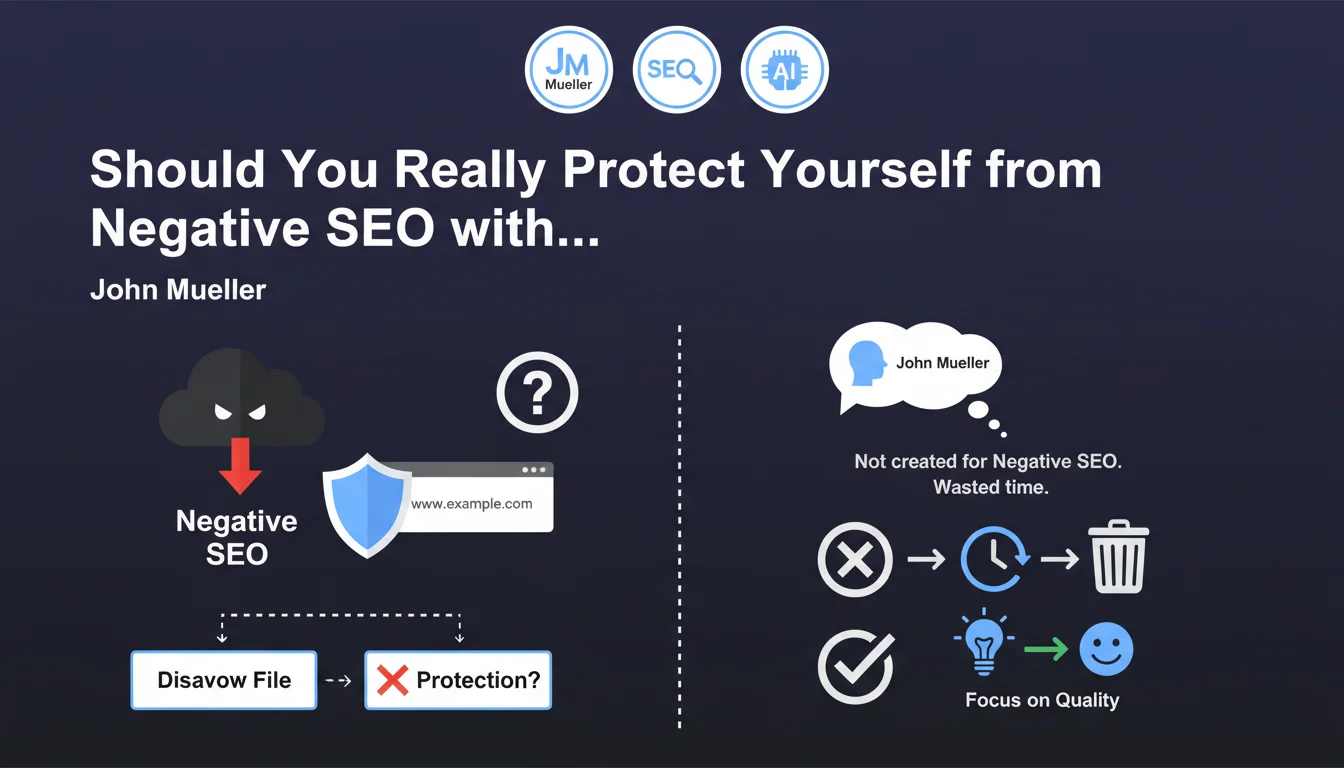
John Mueller, one of Google's official spokespeople, clearly states that the disavow file was not designed to fight Negative SEO. This statement challenges a widely held belief in the SEO community.
According to him, Google doesn't recall a situation where a site actually needed to use disavow to counter toxic external link attacks. He even describes this practice as "completely wasted time" in the majority of cases.
Why was the disavow file initially created?
The disavow tool was developed for a specific reason: to allow webmasters to correct their own link building mistakes. It primarily addresses sites that have used questionable link building techniques or hired unscrupulous providers.
Disavow mainly comes into play in the context of manual actions from Google. It serves to demonstrate your good faith and cleanup efforts when Google's spam team has manually penalized your site.
How does Google actually handle toxic links?
Mueller's position suggests that Google's algorithms are sophisticated enough to naturally ignore poor quality links. The search engine would have the ability to automatically identify and neutralize manipulation attempts.
This approach implies that Google trusts its own systems to filter out the noise and that webmasters generally don't need to manually intervene to report suspicious links pointing to their site.
- Disavow is not an anti-Negative SEO tool according to Google
- It was created to correct your own past link building mistakes
- Its use is only relevant in case of manual action
- Google claims it can automatically ignore toxic links
- In most cases, disavowing links is a waste of time
SEO Expert opinion
Is this statement consistent with real-world observations?
As an SEO expert, I find that the reality in the field is more nuanced than Google's official position. While indeed proven and impactful cases of Negative SEO remain relatively rare, they do exist.
I've observed situations where sites have suffered massive spam link campaigns, particularly in highly competitive niches. In some cases, these attacks coincided with significant ranking drops. Correlation doesn't prove causation, but it raises questions.
Mueller's position probably reflects reality for 95% of sites. However, there are edge cases where disavow may prove necessary, especially during sophisticated and massive attacks.
What nuances should be added to this official recommendation?
We need to distinguish several scenarios. First case: you receive a few dozen random spam links. Ignore them completely, Google knows how to handle this background noise. This is the most common case and Mueller is right.
Second case: you're experiencing a massive attack with thousands of toxic links created quickly. Here, even though Google should theoretically filter them, a preventive disavow may be justified as a precaution, especially if your site already has a fragile link profile.
Third case: you've received a manual action from Google. Disavow then becomes essential to demonstrate your willingness to comply, whether the links were your doing or not.
In which cases should you still consider disavowing?
Despite Mueller's statement, certain situations justify an in-depth analysis and potentially a disavow. If you notice a sudden traffic drop correlated with the massive appearance of suspicious links, an investigation is warranted.
Sites operating in ultra-competitive sectors (finance, casino, health, high-end e-commerce) are more exposed. In these niches, Negative SEO is a documented reality and the precautionary principle may prevail.
Finally, if you've inherited a site with a questionable history or are coming out of a manual penalty, a complete audit of your link profile and targeted disavow remain recommended practices, contrary to what the official statement suggests.
Practical impact and recommendations
What should you actually do when facing suspicious links?
The first recommendation is to not panic as soon as you discover poor quality links. A few dozen spam links are perfectly normal and don't impact your SEO. Google ignores them automatically.
Focus your energy on what really matters: creating quality content and obtaining natural and relevant links. This is infinitely more profitable than spending hours disavowing links that Google is already ignoring.
Nevertheless, maintain regular monitoring of your link profile via Google Search Console and third-party tools (Ahrefs, Majestic, Semrush). Quarterly monitoring is generally sufficient to detect significant anomalies.
What critical mistakes should you absolutely avoid?
The most serious error would be to disavow quality links out of ignorance. A link from an unknown domain is not necessarily toxic. Many beginner SEOs disavow neutral or even beneficial links through excessive zeal.
Another trap: using disavow as a systematic preventive solution. This approach is counterproductive and time-consuming. Only create a disavow file if you have an objective and documented reason to do so.
Also avoid disavowing at the entire domain level when a few pages would suffice. This overly aggressive approach can eliminate potentially useful links from other sections of the same domain.
How do you implement a toxic link management strategy?
Adopt a pragmatic three-level approach. Level 1: Passive monitoring. For 90% of sites, simple quarterly monitoring in Search Console is more than sufficient.
Level 2: In-depth analysis. If you detect an anomaly (sudden spike in suspicious links, unexplained traffic drop), conduct a complete audit of your link profile with professional tools.
Level 3: Targeted action. Only if the analysis reveals a concerning situation (massive attack, manual action), create a precise and documented disavow file. Keep a record of your reasoning.
- Don't panic over a few isolated spam links
- Prioritize acquiring quality links over cleanup
- Monitor your link profile quarterly via Search Console
- Only disavow in clearly justified and documented cases
- Never disavow links without prior in-depth analysis
- Keep an updated disavow file if a manual action is in progress
- Test the impact progressively by disavowing in phases
- Document each disavow decision for traceability
💬 Comments (0)
Be the first to comment.