
Official statement
Other statements from this video 1 ▾
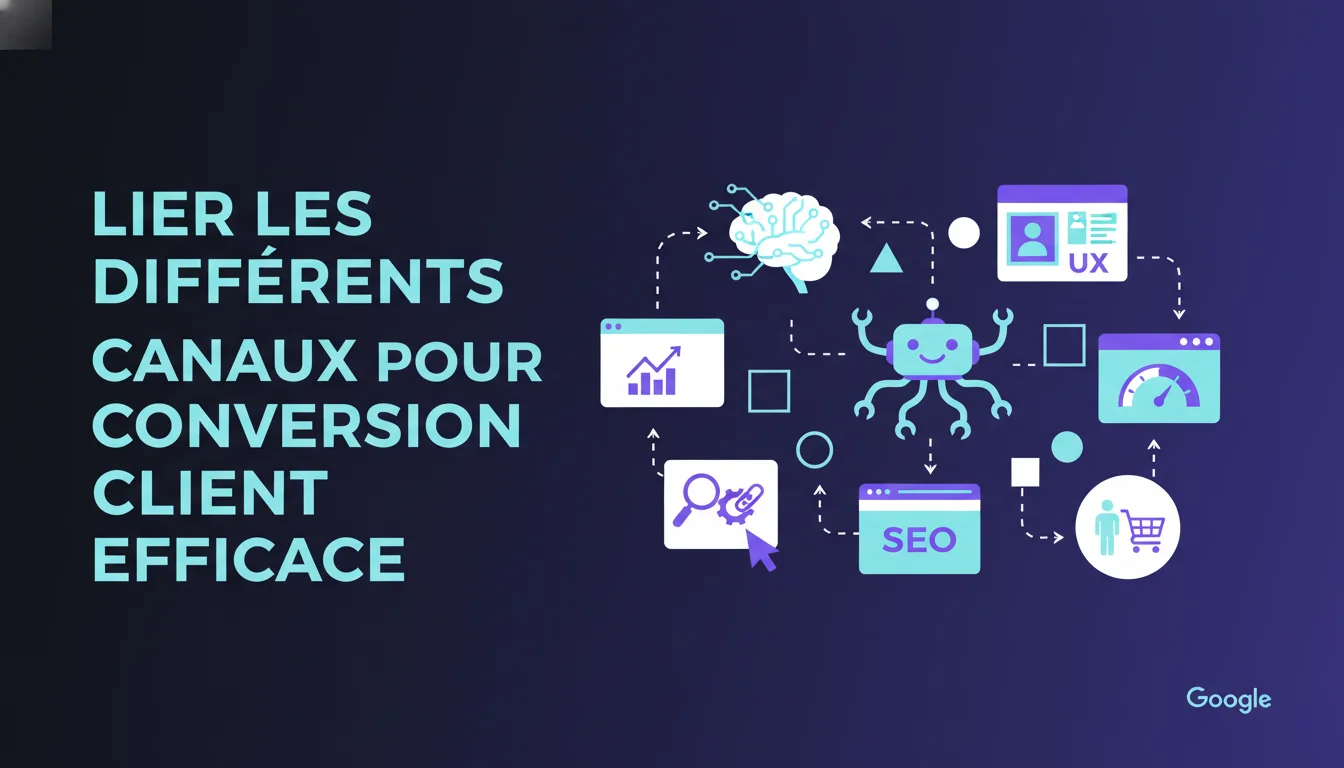
Google states that customer conversion now relies on consistency across all your digital channels: SEO, social media, email, and website. A user exploring your online presence should find complementary answers on each channel to complete their purchase. In practical terms, your SEO strategy needs to align with your other marketing levers to optimize the entire conversion journey.
What you need to understand
What does Google mean by "links between different channels"?
Google is referring to multichannel consistency: your website, social profiles, Google Business Profile, newsletters, and advertising landing pages need to mutually reinforce each other. The idea is that a prospect discovering you through organic search might not find all their answers on your initial landing page.
They will likely check your Google reviews, look at your LinkedIn profile, read your Instagram posts, or download a PDF from your site. Each touchpoint should add to the previous information and move the user closer to conversion. If a channel is missing, contradicts the others, or sends a conflicting message, you lose the prospect.
Why does this approach change the game for SEO?
Traditionally, landing pages were optimized for a keyword with an isolated conversion funnel. Google is now suggesting that conversion no longer occurs on a single channel. Your SEO content needs to point to your other digital assets and vice versa.
For example: an SEO blog post can link to a product demo on YouTube, which itself mentions a webinar announced on LinkedIn. The journey is fragmented but orchestrated. If your SEO strategy ignores your other channels, you’re leaving the prospect at a dead end after the first interaction.
Does this statement imply that Google follows users outside of search?
Not directly. Google isn’t saying it uses your Instagram data to rank your site. What it indicates is that user behavior is multichannel and that satisfaction signals (bounce rates, session time, return visits) can be influenced by your presence elsewhere.
If a user finds your content consistent and rich across multiple platforms, they will return more often, stay longer, and share more. These indirect signals feed into your perceived authority and, ultimately, your ranking. Google doesn’t necessarily connect the dots, but the user does.
- One channel alone doesn’t answer all questions: diversify formats and platforms
- Editorial consistency: same tone, same brand promise everywhere
- Active interconnection: each channel should point to the others (links, CTAs, mentions)
- Complementarity of content: do not duplicate, enrich according to the channel
- Indirect user signals: multichannel engagement improves on-site metrics
SEO Expert opinion
Is this statement consistent with observed practices in the field?
Yes, but with a significant nuance. In B2B markets or with complex products (SaaS, professional services, high-end real estate), we indeed see customer journeys touching 5 to 8 contact points before conversion. Organic SEO often serves as the first entry point, followed by the user checking LinkedIn, reading Trustpilot reviews, watching a YouTube demo, downloading a whitepaper, and finally requesting a quote.
However, for simple transactional queries (buying a common product, booking a local restaurant), a single well-optimized channel often suffices. A Google Business Profile with reviews, hours, and menu can convert without the user ever visiting the website. Google’s statement is therefore true… in certain contexts. [To verify] based on your sector and the degree of purchase consideration.
What risks does this multichannel approach pose for SEO?
The first risk is dilution of efforts. If you spread yourself too thin across too many channels without a clear strategy, you produce mediocre content everywhere instead of excelling in two or three levers. I have seen sites lose organic traffic because the team was obsessed with TikTok and Instagram, at the expense of producing in-depth articles and internal linking.
The second risk is technical inconsistency. If your site points to an abandoned Facebook profile or a YouTube channel without videos for two years, you send a negative signal. It’s better to focus your presence on the channels you can actually maintain. Google talks about “links between channels,” but these links need to be active and relevant, not empty shells.
Should one rethink their SEO traffic attribution in light of this statement?
Absolutely. If you still measure SEO ROI solely through Google Analytics and last-click attribution, you underestimate its real impact. A visitor arriving via organic search, checking three articles, and then returning two weeks later through LinkedIn to convert: your GA dashboard will attribute the conversion to LinkedIn, while SEO initiated the journey.
You need to shift to a multi-touch attribution model and monitor cross-channel journeys (GA4 allows this partially with conversion paths, but it’s still limited). Without this view, you risk under-investing in SEO because your traditional dashboards only show part of the picture. [To verify] with your current tools: are you actually tracking journeys or just the last touchpoint?
Practical impact and recommendations
How can you concretely integrate this approach into your SEO strategy?
First step: map your touchpoints. List all your active channels (site, blog, GBP, social media, email, marketplace, etc.) and check message consistency. Does your LinkedIn bio say the same as your About page? Do your Google reviews contradict your commercial messaging on the site?
Next, create explicit linkages between channels. In your SEO articles, embed CTAs leading to your YouTube resources, LinkedIn case studies, or your Discord community if relevant. Conversely, in your social posts, direct users to your pillar SEO content for further depth. The goal is to create an ecosystem where each channel nourishes the others and prolongs engagement.
What mistakes should be avoided in this multichannel orchestration?
First mistake: duplicating the same content everywhere. A blog post copied and pasted as a LinkedIn post, then in a newsletter, then as a Twitter thread, adds no extra value. Each channel must offer a different angle, a suitable format, and complementary depth.
Second mistake: neglecting structured data consistency. If your site shows different hours than your GBP, or different prices than your Facebook page, Google and the user are confused. Centralize your data (NAP, contact details, prices, stock) and synchronize them everywhere. Use Schema.org on your site and ensure your social profiles reflect the same information.
How to measure the effectiveness of this cross-channel strategy?
Implement a rigorous UTM tracking to identify where your conversions are really coming from. Create distinct UTM codes for each channel (utm_source=linkedin, utm_medium=organic_social, etc.) and analyze conversion paths in GA4. Look at how many interactions, on average, precede a conversion and which channels often appear in these journeys.
Also monitor cross-channel engagement metrics: how many users discovering your site via SEO then visit your LinkedIn profile or subscribe to your newsletter? These micro-conversions are signs that your ecosystem is functioning. If no one clicks on your social links from your articles, that means the orchestration isn’t working.
- Audit the consistency of your message and data (NAP, prices, hours) across all your channels
- Create complementary content by channel, not duplicates
- Integrate cross-channel CTAs in your SEO content (to videos, social profiles, downloadable resources)
- Set up UTM tracking and multi-touch conversion path tracking in GA4
- Measure cross-channel engagement rate (how many SEO visitors then consult your other digital assets)
- Synchronize your structured data (Schema.org, GBP, Open Graph) to avoid inconsistencies
❓ Frequently Asked Questions
Est-ce que Google pénalise un site qui n'a pas de présence sur les réseaux sociaux ?
Faut-il obligatoirement lier son site web à tous ses canaux sociaux ?
Comment savoir si mes canaux se renforcent mutuellement ou se cannibalisent ?
Est-ce que les liens depuis mes profils sociaux comptent comme backlinks pour le SEO ?
Quelle est la priorité : optimiser le SEO on-site ou développer la présence multicanale ?
🎥 From the same video 1
Other SEO insights extracted from this same Google Search Central video · duration 4 min · published on 06/10/2014
🎥 Watch the full video on YouTube →
💬 Comments (0)
Be the first to comment.