
Official statement
What you need to understand
What is Google's official position on buying links?
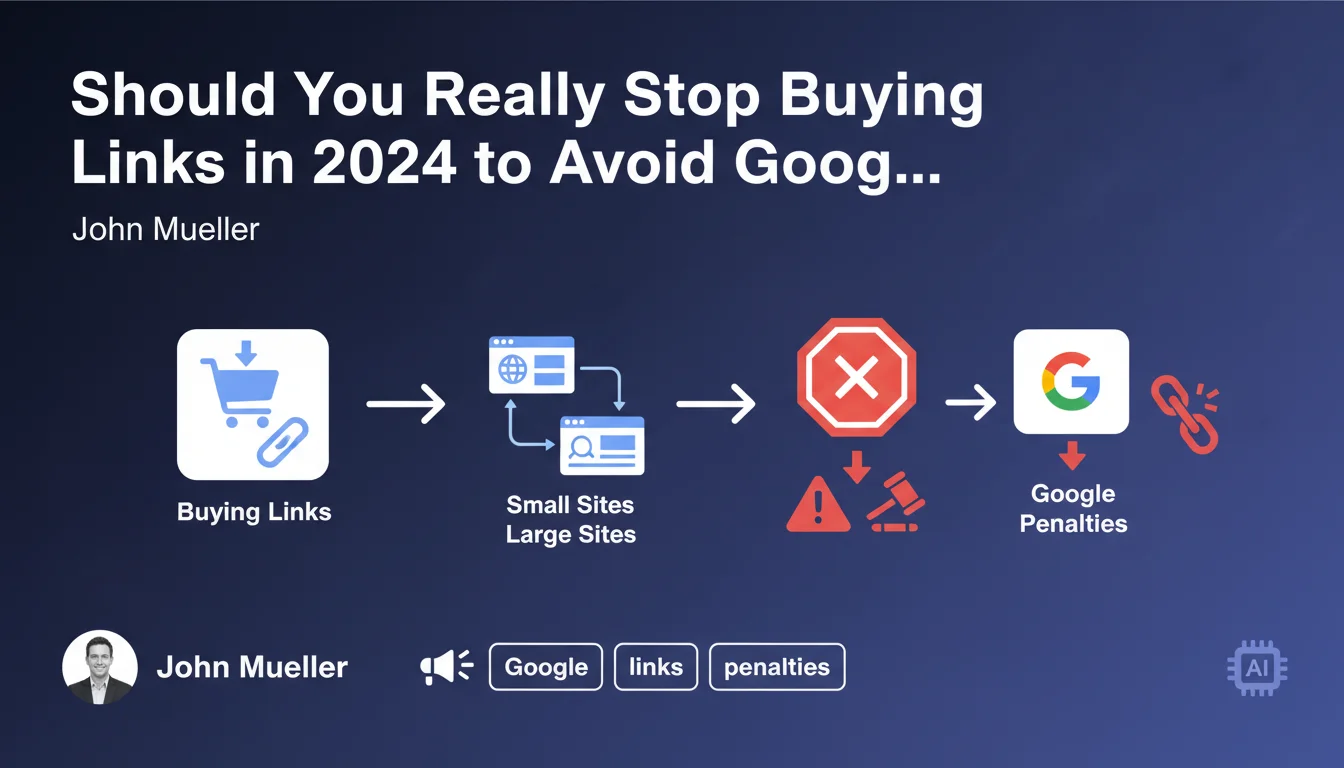
Google maintains a firm and consistent position for many years: buying and selling links with the intent to manipulate PageRank is strictly prohibited. This practice violates the webmaster guidelines and exposes the sites involved to manual or algorithmic penalties.
John Mueller's statement reminds us that this rule applies regardless of size: whether it's a small blog or a major website, the potential consequences remain identical. Fair treatment is therefore a principle displayed by Google.
Why does Google consider link buying a serious violation?
Links constitute one of the fundamental ranking signals of Google's algorithm. When a site buys backlinks, it artificially distorts its popularity and relevance in the eyes of the search engine.
This manipulation damages the quality of search results by allowing less relevant content to rank artificially. Google therefore invests heavily in detecting and penalizing these practices.
What are the concrete consequences of detecting link purchases?
Penalties can take two main forms: automatic algorithmic penalties and manual actions. Manual actions are notified in Search Console and require a reconsideration process after correction.
Consequences include a sharp drop in organic traffic, devaluation of positions on strategic keywords, or even partial or total deindexing in extreme cases.
- Buying links explicitly violates Google guidelines
- The rule applies uniformly to all sites, regardless of their authority
- Penalties range from link devaluation to manual penalty
- Link sellers are also exposed to algorithmic penalties
- Notification is done via Google Search Console for manual actions
SEO Expert opinion
Is this Google position consistent with practices observed in the field?
The reality of the SEO market reveals a significant dissonance between the official discourse and observed practices. Many sites continue to buy links and rank sustainably on competitive queries without apparent penalty.
This situation is explained by Google's technological limitations in detection. When the purchase is discreet, when links come from thematically coherent sites, and when acquisition remains progressive, detection becomes extremely difficult. Algorithms struggle to distinguish a purchased link from a natural editorial link.
However, risks increase proportionally to the site's visibility and success. The more traffic and revenue a site generates, the more it becomes a priority target for quality raters teams and in-depth manual audits.
What nuances should be brought to this categorical prohibition?
Not all monetary transactions involving links are penalizable. Legitimate commercial partnerships, sponsorships, and sponsored content remain acceptable provided the rel="sponsored" or rel="nofollow" attributes are correctly used.
The boundary becomes blurred with certain practices like creative link building: offering a free tool, producing an exclusive study, or organizing an event in exchange for natural mentions. These investments generate links without direct link-for-money transactions.
In what contexts does link buying remain practiced despite everything?
Certain ultra-competitive sectors (casino, finance, health) present an ecosystem where link buying remains widespread. The potential profitability justifies the risk for many players who consider penalties as an acceptable business cost.
Sites with multi-domain strategies sometimes use satellite domains to test the limits, thus protecting their main domain. This sophisticated approach requires in-depth expertise and carries significant legal and reputational risks.
Practical impact and recommendations
What should you do concretely to develop your link building without risk?
Prioritize content marketing strategies that naturally generate links: sector studies with exclusive data, free tools useful to your audience, shareable infographics. This content attracts authentic editorial backlinks.
Invest in digital press relations and digital PR. Collaborate with journalists, offer your expertise on current topics, participate in industry podcasts or webinars. These media mentions create high-quality links.
Develop strategic partnerships based on mutual value: content co-creation, participation in professional events, contribution to industry associations. Legitimate reciprocity creates sustainable link opportunities.
How can you audit your existing link profile to identify risks?
Regularly use Google Search Console to monitor your backlinks and detect any manual actions. Export your link profile and analyze the diversity of sources, thematic relevance, and anchors used.
Supplement with tools like Ahrefs, Majestic or SEMrush to identify toxic links: spammy sites, obvious link networks, over-optimized anchors. Create a disavow file for links you cannot manually remove.
Establish monthly monitoring of your link metrics: dofollow/nofollow ratio, anchor distribution, evolution of referring domains. Any sudden anomaly may signal a problem or negative SEO attack.
What legitimate alternatives allow for accelerating link acquisition?
Link baiting relies on creating content so remarkable that it spontaneously attracts links. Invest in premium formats: original statistical studies, exhaustive reference guides, interactive simulators.
Unlinked brand mentions represent an often-neglected opportunity. Monitor mentions of your brand without hyperlinks and politely contact authors to suggest adding a contextual link.
- Permanently ban all direct link purchases of the "X€ for Y backlinks" type
- Audit your link profile quarterly with Search Console and third-party tools
- Systematically use rel="sponsored" for any paid partnership
- Develop a content marketing strategy generating natural links
- Establish lasting relationships with influencers and industry media
- Create a disavow process to neutralize detected toxic links
- Monitor brand mentions to transform citations into backlinks
- Document all link building actions to justify their legitimacy if necessary
Google's position on buying links remains uncompromising and universal. The risks of penalties, although variable depending on the sophistication of practices, can destroy years of SEO work in a few weeks.
The long-term viable strategy relies on white hat methods: creating exceptional content, digital public relations, authentic partnerships. These approaches require more time but build a resilient and sustainable link profile.
The increasing complexity of detection algorithms and the constant evolution of guidelines make SEO expertise more critical than ever. For companies wishing to develop a robust and compliant link building strategy, support from a specialized SEO agency allows you to navigate serenely in this complex regulatory environment, avoid costly mistakes and maximize ROI on content marketing and digital PR investments.
💬 Comments (0)
Be the first to comment.