
Official statement
What you need to understand
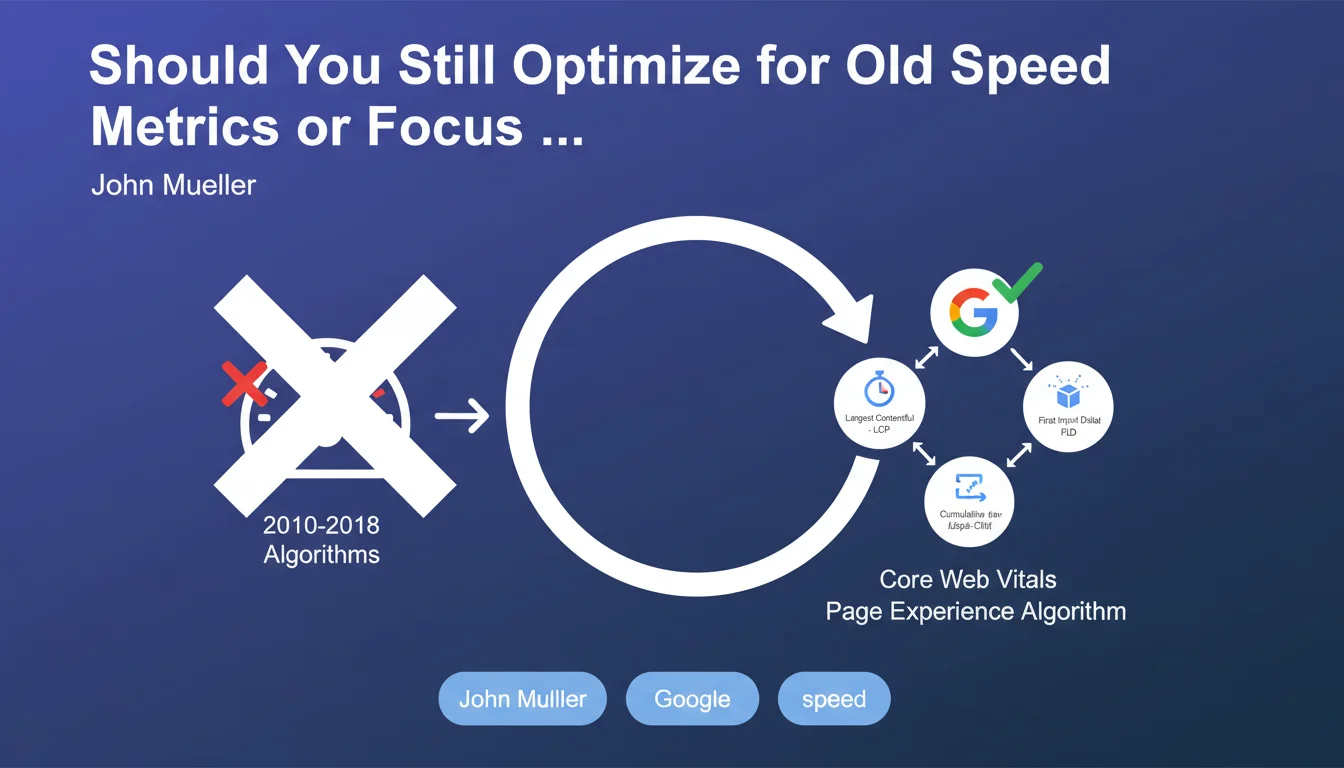
Google has officially confirmed a major change in how it evaluates web page performance. The algorithms used between 2010 and 2018 to measure display time are now completely obsolete.
This statement marks a turning point: the Page Experience algorithm and Core Web Vitals are now the only criteria taken into account to evaluate speed and user experience. All old indicators have been deprecated by Google.
Concretely, this means that historical metrics like full load time or DOMContentLoaded are no longer direct ranking factors. Google focuses exclusively on three key indicators.
- LCP (Largest Contentful Paint): measures the display time of the largest visible element
- FID/INP (First Input Delay / Interaction to Next Paint): evaluates responsiveness to user interactions
- CLS (Cumulative Layout Shift): quantifies the visual stability of the page
- Old performance algorithms (2010-2018) are no longer used for ranking
- Page Experience is the unified framework that encompasses these new metrics
SEO Expert opinion
This confirmation aligns perfectly with field observations since 2021. Sites that have invested heavily in optimizing Core Web Vitals have indeed seen ranking improvements, particularly in competitive sectors.
An important nuance: this doesn't mean that raw speed no longer matters. Core Web Vitals precisely measure the speed perceived by the user, which is often more relevant than the complete technical loading time. A site can load for 10 seconds in the background, as long as the main content is visible quickly.
Warning: Don't throw away your traditional analysis tools though. Metrics like Time to First Byte (TTFB) remain valuable technical indicators for diagnosing underlying problems that indirectly impact Core Web Vitals. They're simply no longer direct ranking factors.
In some specific cases, particularly for e-commerce sites or complex web applications, optimization must be holistic. A good TTFB will naturally facilitate achieving a good LCP.
Practical impact and recommendations
Summary: Focus your optimization efforts exclusively on the three Core Web Vitals (LCP, INP/FID, CLS) which are the only performance indicators used by Google for ranking. Old metrics can be used for diagnosis but should no longer be your primary objectives.
- Audit your Core Web Vitals via Google Search Console and PageSpeed Insights to identify your current scores on real data (field data)
- Prioritize LCP optimization: compress images, use a CDN, implement intelligent lazy loading, optimize the critical rendering path
- Improve INP by reducing blocking JavaScript, optimizing event handlers, and deferring non-essential scripts
- Stabilize CLS by reserving space for images, ads and embeds, and using appropriate font-display settings
- Stop optimizing for complete load time as a primary metric - focus on above-the-fold content
- Don't remove your traditional monitoring tools: use them as diagnostic indicators to understand the root causes of Core Web Vitals issues
- Test on real connections and devices: Core Web Vitals are calculated on field data from real users
- Implement continuous monitoring because Core Web Vitals can fluctuate with content or code updates
- Document your optimizations and measure the impact on your rankings within 2-4 weeks following changes
These technical optimizations often require deep expertise in web development and a fine understanding of interactions between infrastructure, code and user experience. If your internal resources are limited or if you find that your Core Web Vitals are stagnating despite your efforts, support from an SEO agency specialized in web performance can prove decisive in obtaining measurable and sustainable results.
💬 Comments (0)
Be the first to comment.