
Official statement
What you need to understand
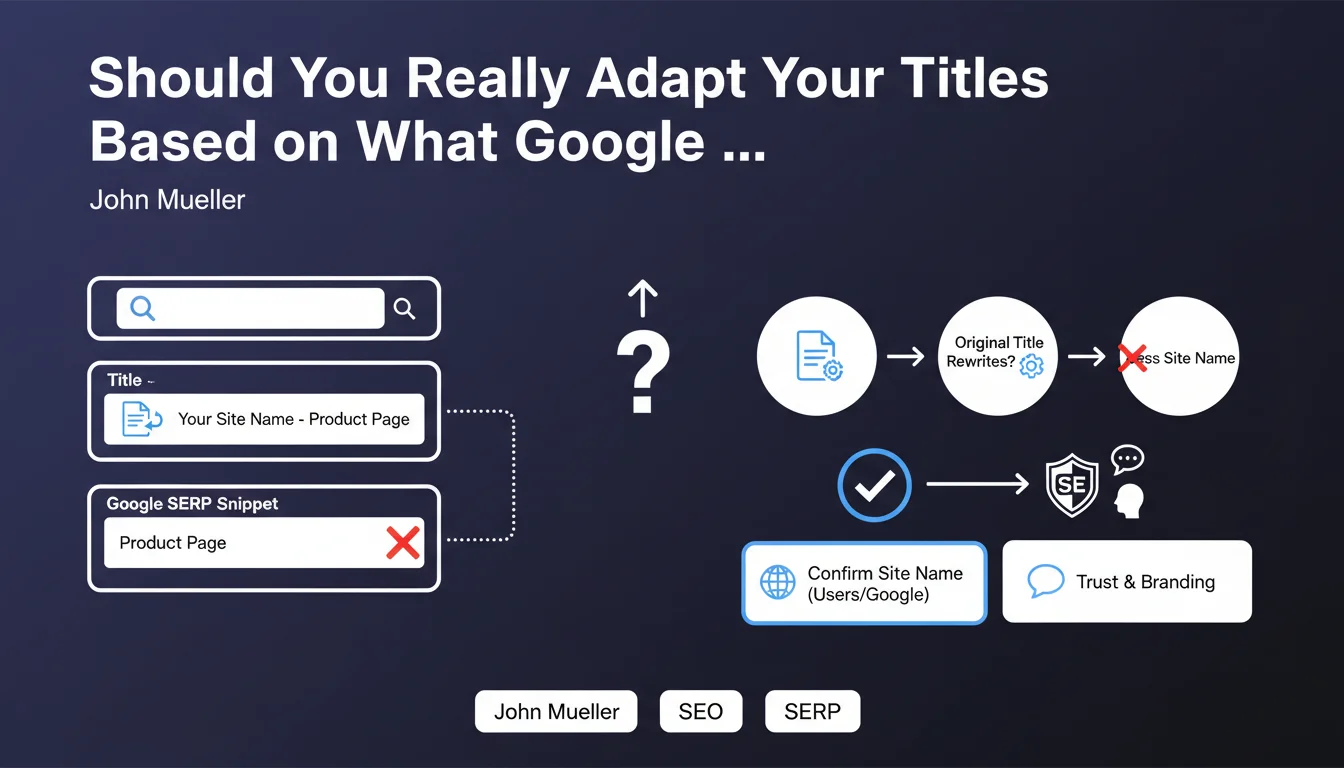
Google regularly rewrites title tags in its search results, particularly by removing the site name when it appears at the end of the title. This practice can confuse SEO practitioners who wonder whether they should adjust their titles accordingly.
The statement provides important clarification: just because Google modifies the display doesn't mean you necessarily need to change your HTML markup. The search engine makes these adjustments to optimize the user experience based on the search context, without this reflecting a flaw in your original title.
Google now displays the site name above the title in the SERPs. Keeping your site name in the title tag makes it easier for the algorithm to confirm this information. It's a consistency signal for the search engine.
- Google rewrites titles to better match the search context
- The rewriting doesn't mean your original title is bad
- Keeping the site name in the title helps Google validate the display
- The "Page Title - Site Name" pattern remains an established best practice
- Only titles that aren't representative of the content deserve revision
SEO Expert opinion
This position is perfectly consistent with field observations. We indeed see that Google massively rewrites titles, sometimes on over 60% of results depending on the sector. Systematically adapting your titles to these rewrites would be an endless and counterproductive race.
However, this needs nuance: if Google systematically rewrites the same title the same way across all queries, it's probably a sign that it doesn't find it descriptive enough. In this specific case, a revision is warranted. The key is to distinguish contextual rewrites (normal) from systematic rewrites (warning signal).
The recommendation to maintain the site name in the title is particularly relevant for branding and consistency of signals sent to Google. This proven pattern facilitates identification of your brand and reinforces user trust.
Practical impact and recommendations
- Don't modify your titles solely because Google rewrites them in the SERPs
- Keep the "Title - Site Name" pattern which remains a recognized best practice
- Audit your titles to verify they accurately describe each page's content
- Identify pages where Google systematically rewrites the title the same way (warning signal)
- Monitor your CTR: if the rewrites negatively impact clicks, optimize those specific titles
- Avoid titles that are too short (less than 30 characters) or too long (more than 60 characters)
- Ban keyword stuffing in your titles which triggers rewrites
- Test different formulations on strategic pages while monitoring the actual display
- Document cases where your titles are kept intact to identify winning patterns
Title optimization remains a delicate balancing act between user relevance, descriptive accuracy, and SEO performance. It's not simply about copying what Google displays, but about creating titles that are robust and representative enough for the search engine to consider them optimal.
This approach requires detailed analysis of your Search Console data, regular SERP monitoring, and deep understanding of search intent for each strategic page. Given the complexity of these optimizations and their direct impact on your visibility, guidance from a specialized SEO agency can prove valuable for developing a tailored strategy and avoiding common pitfalls.
💬 Comments (0)
Be the first to comment.