
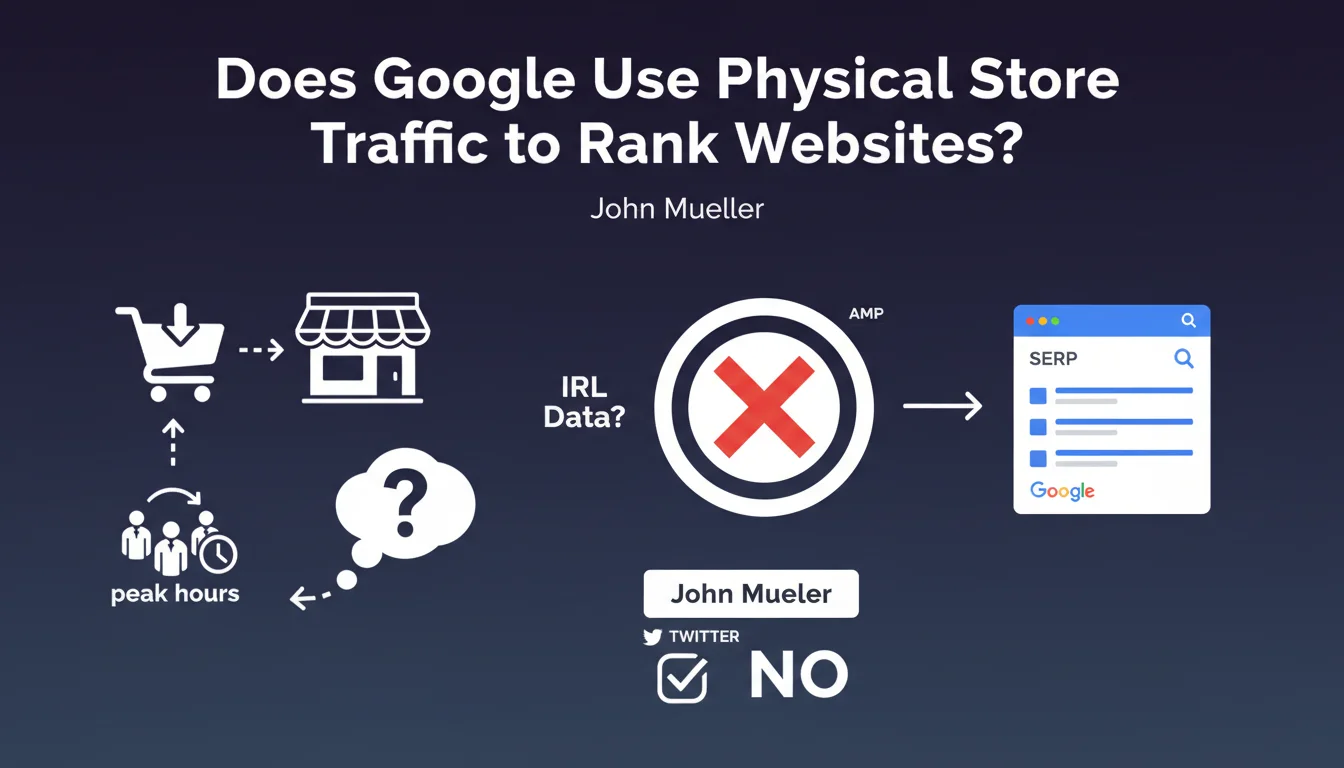
Official statement
What you need to understand
This statement from John Mueller clarifies an important question: Google does not take into account physical foot traffic data from businesses to determine their ranking in search results. Even though Google has information about an establishment's peak hours (displayed in the Knowledge Graph), this data is not used as a ranking signal.
The initial idea was appealing: a restaurant packed at lunchtime could see its site better positioned at that precise moment. But Google considers that online and offline behaviors are not reliably correlated. A store with high physical traffic doesn't necessarily offer a quality web experience.
This clarification reminds us that Google evaluates websites based on purely digital criteria: content quality, user experience, E-E-A-T signals, technical performance, and online behavioral signals.
- Physical foot traffic does not influence organic ranking
- Knowledge Graph data is separate from the ranking algorithm
- Only web signals are taken into account for SEO
- Local relevance remains based on criteria like Google Business Profile and reviews
SEO Expert opinion
This position from Google is consistent with the philosophy of ecosystem separation that I've observed for years. The search engine evaluates the quality of a web presence, not the popularity of a physical establishment. Moreover, we regularly see that highly frequented businesses have poorly ranked sites, and vice versa.
However, there is an important indirect correlation not to be overlooked. A popular business naturally generates more Google reviews, more mentions on other sites, more brand searches. These signals do indeed impact local SEO and organic visibility. Physical foot traffic is not a direct signal, but it creates measurable digital signals.
Practical impact and recommendations
Following this clarification, here are the concrete actions to prioritize for your SEO strategy:
- Focus your efforts on optimizing your Google Business Profile rather than relying on your physical foot traffic
- Develop an active strategy for collecting online customer reviews, which remains a major ranking signal
- Never neglect the quality of your website even if your physical establishment is very busy
- Create quality web content that reflects your expertise, independent of your offline success
- Work on your E-E-A-T signals (experience, expertise, authority, trustworthiness) on the web
- Encourage your satisfied customers to share their experience online (social media, blogs, forums)
- Optimize your site's technical performance: speed, mobile, Core Web Vitals
- Avoid basing your SEO strategy solely on your local physical reputation
💬 Comments (0)
Be the first to comment.