
Official statement
Other statements from this video 2 ▾
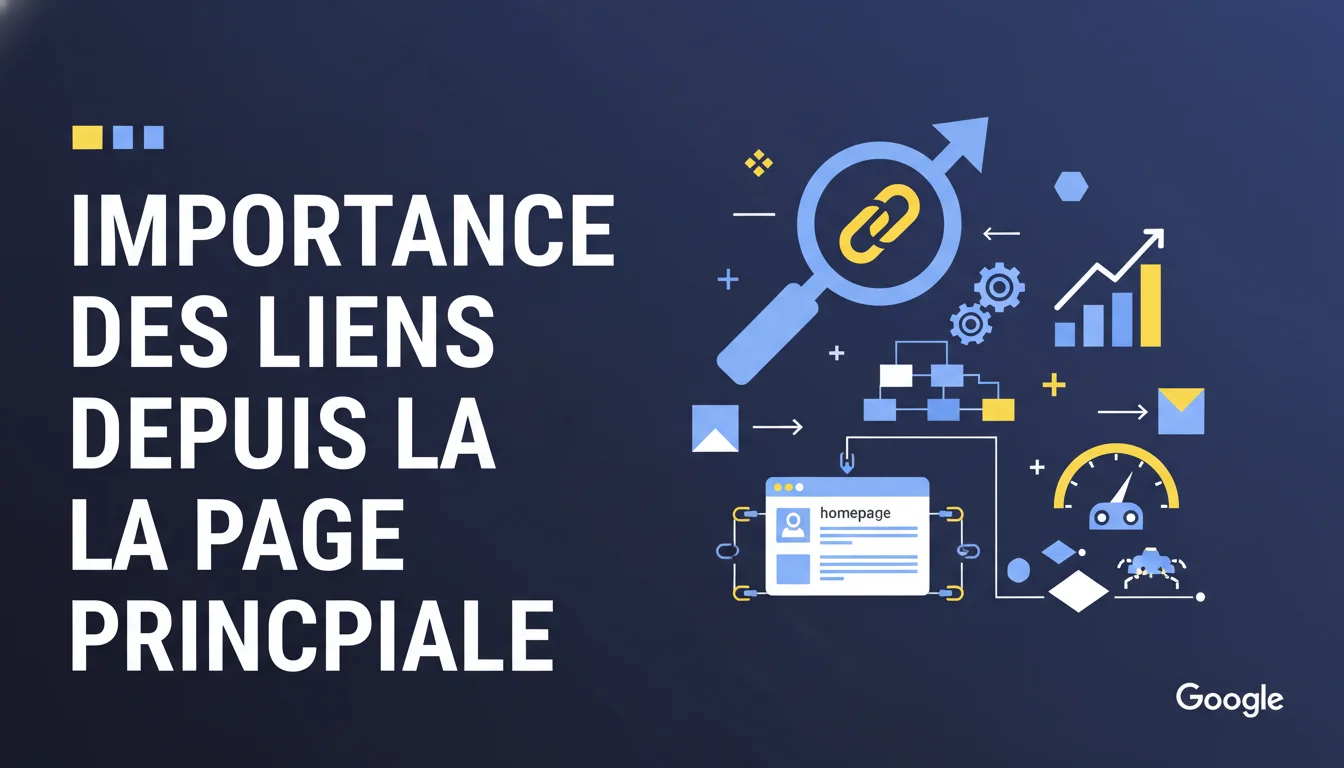
Google recommends creating direct links from the homepage to strategic internal pages to facilitate their crawling and indexing. This practice is based on the principle that the authority of the homepage is transferred more effectively to the pages it directly links to. For SEO, this means rethinking the site's architecture based on business priorities, not just classic UX logic.
What you need to understand
Why does Google emphasize links from the homepage?
The homepage typically concentrates the most external backlinks, giving it superior authority (internal PageRank) compared to other pages on the site. When it directly links to an internal page, it passes on some of that authority through internal linking.
This transmission facilitates two things: first, crawling – Googlebot discovers and explores linked pages from the homepage more quickly. Secondly, indexing – pages that receive SEO juice from the root are perceived as more important by the algorithm.
What qualifies as a "deep" page in this context?
A deep page is located several clicks away from the homepage. For example, a product page only accessible via Home > Category > Subcategory > Product is four clicks deep.
The more clicks there are, the less crawl budget is available for that page. Google prioritizes easily accessible pages, those that require fewer resources to be explored. As a result, a page six clicks deep may take weeks to be indexed or may not be indexed at all if the site is large.
How does this differ from classic UX recommendations?
UX designers often prefer a streamlined navigation with few links on the homepage to avoid overwhelming the user. However, what works for humans does not necessarily work for the indexing bot.
A site can very well offer a clear navigation for the user while maintaining invisible direct links (for instance in a structured footer or through editorialized content blocks) to strategic pages. The goal is not to turn the homepage into a directory, but to create discreet and effective pathways.
- The homepage holds the highest authority in the site due to the external backlinks it receives.
- Direct links from the homepage speed up the crawling and indexing of internal pages.
- A deep page (located four or more clicks away) risks being under-explored or ignored by Googlebot.
- UX and SEO are not always aligned: a minimalist menu can hinder the discoverability of strategic content.
- Internal PageRank flows better from the root to the critical nodes of the site.
SEO Expert opinion
Is this recommendation really applicable to all sites?
No. On a e-commerce site with 50,000 products, it is materially impossible to link all strategic products from the homepage without turning it into an unusable bazaar. This guideline mainly applies to medium-sized sites (a few hundred to a few thousand pages) where editorial priorities are clear.
For large sites, the strategy is to link from the homepage to the main category pages, and then optimize the internal linking between those categories and subpages. Google does not say "link everything", it says "link directly what matters". A crucial nuance. [To be confirmed]: Google never specifies how many direct links are optimal, or at what threshold the transmitted authority is diluted.
What do we really observe on the ground?
Crawl log audits consistently show that pages linked from the homepage are crawled 3 to 10 times more often than those buried deeper. This observation has been documented for years, nothing new.
What is less obvious is the real impact on ranking. A page linked from the homepage will not rank better if its content is mediocre or if it has no thematic relevance. The link facilitates exploration, not positioning. Confusing the two is a common mistake among juniors.
What mistakes should absolutely be avoided?
The first mistake: saturating the homepage with irrelevant links. If you add 50 links to secondary pages just to "help Google", you dilute the PageRank transmitted to each target. Result: you don’t help anyone.
The second mistake: neglecting semantic context. A link from the homepage to a product page must be surrounded by coherent content; otherwise, Google will perceive it as an artificial or decorative link. Placement is as important as the existence of the link.
Practical impact and recommendations
Which pages should be prioritized for linking from the homepage?
Identify the pages that generate the most conversions or potential organic traffic but are currently poorly positioned or under-explored. Typically: premium service pages, strategic landing pages, pillar content (pillar pages), high-margin product categories.
Use your Search Console data to spot pages that receive impressions but few clicks, or those that have good semantic potential but stagnate on pages 2-3. These are your ideal candidates for a boost via the homepage.
How can you integrate these links without degrading UX?
Several options are available. An editorialized block like "Our Expertise" or "Featured" can insert 4-6 contextualized links without cluttering the main navigation. A structured footer can accommodate links to strategic sections, provided it remains readable and non-spammy.
You can also use rotating blocks or conditional highlighting modules (displayed based on user profile). The idea is to maintain a smooth experience for humans while creating direct pathways for the bot. The two do not exclude each other.
How can you check if the strategy works?
Three indicators to closely monitor. First, the crawl frequency of the targeted pages via Google Search Console or your server logs. If they go from 1 crawl per month to 1 crawl per week, that’s positive.
Next, the indexing delay: how long does it take Google to index a new page or take a change into account? Finally, watch the organic positions in the medium term (3-6 months). If boosted pages rise, you validate the approach. Otherwise, the issue lies elsewhere (content, backlinks, competition).
- Audit your crawl logs to identify strategically under-explored pages.
- Create direct links from the homepage to a maximum of 5-10 priority pages.
- Contextualize these links within editorial blocks or thematic sections.
- Avoid overloading: prioritize quality (relevance) over quantity.
- Monitor crawl frequency and indexing delays via Search Console.
- Measure the impact on organic positions after 3-6 months.
❓ Frequently Asked Questions
Combien de liens depuis la homepage est-il raisonnable d'ajouter ?
Est-ce que les liens en footer comptent autant que ceux dans le contenu principal ?
Faut-il utiliser des ancres optimisées pour ces liens internes ?
Cette stratégie fonctionne-t-elle aussi pour les sites à forte saisonnalité ?
Que faire si ma homepage est déjà saturée de liens ?
🎥 From the same video 2
Other SEO insights extracted from this same Google Search Central video · duration 1 min · published on 02/06/2009
🎥 Watch the full video on YouTube →
💬 Comments (0)
Be the first to comment.