
Official statement
Other statements from this video 4 ▾
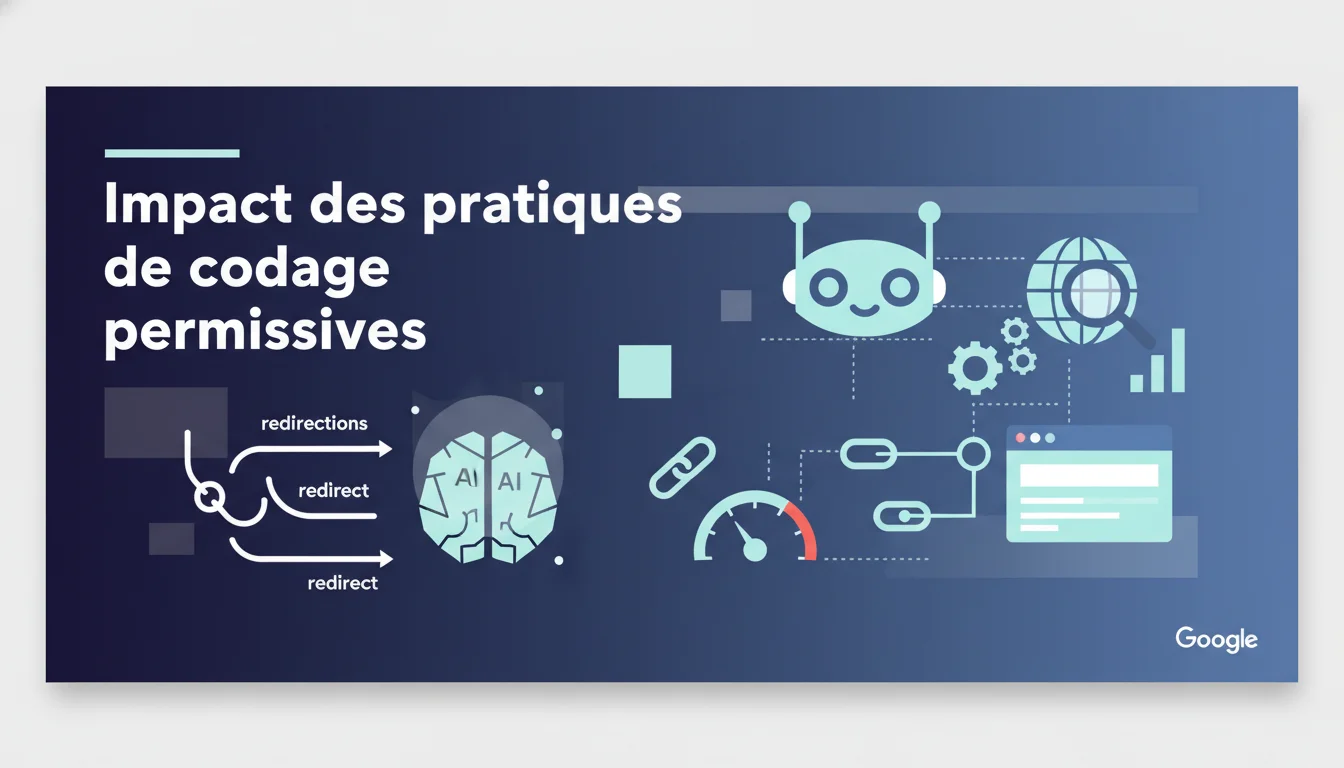
Google confirms that permissive coding practices create exploitable vulnerabilities for cybercriminals without direct server access. For SEO, this means open redirects and SQL injections can turn your site into a spam vector, impacting rankings and trust. Securing your code is no longer optional; it's a fundamental building block of your visibility strategy.
What you need to understand
Why does Google link code security to SEO?
Google's position is clear: a vulnerable site becomes a target for automated attacks. Open redirects allow hackers to inject malicious URLs that redirect your visitors to phishing schemes or spam sites. The engine detects these anomalies and can quickly downgrade your domain.
SQL injections, on the other hand, open the door to direct manipulation of your database. An attacker can insert thousands of spam pages, modify your existing content, or steal sensitive data. Google scans for these infection signals and penalizes.
What are the concrete exploitation mechanisms?
An open redirect occurs when your code accepts any URL parameter without validation. A typical example is: yoursite.com/redirect?url=https://phishingsite.com. The cybercriminal shares this link using your domain authority to deceive users and search engines.
The SQL injection exploits poorly protected forms or URL parameters. Instead of entering a name, the attacker injects SQL code that executes on your server. The result: creation of invisible satellite pages, modification of titles, insertion of toxic outbound backlinks. Your site becomes an unintentional PBN.
How tolerant is Google of these vulnerabilities?
Google makes no distinction between intentional compromise and technical negligence. If your site distributes malicious content or participates in spam networks, penalties will be imposed. The Search Console will display security warnings, and browsers will block access to your pages.
The response time varies based on the severity. A massive site with hundreds of generated spam pages can be partially deindexed within 48-72 hours. Recovery after cleanup often takes weeks, or even months, if trust is significantly damaged.
- Open redirects: always validate and whitelist allowed destinations.
- SQL injections: use prepared statements and escape all user inputs.
- Active monitoring: check Search Console for abnormal indexing spikes or security alerts.
- Regular audits: scan code with SAST (Static Application Security Testing) tools.
- Update dependencies: CMS, plugins, and frameworks must be kept up to date to patch known CVEs.
SEO Expert opinion
Is this statement consistent with field observations?
Absolutely. SEO teams regularly encounter cases where a clean site turns into a compromised one in just days after an injection attack. The signals can sometimes be subtle: a sudden increase in indexed pages, spam queries in Search Console, or a drastic drop in historical keywords.
What strikes is the speed of Google's action once the infection is detected. Malware detection algorithms have become extremely responsive. A site can lose 60-80% of its visibility within days if the attack generates content at scale.
What nuances should be added?
Google remains vague on one point: the distinction between passive vulnerability and active exploitation. Having a flaw in your code does not automatically trigger a penalty as long as it is not exploited. The problem is that you never know when a malicious bot will discover it.
Another gray area is recovery timelines. Google claims that cleaning the site and submitting a reconsideration request is enough. In reality, full traffic restoration often takes 4 to 8 weeks even after cleaning validation. [To be verified] if hidden factors (trust history, residual toxic backlinks) extend this period.
In what cases does this rule not apply?
Statically generated sites (JAMstack, Gatsby, Hugo) are structurally immune to SQL injections since there's no dynamic database. Open redirects are still possible if routing is misconfigured, but the risk is drastically reduced.
Highly isolated environments (SaaS with strict isolation, CDN with integrated WAF) also limit the impact. However, never underestimate: an outdated WordPress plugin can create a vulnerability even behind a WAF if the rules are not updated.
Practical impact and recommendations
What concrete steps should be taken to secure your code?
First priority: audit all user entry points. Forms, URL parameters, cookies, HTTP headers—every input should be validated, escaped, and sanitized. Modern frameworks (Laravel, Django, Rails) incorporate these protections natively if you use their ORM methods.
For redirects, implement a strict whitelist. If your code accepts a redirect parameter, verify that it belongs to your domain or an explicitly allowed list of destinations. Reject everything else with a status code 400.
What mistakes should absolutely be avoided?
Never concatenate user variables directly into SQL queries. This opens the door to injections. Always use prepared statements with bound parameters, even for "simple" queries or one-off scripts.
Another classic pitfall: relying solely on client-side validations (JavaScript). A skilled attacker can bypass these controls in seconds using tools like Burp Suite. Server-side validation is non-negotiable.
How can I check if my site is compliant and secure?
Set up proactive Search Console monitoring. Configure alerts for abnormal indexing spikes, massive new 404 errors, and especially security warnings. Google often sends these notifications before the SEO impact is visible.
On the technical side, conduct regular scans using tools like OWASP ZAP, Acunetix, or Detectify. A quarterly audit is not an extravagance, especially if you manage a WordPress site with third-party plugins. CVEs are released every week.
- Implement prepared statements (PDO, ORM) for all database interactions.
- Validate and whitelist all redirects with verification of the destination domain.
- Enable detailed logs on suspicious access attempts (rate limiting, IP blocking).
- Keep CMS, plugins, and frameworks up to date with an automated patch process.
- Install a WAF (Web Application Firewall) with OWASP Top 10 rules activated.
- Set up Search Console alerts for security, abnormal indexing, and critical errors.
❓ Frequently Asked Questions
Une redirection ouverte peut-elle vraiment impacter mon SEO même si je ne m'en sers pas ?
Comment savoir si mon site a été compromis par une injection SQL ?
Les plugins WordPress sont-ils vraiment un risque majeur pour les injections SQL ?
Combien de temps faut-il pour récupérer d'une pénalité liée à une compromission ?
Un WAF suffit-il à se protéger contre toutes les injections SQL et redirections ouvertes ?
🎥 From the same video 4
Other SEO insights extracted from this same Google Search Central video · duration 8 min · published on 12/03/2013
🎥 Watch the full video on YouTube →
💬 Comments (0)
Be the first to comment.