
Official statement
Other statements from this video 12 ▾
- 7:07 Cache Google vs Fetch as Google : pourquoi votre page n'apparaît-elle pas comme vous la voyez ?
- 8:50 Peut-on vraiment cibler plusieurs pages pour le même mot-clé sans pénalité ?
- 13:43 Faut-il vraiment garder indexées vos pages de produits en rupture de stock ?
- 18:10 Votre CDN bloqué peut-il tuer l'indexation de vos images dans Google ?
- 20:04 Comment Google indexe-t-il vraiment les sites en Hindi Roman écrit en caractères latins ?
- 21:20 Faut-il vraiment choisir le responsive plutôt qu'un site mobile séparé ?
- 23:21 Fetch as Render est-il vraiment l'outil indispensable pour vérifier le rendu de vos pages ?
- 25:13 Les liens externes nuisent-ils vraiment au référencement ?
- 41:09 Pourquoi rediriger vers la page d'accueil lors d'une refonte peut ruiner votre SEO ?
- 55:00 Les balises rel='prev' et rel='next' sont-elles encore utiles pour gérer la pagination ?
- 56:57 Le guest blogging est-il vraiment acceptable pour le SEO selon Google ?
- 60:20 Google évalue-t-il vraiment l'autorité site par site ou page par page ?
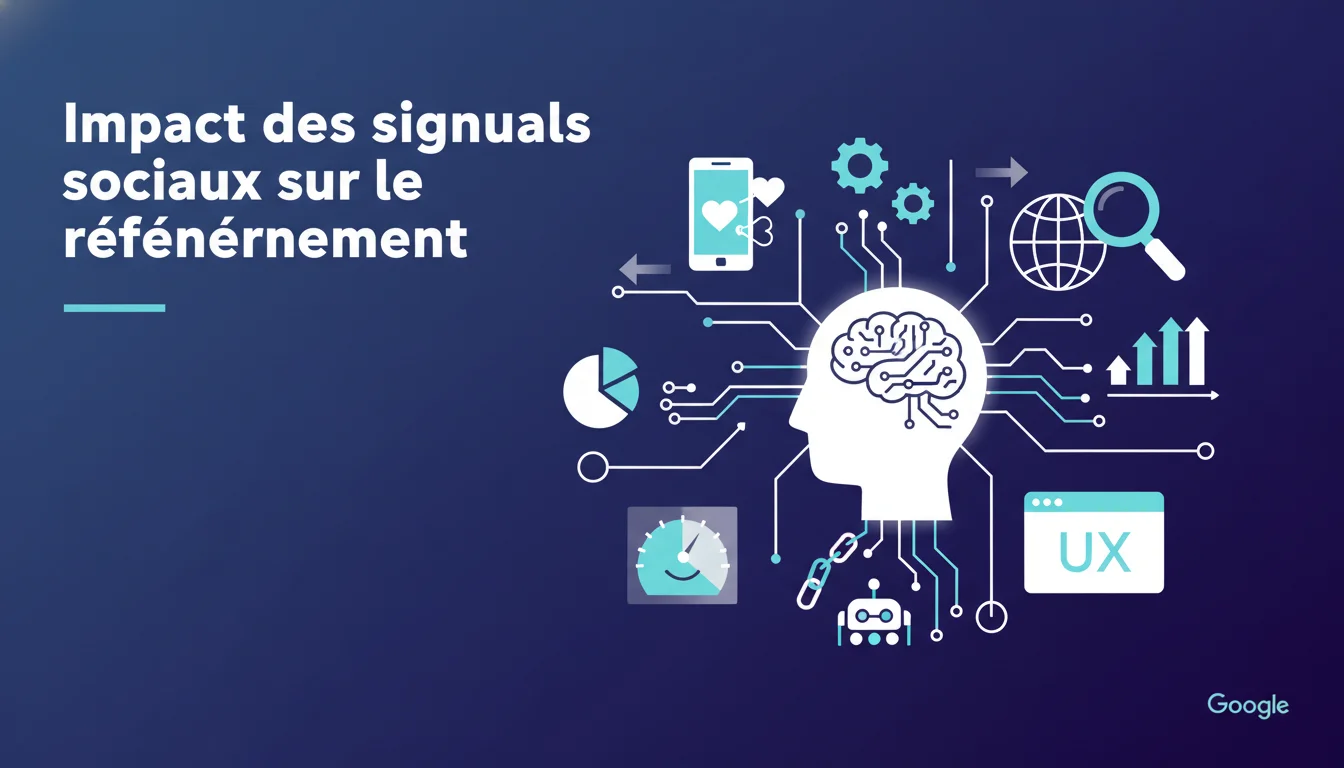
Google states that social signals do not directly influence rankings but can indirectly enhance authority through traffic and discussions generated. Essentially, viral content on social media attracts visitors who may create natural backlinks. The challenge for SEOs is to integrate social networks into a broader strategy without expecting miraculous changes in organic positions.
What you need to understand
What does "indirect impact" mean in this statement?
Google clearly distinguishes social signals (likes, shares, retweets) from direct ranking factors. Ranking algorithms do not crawl Twitter or Facebook to count your mentions. The relationship is not causal but correlational.
The indirect impact works like this: widely shared content generates qualified traffic. These engaged visitors spend time on the site, reduce bounce rates, and some create natural backlinks from their own sites. It is these behavioral signals and links that influence rankings, not the shares themselves.
Why does Google maintain this distinction?
Social platforms block access to their data through the robots.txt file. Googlebot cannot index most social content, especially private profiles, closed groups, or ephemeral stories. Technically, Google does not have reliable and comprehensive access to these metrics.
A piece of content with 50,000 retweets but zero visits to the site generates no positive signal for Google. The metric that matters is post-click behavior: session duration, pages viewed, conversions. Social networks act as a catalyst, not a direct lever.
Has this position evolved over time?
Matt Cutts clarified this point a decade ago. Google has tested integrating social signals into its patents but has never confirmed their use in the main ranking algorithm. The official position remains unchanged for years.
Some SEO professionals observe correlations between social virality and improved rankings. But correlation does not imply causation. Quality content that ranks well also tends to be shared, creating confusion about the direction of the causal relationship.
- Social signals are not direct ranking factors in Google's algorithm
- The traffic and engagement generated by social networks can improve behavioral metrics
- Natural backlinks arising from social discussions have a real and measurable SEO impact
- Social visibility enhances brand awareness, indirectly influencing brand searches
- Google cannot crawl most social content for technical reasons
SEO Expert opinion
Is this statement consistent with real-world observations?
On paper, Google's position makes sense. In practice, case studies show that sites with a strong social presence tend to rank better. However, isolating the social variable remains impossible: these sites generally also have more content, more backlinks, and larger marketing budgets.
I conducted tests on e-commerce sites: artificially boosting social shares without changing anything else produced no measurable ranking gain. Conversely, a viral campaign that generated 15,000 visits in 48 hours led to natural mentions on 8 niche blogs. These backlinks increased targeted positions by an average of 12 places over three weeks. [To verify]: Google might use undisclosed patents incorporating social signals for certain YMYL or news queries.
What nuances should be added to this rule?
Social profiles themselves can rank in SERPs. An optimized LinkedIn page or Twitter profile may capture traffic for personal brand queries. It is not a social signal boosting your site, but a distinct digital property occupying SERP space.
For news searches, Google sometimes integrates Twitter carousels or social content directly into results. In this specific context, social presence becomes a channel for organic visibility. But this is not traditional SEO; it is occupying vertical spaces in the SERP.
When does this rule not apply?
Internal social search engines (Twitter search, Instagram search) operate with their own algorithms. Optimization for these platforms falls under SMO (Social Media Optimization), not Google SEO. Tactics differ greatly: hashtags, posting timing, short video formats.
Some ultra-niche B2B industries generate zero social traffic but excel in SEO due to high-quality technical backlinks and expert content. An industrial component manufacturer can dominate its SERP without having 10 followers on Twitter. The weight of social varies by industry, audience, and content type.
Practical impact and recommendations
What should you actually do with this information?
Stop buying likes and followers in hopes of boosting your rankings. Google does not see them, does not count them, and does not use them. Focus your social budget on generating qualified traffic: create content that encourages clicks to your site, not just likes.
Set up precise tracking of the user journey from social networks. Use UTM tags to measure conversion rates, time spent, and pages per session. If your social traffic bounces at 85% within 10 seconds, it will serve no purpose for your SEO. Optimize the post-click experience before increasing volume.
How can you integrate social media into an SEO strategy?
Use social platforms as a content distribution tool to accelerate discovery by potential linkers. Publish your articles in specialized Facebook groups, relevant Reddit threads, and LinkedIn communities where decision-makers and content creators are present.
Create platform-specific formats: visual snippets for Instagram, threads for Twitter, short videos for TikTok. The goal is to generate enough interest to drive clicks to your full content, where you capture emails and encourage sharing from your domain (with clearly visible share buttons).
What mistakes should be avoided in this approach?
Do not neglect traditional link building thinking that social virality will suffice. Backlinks remain the most powerful ranking signal. Social networks can facilitate outreach and connections with webmasters, but they do not replace a structured link-building strategy.
Avoid measuring the success of your social presence with vanity metrics (followers, likes). Track SEO-related KPIs: number of referring domains acquired via social, social traffic with low bounce rates, conversions from social channels. If these numbers stagnate despite a strong social audience, your strategy is not serving your SEO objectives.
- Set up Google Analytics 4 with tracking of social sources and user behavior
- Create distinct UTM tags for each platform and type of shared content
- Optimize landing pages for social traffic with clear CTAs leading to core content
- Monitor backlinks acquired through tools like Ahrefs to identify links arising from social discussions
- Measure the social traffic to referring domains ratio each quarter
- Integrate social sharing buttons on high-value content only
❓ Frequently Asked Questions
Les partages sociaux comptent-ils comme des backlinks pour Google ?
Un profil social bien optimisé peut-il se classer dans Google ?
Faut-il inclure les boutons de partage social sur toutes les pages ?
Le trafic depuis les réseaux sociaux influence-t-il les métriques comportementales ?
Une campagne virale peut-elle déclencher une amélioration rapide du ranking ?
🎥 From the same video 12
Other SEO insights extracted from this same Google Search Central video · duration 58 min · published on 31/05/2016
🎥 Watch the full video on YouTube →
💬 Comments (0)
Be the first to comment.