
Official statement
What you need to understand
Why does the question of redirect type arise during HTTPS migration?
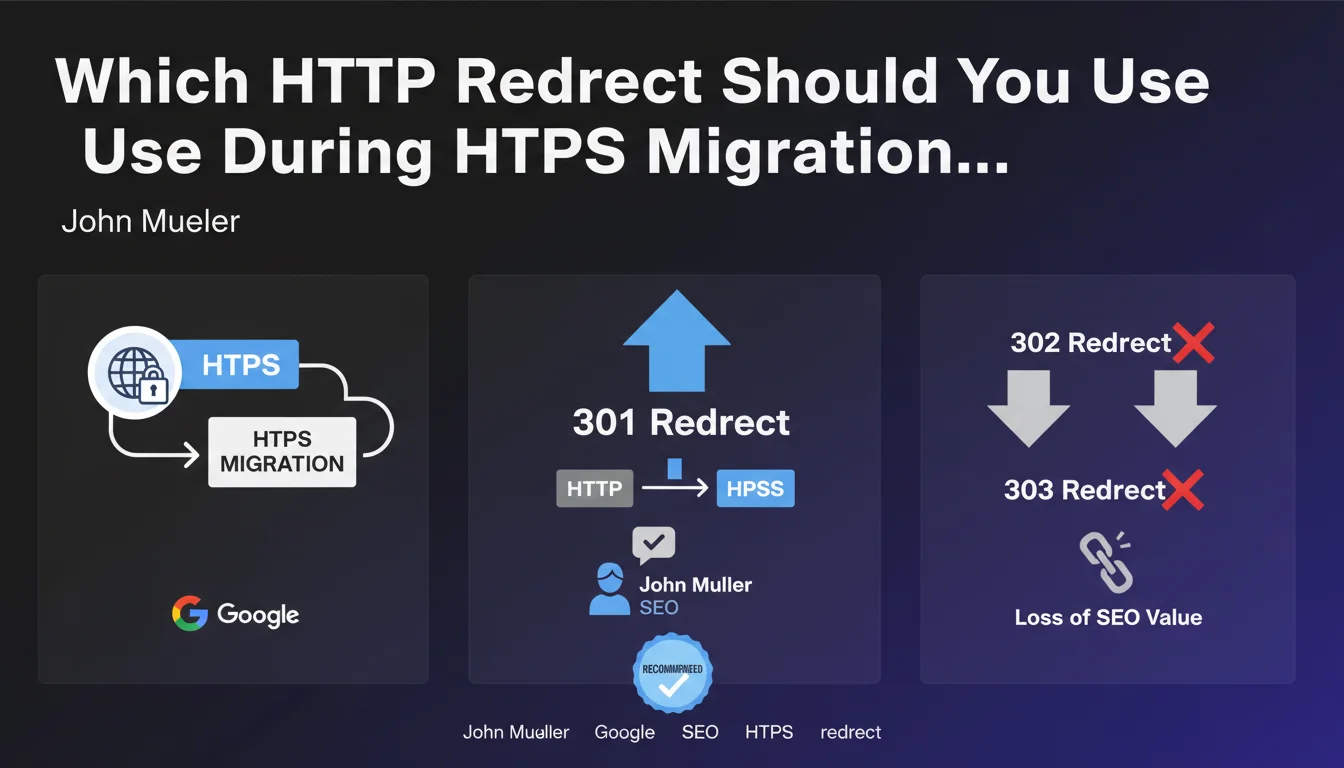
When migrating a site from HTTP to HTTPS, each old URL must redirect to its new secure version. The choice of HTTP status code is not trivial: it determines how Google will interpret this migration.
Some developers use temporary redirects (302, 303 or 307) as a precaution, thinking they can roll back. Others opt directly for the permanent 301 redirect, recommended by Google.
What's the difference between a 301 redirect and other status codes?
A 301 redirect indicates to search engines that the move is permanent. It transfers the majority of PageRank and SEO signals to the new HTTPS URL.
302, 303 and 307 redirects are temporary redirects. Google may then keep the old HTTP URL in its index longer, delay the transfer of SEO juice, and create duplicate content problems.
What common technical mistake complicates these migrations?
Contrary to the 302 or 303 mentioned in the initial question, it's mainly the 307 redirect that appears frequently during HTTPS migrations. It is often implemented by default in certain server configurations.
This 307 redirect is temporary and preserves the HTTP method, which can create confusion in Google's processing and significantly slow down the migration.
- 301: permanent redirect, optimal SEO transfer (recommended)
- 302/303/307: temporary redirects, incomplete or delayed SEO transfer
- The 307 is the most common error in practice during HTTPS migrations
- Only the 301 guarantees a complete and rapid transfer of SEO signals
SEO Expert opinion
Is this Google recommendation consistent with field observations?
After 15 years of experience with hundreds of migrations, I confirm that the 301 redirect is absolutely essential. Sites using temporary redirects systematically experience prolonged traffic losses of 3 to 6 months.
The observation concerning 307 redirects is particularly relevant. Many poorly configured Nginx or Apache servers automatically implement 307 redirects when setting up HTTPS, creating problems invisible to non-specialists.
In what cases could we consider a different approach?
There are very specific situations where a temporary redirect might seem justified: A/B testing, progressive migration by sections, or prior technical validation. Yet, even in these cases, I advise against this approach.
The best practice is to test HTTPS migration in a development environment, then deploy directly with 301s. The risk of wanting to "roll back" is virtually nil, and the SEO cost of a temporary redirect is too high.
What technical nuances are often overlooked?
Beyond the status code, the redirect chain is crucial. Some sites inadvertently create multiple redirects (HTTP → HTTPS → WWW → final version), diluting the PageRank transfer at each step.
Crawl speed is also impacted: Google crawls a site with temporary redirects more slowly, delaying the full consideration of the new HTTPS version.
Practical impact and recommendations
How can I check what type of redirect is currently in place on my site?
Use tools like Screaming Frog, curl command line, or browser extensions to check status codes. Test several representative URLs from your site.
Particularly check server-level redirects (.htaccess file for Apache, Nginx configuration) and make sure they return a 301 code and not 307.
- Audit all HTTP to HTTPS redirects with a professional crawler
- Verify the status code: only 301 is acceptable for a migration
- Eliminate multiple redirect chains (maximum 1 redirect per URL)
- Test redirects for URLs with and without www, with trailing slash and without
- Configure HSTS (HTTP Strict Transport Security) after validating the 301s
- Update Search Console with the new HTTPS property
- Submit a new XML sitemap with HTTPS URLs
- Check for absence of mixed content (HTTP resources in HTTPS pages)
- Monitor crawl and indexing evolution for at least 3 months
What critical mistakes must absolutely be avoided?
The most common error is to leave default 307 redirects without checking them. The second is to create redirects in JavaScript or via meta refresh, which don't correctly transmit SEO value.
Never redirect all HTTP URLs to the HTTPS homepage alone. Each URL must redirect to its exact HTTPS equivalent, preserving the structure and parameters.
What should I do if temporary redirects have already been implemented?
Correct immediately to 301 redirects. Even if weeks have passed, the change will allow Google to consolidate signals and accelerate the migration.
Then submit a new crawl request via Search Console to force Google to recrawl the corrected URLs quickly. Monitor the evolution of impressions and traffic in the following weeks.
In summary: HTTPS migration requires permanent 301 redirects, never 302, 303 or 307. Systematically check your server configurations because temporary 307 redirects are often implemented by default.
This technical verification may seem simple, but it requires deep expertise in server configurations and a fine understanding of Google's crawl mechanisms. The stakes are considerable: a poorly executed migration can lead to lasting traffic losses that are difficult to recover. To secure this critical step and benefit from personalized support adapted to your infrastructure, the intervention of an SEO agency specialized in technical migrations can prove decisive in preserving your assets and optimizing the transfer of your SEO signals.
💬 Comments (0)
Be the first to comment.