
Official statement
What you need to understand
Why Does a Domain's History Affect Its SEO Performance?
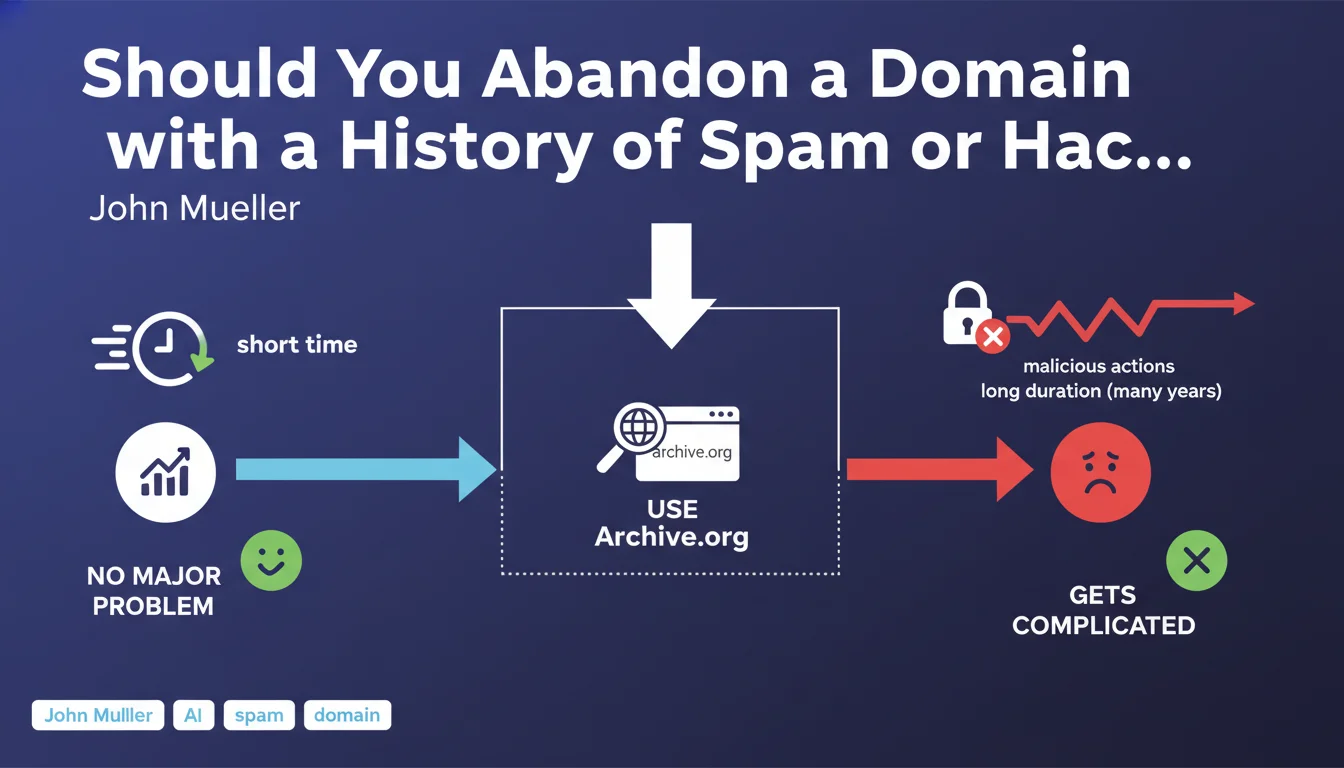
Google retains memory of a domain's past actions, whether positive or negative. When a site has been used for spam, hacking, or malicious practices, these negative signals remain associated with the domain in Google's index.
The duration and intensity of questionable practices determine the severity of the negative footprint. A domain that briefly served suspicious activities can recover naturally over time, while a heavy and prolonged history can permanently compromise its reputation.
How Does Google Handle Domains Based on the Duration of Malicious Practices?
For short-term actions, Google indicates that the problem is generally not major. Time gradually erases these negative traces, and the domain can regain a neutral evaluation after a few months or years.
On the other hand, for prolonged malicious practices (several years of spam or hacking), the situation becomes much more complex. The domain carries a historical burden that can persist for a long time, even after a change of owner and content.
What Method Should You Use to Evaluate a Domain's History?
The Archive.org (Wayback Machine) tool is recommended by Google to analyze what a site offered in the past. This verification helps identify problematic periods and assess the severity of the negative history.
This historical analysis is crucial before purchasing an expired domain or taking over an existing site. It allows you to anticipate potential SEO difficulties.
- Short-term spam or hacking actions naturally fade over time
- A malicious history of several years may require abandoning the domain
- Archive.org is the recommended tool for analyzing a domain's past
- Google does not offer an official "reset" function for an infected domain
- Changing domains sometimes remains the only viable solution
SEO Expert opinion
Is Google's Position Consistent with Real-World Observations?
My 15 years of experience completely confirms this statement. I've observed numerous cases where domains with a moderate spam history were able to recover in 6 to 18 months after a complete cleanup and publication of legitimate content.
Conversely, certain domains that hosted spam site networks or pirated content for years remain penalized even after 3-4 years of healthy practices. The weight of history is proportional to its duration and intensity.
What Important Nuances Should Be Added to This Statement?
The notion of "short duration" remains vague. In practice, we observe that less than 6 months of suspicious activities generally resolves well, while beyond 2 years, the chances of recovery decrease significantly.
Another determining factor is the exact nature of the practices. A site temporarily hacked by a third party recovers more easily than a domain intentionally used for mass spam or phishing.
In Which Cases Can a Domain with Negative History Be Saved?
A domain remains recoverable if the negative history is recent and limited, if the domain otherwise possesses strong positive signals (age, previous quality backlinks), and if you can invest in a rehabilitation strategy over 12-24 months.
Changing domains becomes inevitable when the negative history is massive and prolonged, when the domain has been listed in durable blacklists, or when the cost of rehabilitation exceeds that of a fresh start with a clean domain.
Practical impact and recommendations
How Can You Verify a Domain's History Before Acquisition?
Systematically use Archive.org to visualize previous versions of the site over at least the last 5 years. Examine the nature of the content, the frequency of radical changes, and identify suspicious periods.
Complement this analysis with tools like Ahrefs or Majestic to examine the historical backlink profile. Sudden spikes of low-quality links or spam anchors signal a problematic history.
- Consult Archive.org for a minimum of 5 years of domain history
- Analyze the backlink profile to detect spam patterns
- Check if the domain appears in blacklists (Spamhaus, Google Safe Browsing)
- Examine Search Console if accessible to identify any manual penalties
- Search for the domain on Google to see its current indexation
What Should You Do If You Already Own a Domain with Negative History?
First evaluate the severity and duration of the problematic history. For a recent and limited past, completely clean the site, disavow toxic backlinks, and publish high-quality content for at least 12-18 months.
If the history is heavy (several years), calculate the ROI of rehabilitation versus a domain change. Sometimes, starting fresh on a clean domain with selective redirects is more profitable than attempting to rehabilitate a severely compromised domain.
What Mistakes Should You Absolutely Avoid with a Domain Having a Loaded History?
Never attempt to hide the history by artificially modifying dates or using cloaking techniques. Google maintains its own archives and will detect these manipulations.
Avoid buying expired domains without thorough verification solely for their apparent metrics (DA, TF). A domain with excellent indicators but a spam history can be a costly trap.
- Don't buy an expired domain without a complete audit of its history
- Don't ignore warning signals in Archive.org or SEO tools
- Don't keep an infected domain out of emotional attachment if data shows you need to change
- Don't neglect disavowing toxic backlinks inherited from the past
- Don't hope for a magical Google "reset" that doesn't officially exist
💬 Comments (0)
Be the first to comment.