
Official statement
Other statements from this video 1 ▾
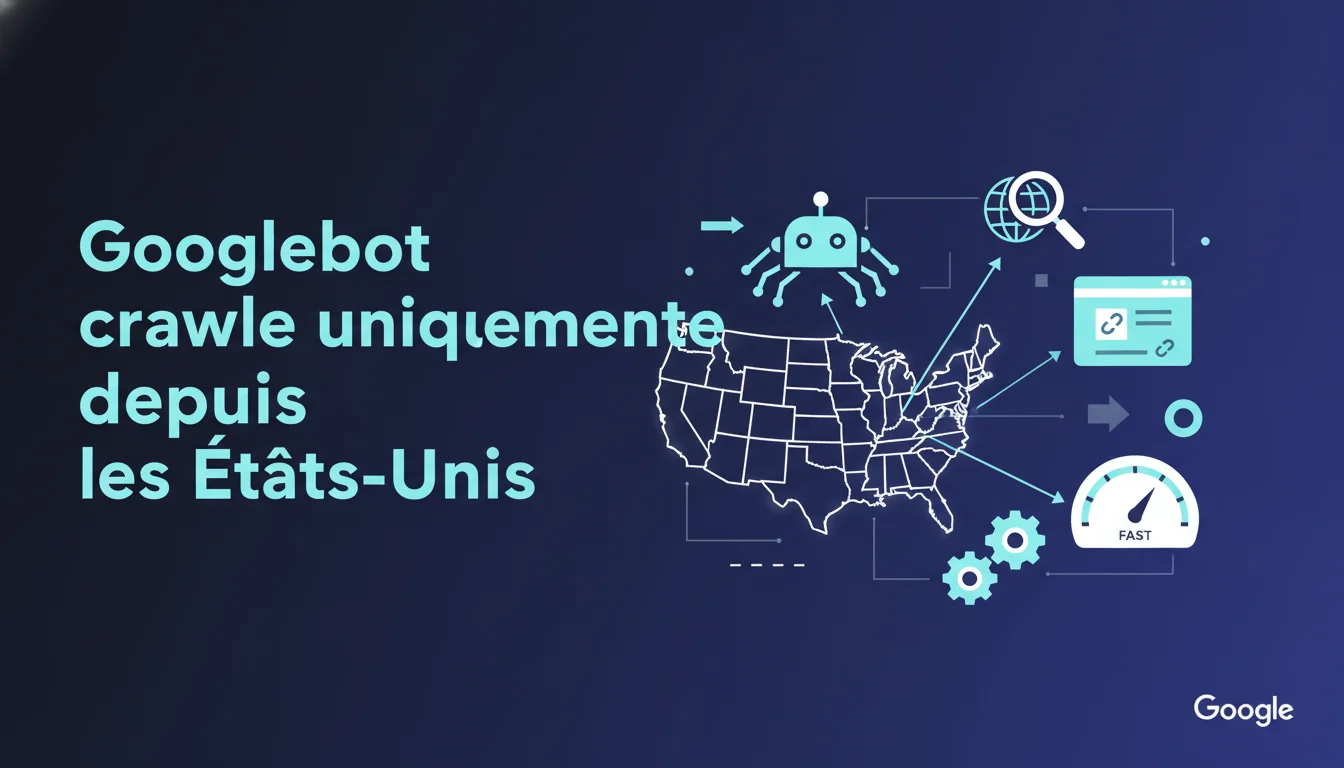
Google claims that Googlebot carries out all of its crawls from American IP addresses. Practically, your site must serve the same content to Googlebot as to a standard visitor based in the United States, without geo-blocking or redirection. This statement raises questions about geolocation, international versions, and crawler detection, with direct implications for multi-region sites and CDN configurations.
What you need to understand
What does it really mean to crawl only from the USA?
Google specifies that all Googlebot requests come from IP addresses located in the United States. This centralized infrastructure means that your server, CDN, or firewall will consistently detect American connections when the bot has access.
This architecture differs from some third-party crawlers that distribute their requests geographically. For Google, the geographic origin of the crawl remains fixed, regardless of your site's local version (google.fr, google.de, google.co.uk).
How does this impact geo-targeted sites?
Many sites adapt their content based on the visitor's IP: automatic redirection to a local version, displaying prices in a specific currency, or outright blocking certain regions. If your site automatically redirects American IPs, Googlebot will experience this redirection.
The major risk is serving Googlebot content that differs from what you provide to your French, German, or Japanese users. This discrepancy creates a mismatch between what Google indexes and what your visitors actually see, potentially affecting local ranking.
What is the difference with Search Console and local versions?
Google crawls from the USA, but it has distinct local engines (google.fr, google.de, etc.). The Search Console allows you to geo-target your site through international settings and hreflang tags.
The American crawl does not prevent Google from understanding that a page is targeting France or Germany. Geo-targeting relies on technical signals (hreflang, ccTLD, GSC parameters) rather than the crawler's IP origin. This distinction is crucial to avoid confusion.
- Googlebot exclusively uses American IPs, regardless of the market targeted by your content
- Geo-blocks and IP redirects directly affect crawling and indexing
- Geo-targeting in the SERPs depends on technical signals (hreflang, ccTLD, GSC), not on the crawling IP
- Consistency between crawled content and content served to users remains critical to avoid penalties
- CDNs and firewalls must allow American IPs from Googlebot without restriction
SEO Expert opinion
Is this geographical centralization consistent with field observations?
On paper, this statement confirms what server logs have shown for years: Googlebot’s IPs indeed resolve to American ranges. Verification tools like reverse DNS consistently point to googlebot.com with US locations.
However, some professionals report crawl behaviors that seem to vary based on local time zones or regional traffic spikes. This perception could be explained by intelligent crawl budget management rather than a real geographic distribution of crawlers. [To be verified]: Google has never publicly documented whether secondary data centers participate in crawls in specific cases.
What nuances should be applied to this statement?
Google speaks of Googlebot, but other Google crawlers exist: Google Inspection Tool (for Search Console), AdsBot, Google-Read-Aloud, etc. This statement does not clarify whether these secondary crawlers follow the same geographic logic.
Furthermore, mobile-first rendering and indexing tests may involve distinct infrastructures. Do the Mobile-Friendly Test and the URL inspection tool strictly use American IPs? The documentation remains vague on these related points.
In what cases does this rule pose a concrete problem?
Sites with strict geographic blocking face the most obvious difficulties. A European site that blocks American IPs for legal reasons (GDPR, content licenses) finds itself in a dilemma: block Googlebot or violate its own constraints.
Another problematic case: e-commerce sites with different catalogs based on regions. If your French store shows products A, B, C to French visitors but Googlebot sees the American catalog with products X, Y, Z, you create a mismatch between indexing and reality. This disconnect directly harms ranking and relevance of results.
Practical impact and recommendations
How can you configure your infrastructure for a US crawl without compromising the local experience?
The standard solution is to detect Googlebot by its user-agent rather than by its IP, then serve it the appropriate content according to your hreflang tags. Your server or CDN should identify the crawler and ignore standard IP geo-targeting rules.
For multi-country sites, implement conditional logic: if user-agent = Googlebot, serve the version defined by the URL (example: /fr/ for France, /de/ for Germany) regardless of the source IP. Never redirect Googlebot based on geography.
What technical errors should absolutely be avoided?
The first common mistake: blocking American IP ranges in the firewall or WAF without explicitly whitelisting Googlebot IPs. Result: your site becomes invisible to Google. Check server logs to confirm that Googlebot accesses without error 403 or 451.
The second mistake: showing different content to Googlebot through unintentional cloaking. If your CDN automatically serves a US version to an American IP while your French users see something else, Google may consider this manipulation. Consistency remains the golden rule.
How to audit and validate your current configuration?
Use the URL inspection tool in Search Console to see exactly what Google crawls and renders. Compare this version with what a local user sees during normal browsing. Any significant differences require correction.
Analyze your raw server logs to identify Googlebot requests and check the returned HTTP codes (200, 301, 302, 403, etc.). An abnormal rate of redirects or errors for Googlebot indicates a geographic configuration problem.
- Explicitly whitelist Googlebot’s IP ranges in your firewall, WAF, and security rules
- Configure your CDN to serve content based on the URL, not on the IP, when the user-agent is Googlebot
- Correctly implement hreflang to signal linguistic and regional versions to Google
- Test with the URL inspection tool and compare with the actual user version
- Analyze server logs monthly to detect any abnormal blocking or redirection of Googlebot
- Avoid any cloaking, even unintentional, between the crawled version and the user version
❓ Frequently Asked Questions
Googlebot crawle-t-il vraiment TOUTES les versions locales depuis les USA uniquement ?
Comment Google indexe-t-il les sites qui bloquent les IPs américaines ?
Un CDN qui sert du contenu différent selon l'IP pose-t-il problème pour Googlebot ?
Les autres crawlers Google (AdsBot, etc.) suivent-ils la même règle ?
Dois-je rediriger Googlebot vers une version spécifique de mon site multi-pays ?
🎥 From the same video 1
Other SEO insights extracted from this same Google Search Central video · duration 2 min · published on 28/02/2011
🎥 Watch the full video on YouTube →
💬 Comments (0)
Be the first to comment.