
Official statement
Other statements from this video 14 ▾
- 8:36 How does Google really index videos from millions of websites?
- 20:32 How does Google really index your online videos?
- 23:50 How does Google truly identify videos on your web pages?
- 34:33 Does Google really analyze the audio and visual content of your videos for SEO?
- 64:18 Why does Google refuse to index your videos if they're not publicly accessible on the web?
- 68:42 What role does immediate visibility of videos play in their indexing?
- 70:29 Is VideoObject markup really enough to get your videos indexed in Google?
- 76:16 How can you leverage structured data to enhance your video’s LIVE badge and key moments?
- 78:24 How can an inaccessible video thumbnail undermine your visibility in search results?
- 84:14 Are video sitemaps really effective for indexing your content?
- 87:54 Is it really necessary to make video files accessible to Google for ranking in rich video searches?
- 93:09 Do animated video previews in Google really replace static thumbnails?
- 97:11 Why does Google emphasize direct access to video files for SEO?
- 98:57 How does Google automatically detect key moments in your SEO videos?
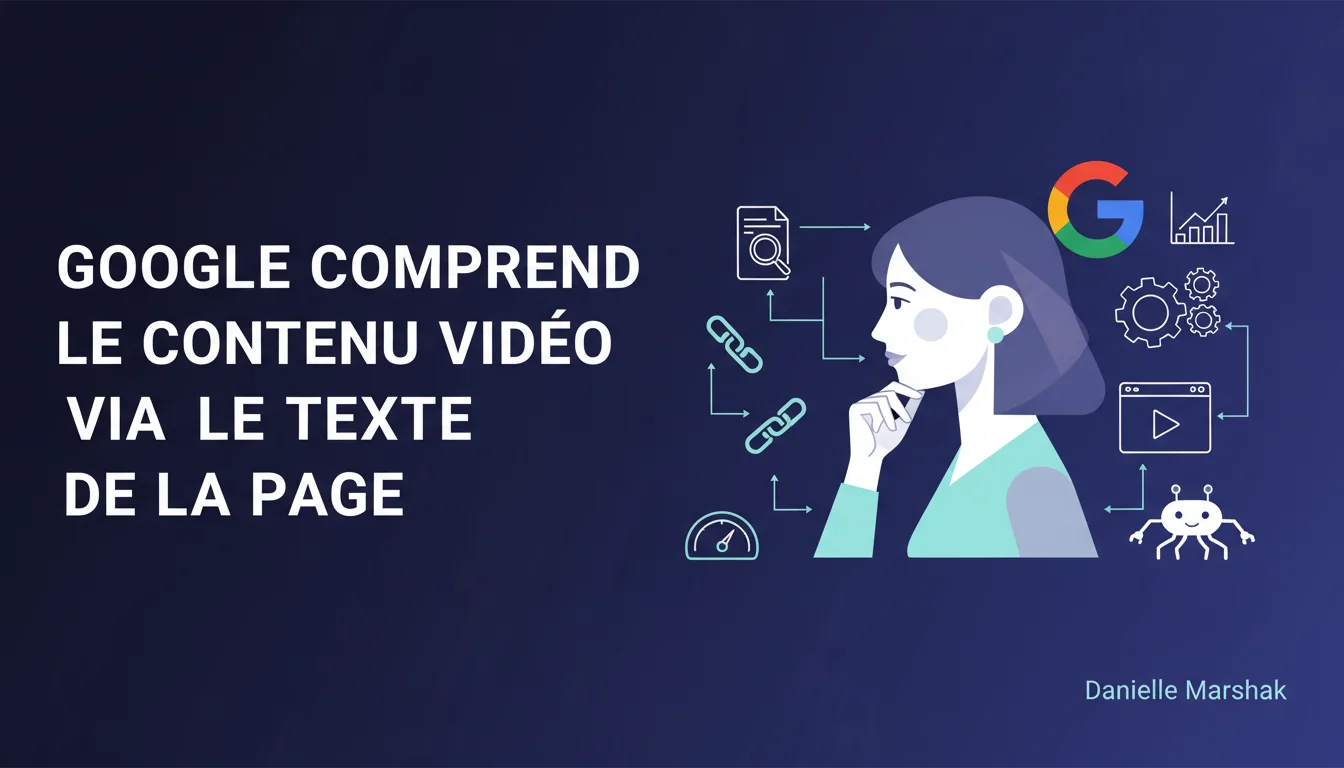
Google claims to understand the topic of a video solely through textual context: page title, headers, captions surrounding the video, or external signals like links. No direct analysis of the video file itself is mentioned. For an SEO practitioner, this means that optimizing a video is about enhancing its textual environment, and neglecting this context renders the video invisible to Google.
What you need to understand
Does Google analyze the video file directly?
No. This statement confirms what many suspected: Google does not "watch" your videos. The engine does not perform frame-by-frame analysis, does not dissect the audio track, nor does it detect objects or faces in the video stream. It relies solely on the visible text on the page hosting the video. What matters is the surrounding textual context: the HTML page title, the <h1>, <h2> tags, the paragraphs around the <video> tag or the YouTube iframe, the captions, and the displayed transcripts. Google reads the page as it would for any text content and infers the topic of the video from these elements. Google also mentions links pointing to the video page. The anchor text, the context of the link (paragraphs before/after), and the theme of the source page—all contribute to the understanding of the topic. This is classic thematic PageRank functionality: external signals reinforce or clarify what Google understood via on-page factors. Essentially, if ten sites specializing in technical SEO link to your video with anchors like "JavaScript crawl," Google deduces that your video is about crawling and JavaScript. Logical, but it also means that a video without textual context or backlinks will remain a black box. The statement does not explicitly say, but the answer is evident: Google will not be able to properly index the topic. A page that contains only an embedded YouTube video without a title, description, or introductory paragraph is a blank page for the engine. At best, Google guesses it's a video, but it won't know what it is about. This poses a real problem for sites that rely on "pure" video content without any textual framing. VOD platforms, minimalist landing pages with just a player—all these configurations start with a structural disadvantage. Text remains the fuel for indexing, even for audiovisual content.What external signals are mentioned?
What happens if there is no text accompanying the video?
SEO Expert opinion
Is this statement consistent with field observations?
Yes, absolutely. For years, it has been observed that well-ranked videos are invariably accompanied by dense text. YouTube pages that rank in the top 3 have optimized titles, lengthy descriptions, tags, and indexable automatic transcripts. Self-hosted videos that perform well always have an accompanying article, FAQ, or summary. What Google doesn't say is that this dependence on text creates a structural bias favoring certain formats. Tech tutorials, educational videos, and product demos thrive because they lend themselves to rich textual descriptions. Artistic videos, short films, and experimental formats—much more complicated. [To be checked]: to what extent does Google use video metadata (duration, resolution, codec) to refine understanding? The statement remains silent on that. Google talks about "understanding the topic," but says nothing about the perceived quality of the video. Understanding that a video deals with "JavaScript crawl" does not mean Google evaluates whether it is relevant, comprehensive, or up-to-date. The engine can well index a mediocre video with solid textual context and ignore an exceptional video without any framing. Another point: the statement does not mention video rich results (carousels, snippets with previews). To be eligible, one needs schema.org VideoObject markup, a public URL for the file, a thumbnail—technical criteria that go beyond simple text. So, "understanding the topic" via text is one thing; being visible in the video features of the SERP is another. Sites with user-generated video content (UGC) get stuck. If creators upload videos without descriptions or with vague titles ("My video 2024"), the hosting site cannot do much. Even with good overall context (site theme, categorization), the lack of local context weakens indexing. Streaming platforms or online training that segment their content into very short video chapters also pose problems. If each 2-minute segment has a dedicated URL but little text, Google struggles to differentiate and prioritize. Video SEO at scale requires solid content engineering—automatic transcripts, summary generation, proper taxonomy.What nuances should be added to this claim?
When does this logic show its limits?
Practical impact and recommendations
What should be done concretely to optimize a video?
First, each video page must contain at least 300-400 words of unique text. An explicit page title (strong <title> tag), a clear <h1>, a 2-3 paragraph introduction summarizing the topic, <h2> subheadings structuring the chapters or themes addressed. Don’t just settle for a player and a Play button. Next, integrate a complete transcript. Not just for accessibility—it's for SEO. Google indexes this text, detecting entities, co-occurrences, and thematic vocabulary. If you have 50 videos and generating manual transcripts is unrealistic, use auto-transcription tools (YouTube, third-party services), then review and correct. A transcript filled with errors or misinterpretations dilutes relevance. Never leave a video orphaned, meaning without internal or external links. If no one points to the page, Google will take weeks to crawl it, and it will not accumulate any relevance signals. Integrate your videos into your internal linking structure: from related articles, from a pillar page, from a video sitemap. Avoid duplicate video content as well. If you publish the same video on YouTube, Vimeo, Dailymotion, and your site, Google will have to choose which version to index. Generally, YouTube wins—which can cannibalize traffic to your domain. If you want to maintain control, self-host it and only publish a clip or teaser on YouTube with a CTA to the full version. Run a search for site:yourdomain.com + video keyword. Do your video pages appear? With a rich video snippet (thumbnail, duration)? If not, check your VideoObject markup in the Search Console, under the "Improvements" section. Google signals errors: missing content URL, invalid thumbnail, description too short. Then, analyze the Search Console queries that trigger the display of your video pages. If you see impressions but few clicks, it may be that the snippet is not explicit enough—rework the title and meta description. If you see no impressions on target queries, it means Google does not understand the topic: enhance the textual context.What mistakes should you absolutely avoid?
How to verify that Google understands your videos correctly?
❓ Frequently Asked Questions
Google peut-il comprendre une vidéo sans aucun texte sur la page ?
Faut-il obligatoirement héberger la vidéo sur son propre domaine pour ranker ?
Les transcriptions automatiques de YouTube suffisent-elles pour le SEO ?
Le balisage schema.org VideoObject est-il indispensable ?
Les backlinks vers une page vidéo ont-ils plus de poids que pour une page classique ?
🎥 From the same video 14
Other SEO insights extracted from this same Google Search Central video · duration 112h10 · published on 17/03/2021
🎥 Watch the full video on YouTube →
💬 Comments (0)
Be the first to comment.