
Official statement
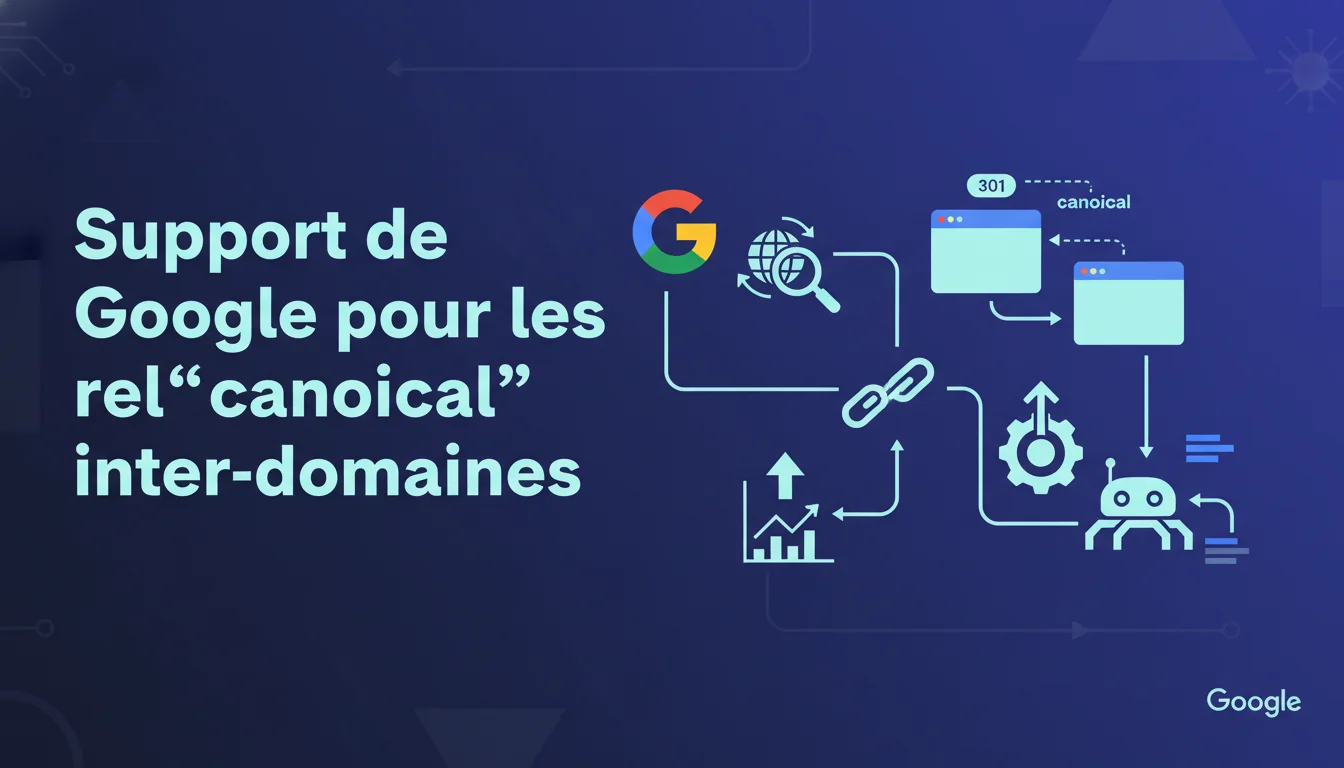
Google recognizes rel=canonical tags between distinct domains and treats them like soft 301 redirects. However, a 301 remains the recommended method as it is universally understood by all search engines. Google reserves the right to ignore these canonicals if it detects manipulation or inconsistency in their usage.
What you need to understand
What does a cross-domain rel=canonical really mean?
A cross-domain canonical tag indicates that a page on domain-a.com is a copy of a page on domain-b.com, and that the latter should be considered the reference version. Unlike a standard canonical that remains on the same domain, this one crosses ownership boundaries.
Google states that it treats these canonicals as logical 301 redirects, without actual server transfer. The content remains accessible on both domains, but the engine chooses which version to index. This approach avoids duplicates when multiple domains legitimately host the same content.
Why does Google say a 301 is still preferable?
The 301 redirect constitutes a universal HTTP standard: all search engines understand and respect it. Bing, Yandex, and Baidu may not have the same flexibility as Google regarding cross-domain canonicals.
A 301 also more directly transfers the history of backlinks and authority. Google promises that the cross-domain canonical works "essentially" like a 301, but this "essentially" hides nuances. The 301 offers a stronger technical guarantee.
In what contexts does this mechanism make sense?
Several scenarios justify the use of a cross-domain canonical rather than an immediate redirect. The gradual domain migrations where the old site must remain accessible temporarily is a classic example.
Content syndication, where a publisher allows the republication of articles on other platforms, also benefits from this mechanism. The partner site then points to the canonical original, avoiding a duplicate content penalty while keeping the content visible. This is also relevant for international domains managing the same content in the same language but with local TLDs.
- Google generally respects these canonicals, but with no absolute guarantee
- A 301 redirect remains the universal method for all engines
- The cross-domain canonical primarily supports gradual migrations and syndications
- Google reserves the right to ignore the signal if it detects manipulative intent
- The tag should point to almost identical or very similar content, not a generic page
SEO Expert opinion
Does this apparent flexibility hide real risks?
Google uses the term "generally" to qualify the respect for these canonicals. This ambiguity is not trivial. In practice, it is observed that Google often ignores cross-domain canonicals when it detects inconsistencies: significantly different content, absence of backlinks to the canonical version, or too divergent authority histories between the two pages.
The mention of "improper action from the webmaster" remains deliberately vague. Essentially, if you use this mechanism to funnel juice from multiple satellite domains to a primary site without real added value, Google may simply ignore the signal. [To be verified]: No public data specifies the actual compliance rate of these canonicals or the exact criteria for invalidation.
Do cross-domain canonicals really transfer as much PageRank as a 301?
Google claims that the mechanism works "essentially" like a 301, without providing further details. Empirical tests show that the authority transfer exists, but seems slightly less direct than with a true redirect. The difference remains marginal for legitimate use, but it does exist.
Unlike a 301, a canonical does not trigger a change of URL on the user side. Google can thus observe visitor behavior on both versions. If engagement differs significantly, the engine might interpret this as a signal that the pages are not truly equivalent and ignore the canonical. This is a gray area that the official statement does not cover.
When does this mechanism become counterproductive?
Pointing a cross-domain canonical to a page that is not a strict equivalent of the source content is the most frequent mistake. Google may then choose to completely ignore the signal and index both versions, creating exactly the problem you were trying to avoid.
If you control both domains and the migration is permanent, a 301 remains safer. The cross-domain canonical is justifiable mainly when you do not control the third party domain (syndication) or when you need to keep two versions accessible temporarily. Using this mechanism to "test" a migration is risky: Google can take weeks to process the canonical, and you will have no guarantee that it respects it.
Practical impact and recommendations
When should you choose a canonical over a redirect?
Opt for a 301 redirect as soon as you control both domains and the migration is permanent. The cross-domain canonical is reserved for situations where an HTTP redirect is not possible or desirable: content syndication with editorial partners, or a long transition phase where the old domain must remain functional for business reasons.
If you choose the canonical, make sure the content is almost identical on both pages. A minor difference in the sidebar or footer is acceptable, but altering the body text or the search intent renders the signal suspicious in Google's eyes. The engine seeks strong semantic equivalence, not just thematic similarity.
How can you check that Google respects your canonical?
Use the URL inspection tool in the Search Console of the source domain. Google explicitly states which URL it considers canonical for the inspected page. If the displayed URL does not match your tag, it means the engine has chosen to ignore it.
Also monitor the indexing volumes in both Search Consoles. If both versions remain indexed several weeks after implementing the canonical, Google likely does not respect it. Then seek the causes: overly divergent content, lack of consistency in signals (backlinks, sitemap, internal linking pointing to the wrong version).
What to do if Google ignores your cross-domain canonical?
First, check the technical consistency: is the tag present in the <head>, correctly formatted, and accessible for crawling? A canonical in JavaScript executed late may be ignored. Also make sure that no other tag (noindex, robots.txt) blocks access to the canonical version.
If everything is correct on the technical side, the problem likely arises from contradictory signals. Google may detect that the two pages have distinct backlink profiles or that your sites' internal linking mostly points to the non-canonical version. Consolidate your signals: redirect modifiable backlinks, adjust internal linking, and remove the non-canonical page from the XML sitemap. If nothing works after a few months, switch to a real 301.
- Use a 301 redirect by default for any permanent migration between domains you control
- Reserve the cross-domain canonical for syndications or long transitions where a 301 is not feasible
- Check via Search Console that Google actually respects your canonical a few weeks after implementation
- Ensure that the content of both pages is almost identical, not just thematically similar
- Consolidate all secondary signals: internal linking, sitemap, backlinks should point to the canonical version
- If Google ignores your canonical after 2-3 months, switch to a permanent 301 redirect
💬 Comments (0)
Be the first to comment.