
Official statement
Other statements from this video 9 ▾
- □ Search Console: Why do the data never match between the old and new interface?
- 4:57 Should you really avoid English keywords in local language content?
- 10:54 How does hreflang really help Google target the right language?
- 16:15 Should you really translate alt tags into Hindi for a multilingual site?
- 44:04 Are XML sitemaps truly essential or just a convenience for Google?
- 46:52 Do local language URLs really influence your site's SEO?
- 54:06 Should you really apply nofollow to all third-party links?
- 55:16 Can a site really rank on Google without any backlinks?
- 58:02 Is Responsive Design really the only mobile approach that matters to Google?
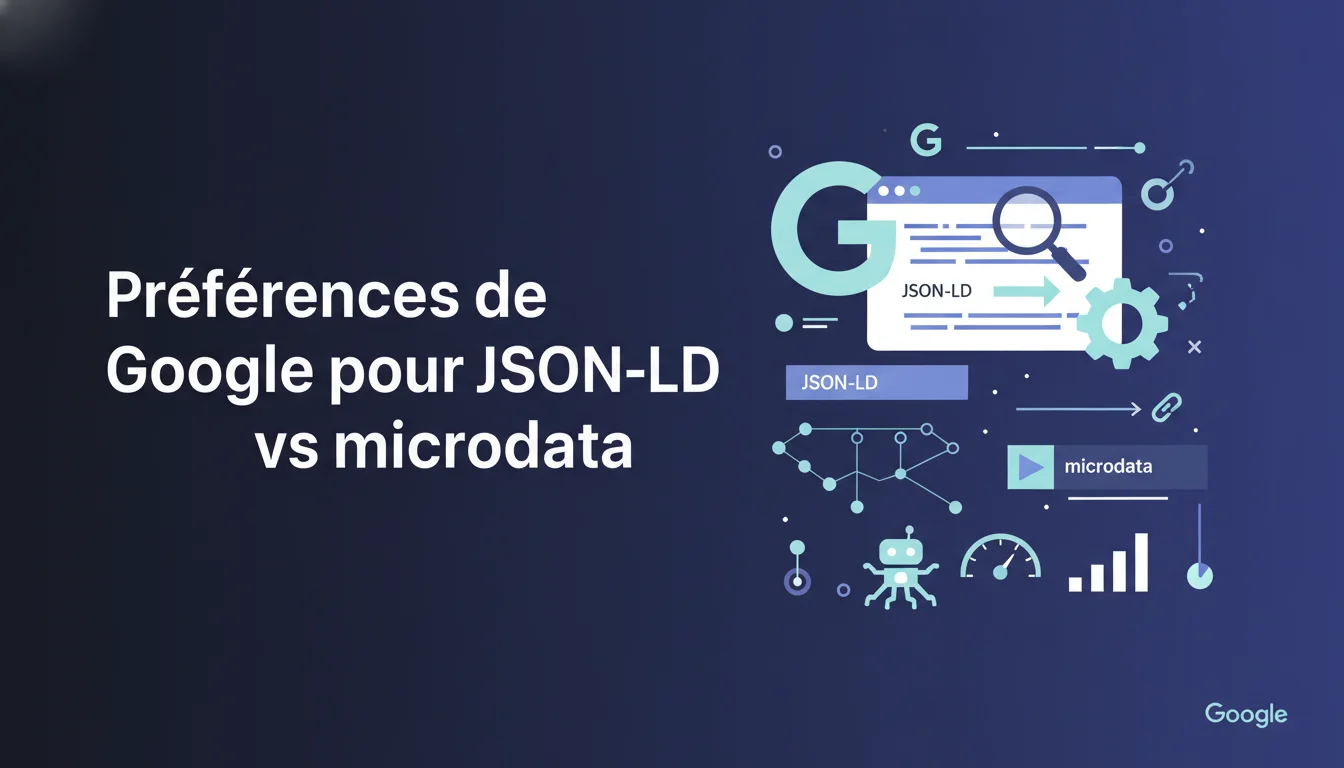
Google claims to support both JSON-LD and microdata equally for rich snippets, leaving webmasters to choose the format. In reality, JSON-LD has emerged as the recommended standard by the Search team, particularly for its ease of implementation and separation from HTML. This official neutrality masks an on-the-ground reality: JSON-LD benefits from better documentation, priority support for new markup types, and simplifies technical maintenance.
What you need to understand
Why does Google maintain this neutral position between formats?
This statement reflects a historical reality: microdata has long been the dominant format before JSON-LD gradually took over. Google cannot simply deprecate microdata without creating massive issues for millions of sites still using it.
The official position also allows Google to avoid forcing a drastic migration that would penalize legacy sites. But behind the scenes, all recent documentation, code examples, and new types of schema.org are systematically presented in JSON-LD first.
What are the real technical differences between these two formats?
Microdata is embedded directly in the HTML through itemscope, itemprop, and itemtype attributes. This approach creates a strong link between semantic markup and the DOM structure. For simple, static content, it works fine.
JSON-LD operates differently: it's a standalone block of JavaScript code, usually placed in the head, completely independent of the visible HTML. This separation allows dynamic generation of structured data without touching the markup, a huge advantage for complex sites or CMS.
In what context was this statement made?
Google has always maintained this line of communication to avoid panicking webmasters who have invested time in microdata. Forums and official channels regularly repeat this reassuring message: both formats work.
The problem is that this displayed neutrality no longer really corresponds to Google's development priorities. Look at the announcements on new types of rich results: FAQ, HowTo, enriched Product reviews... everything is documented in JSON-LD first, with microdata as an option.
- JSON-LD: preferred format in official documentation, easier to implement via JavaScript, clear separation between data and presentation
- Microdata: historic format still supported, embedded in HTML, requires precise knowledge of the DOM
- RDFa: a third format mentioned but almost absent from practitioner discussions and recent Google documentation
- The choice of format does not directly impact ranking, but the quality and completeness of the markup does
- Google can parse both formats simultaneously on the same page without conflict (but avoid duplicating the same data)
SEO Expert opinion
Does this displayed neutrality match the reality on the ground?
Honestly, no. While Google does support both formats, the entire ecosystem has shifted towards JSON-LD in recent years. Developers prefer JSON-LD because it integrates cleanly into any modern tech stack without polluting HTML.
In practice, all major CMS (WordPress, Shopify, Drupal) generate JSON-LD by default through their SEO plugins. Yoast, Rank Math, SEOPress: they all bet on JSON-LD. This silent migration says a lot about the market's real preferences, even if Google maintains its diplomatic stance.
What are the real risks of sticking with microdata?
No immediate risk of visibility loss. Your rich snippets will continue to display correctly as long as the markup is valid and complete. Google has never threatened to deprecate microdata and likely never will to avoid a web catastrophe.
The real issue lies elsewhere: the speed of maintenance and evolution. When Google launches a new type of structured data (for example, dynamic price annotations or video reviews), the documentation comes out in JSON-LD. Adapting these examples into microdata requires more work, more testing, and greater risk of errors. [To be verified]: could certain advanced markup types eventually become JSON-LD only? Nothing official, but the trend is clear.
In what cases does microdata still have a practical advantage?
For ultra-simple static sites with little dynamic content, microdata may suffice. If your markup consists of a few breadcrumbs and a basic article schema, the microdata approach remains functional and understandable for a typical web integrator.
But let's be honest: these cases are becoming rare. As soon as you have server-generated content, price variations, customer reviews, events, or FAQs, JSON-LD drastically simplifies management. The migration cost is largely amortized by the ease of future maintenance.
Practical impact and recommendations
What should you do if your site still uses microdata?
First step: audit your current markup using Search Console and the Rich Results Test. If your rich snippets display correctly and you don’t have critical errors, there’s no absolute urgency to migrate.
However, if you anticipate technical changes, a redesign, or the addition of new types of structured data, take the opportunity to switch to JSON-LD. The migration can occur gradually, type of content by type of content, without breaking everything at once.
How can you migrate from microdata to JSON-LD without risk?
The best approach is to implement JSON-LD alongside on a few test pages, validate in Search Console that Google correctly parses the new blocks, then gradually deploy. Only remove microdata when you are sure that JSON-LD is working.
Use tools like the schema.org validator and the Google Rich Results Test to compare rendering before and after. Make sure all critical properties (price, availability, rating, author...) are correctly included in the new format.
What common mistakes should be avoided with JSON-LD?
The most frequent error: generating invalid JSON-LD with improperly escaped quotes, extra commas, or incorrect schema.org types. Poorly formed JSON will simply be ignored by Google, with no visible error message to the user.
Another classic pitfall: duplicating the same data in multiple JSON-LD blocks on the same page. Google may then arbitrarily choose which one to use, or worse, consider it structured data spam and ignore everything. A single well-constructed block per entity is sufficient.
- Always validate your JSON-LD with the Rich Results Test before deployment
- Test on pilot pages before rolling out site-wide
- Ensure that structured data accurately corresponds to the visible content on the page (strict consistency)
- Monitor Search Console for 2-3 weeks post-migration for any potential errors
- Do not duplicate the same entities in microdata AND JSON-LD simultaneously
- Document your JSON-LD generation logic to facilitate future maintenance
❓ Frequently Asked Questions
Microdata et JSON-LD peuvent-ils coexister sur la même page ?
Est-ce que JSON-LD améliore le ranking par rapport à microdata ?
Pourquoi JSON-LD est-il devenu le format dominant ?
Google va-t-il déprécier microdata à terme ?
Comment vérifier que mon JSON-LD est correctement parsé par Google ?
🎥 From the same video 9
Other SEO insights extracted from this same Google Search Central video · duration 58 min · published on 30/06/2015
🎥 Watch the full video on YouTube →
💬 Comments (0)
Be the first to comment.