
Official statement
What you need to understand
What does this statement from Google actually mean?
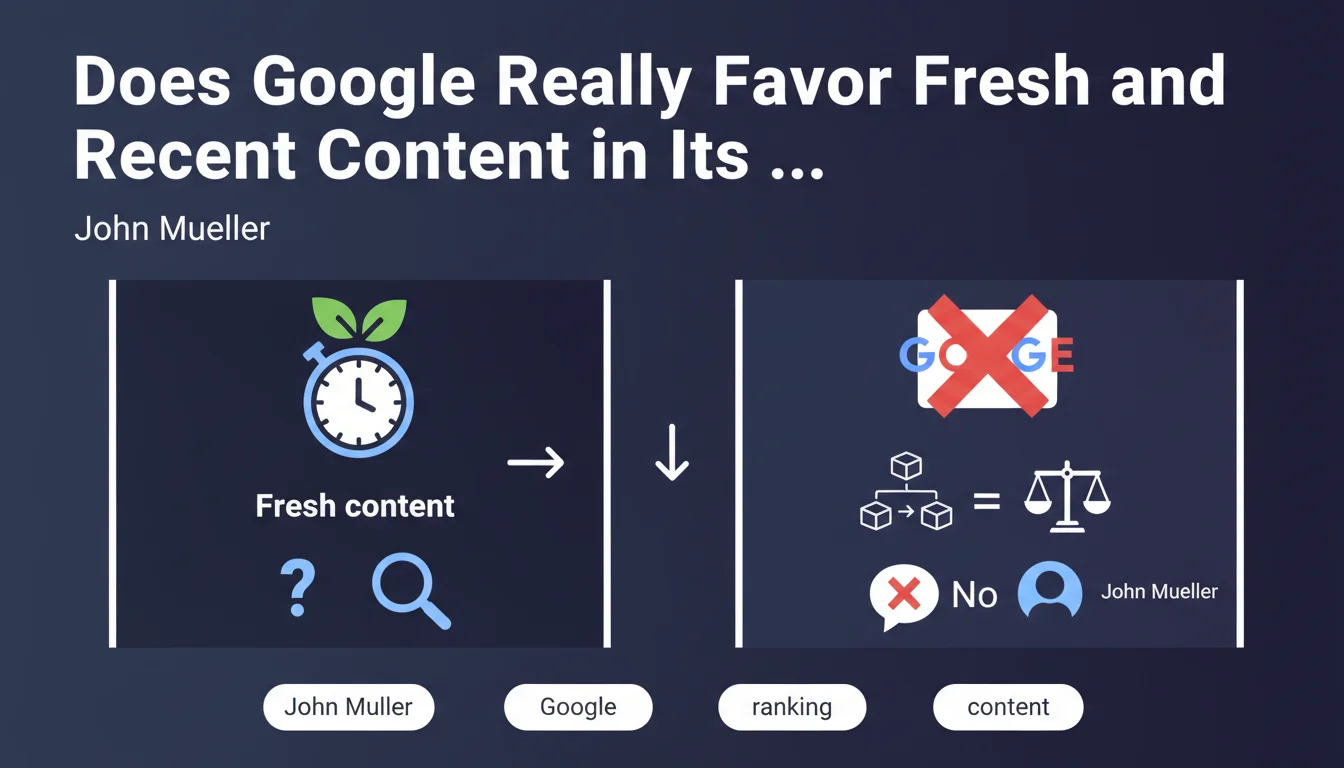
The initial statement claims that Google does not favor fresh content in its ranking algorithm. This position seems to contradict the daily experience of SEO professionals.
In reality, this assertion requires a nuanced interpretation. Google does not systematically favor recent content for all queries, but applies contextual criteria depending on search intent.
What is the QDF algorithm and how does it work?
The QDF (Query Deserves Freshness) algorithm is a system developed by Google to identify queries that require recent results. It activates automatically for certain types of searches.
This algorithm analyzes search spikes, emerging news, and trends to determine whether a query would benefit from freshly published or updated content.
For what types of queries is freshness a determining factor?
Freshness becomes a major ranking factor for queries related to news, recent events, perishable information, and rapidly evolving topics.
- News and recent events: elections, natural disasters, political scandals
- Recurring queries: sports schedules, movie releases, annual events
- Frequently updated information: product reviews, technology tutorials, regulations
- Trends and buzz: viral phenomena, new products, innovations
- Evergreen queries: definitions, historical concepts, basic tutorials (freshness less important)
SEO Expert opinion
Is this statement consistent with field observations?
No, this claim massively contradicts the empirical observations of SEO professionals. A/B tests systematically show that updating existing content improves their rankings for numerous queries.
Google's official documentation itself mentions freshness as a quality signal in several patents and communications. The QDF algorithm is documented and observable daily in the SERPs.
What nuances should be applied to this statement?
The essential nuance lies in the word "favor". Google does not give an automatic bonus to all recent content, but evaluates the relevance of freshness according to the query context.
For a query like "crepe recipe", a 2015 article can perfectly dominate the results. For "2024 election results", only ultra-recent content will be visible. Freshness is therefore a conditional factor, not a universal one.
In what cases does freshness not constitute an advantage?
For evergreen queries (definitions, timeless concepts, foundational guides), freshness offers little advantage. Domain authority, content quality, and backlinks take clear precedence.
An old but comprehensive and authoritative article will often outperform recent but superficial content on these topics. Depth and expertise matter more than publication date.
Practical impact and recommendations
How can you strategically optimize the freshness of your content?
First identify your content according to its query typology. Classify it into three categories: news/trending, recurring/seasonal, and evergreen/timeless.
For news content, prioritize responsiveness and publication frequency. For evergreen content, focus on substantial annual or semi-annual updates rather than cosmetic modifications.
Use the visible modification date on your pages to signal significant updates. Add "Last updated" sections with a summary of changes to reinforce freshness signals.
What mistakes should you avoid in your fresh content strategy?
Do not artificially modify publication dates without real content improvement. Google detects these manipulations and may penalize this deceptive practice.
Avoid over-optimizing freshness on evergreen content that doesn't need it. This dilutes your editorial resources without tangible SEO benefit.
- Audit your content to identify those requiring regular updates
- Implement a review calendar adapted to each content typology
- Monitor queries where QDF activates via SERP analysis and Google Trends
- Add "news" or "updates" sections on your strategic pages
- Incorporate recent data, updated statistics, and contemporary examples
- Check for schema.org markup with dateModified and datePublished
- Create a reactive content strategy to capitalize on emerging trends
- Monitor competitors on your key queries to detect their freshness strategies
How do you measure the effectiveness of your freshness strategy?
Track the evolution of organic traffic before and after your content updates. Use Search Console to identify pages whose CTR and impressions increase following updates.
Analyze the ranking of queries sensitive to freshness in your sector. Compare your publication speed to competitors on news topics to identify opportunities.
💬 Comments (0)
Be the first to comment.