
Official statement
Other statements from this video 1 ▾
Google encourages reporting black hat techniques (cloaking, link buying, PBNs, doorway pages) through its spam report form. These reports contribute to algorithm adjustments and may trigger manual actions. In practice, this process can influence your competitive landscape, but its actual effectiveness remains unclear and varies by industry.
What you need to understand
What techniques does Google consider punishable spam?
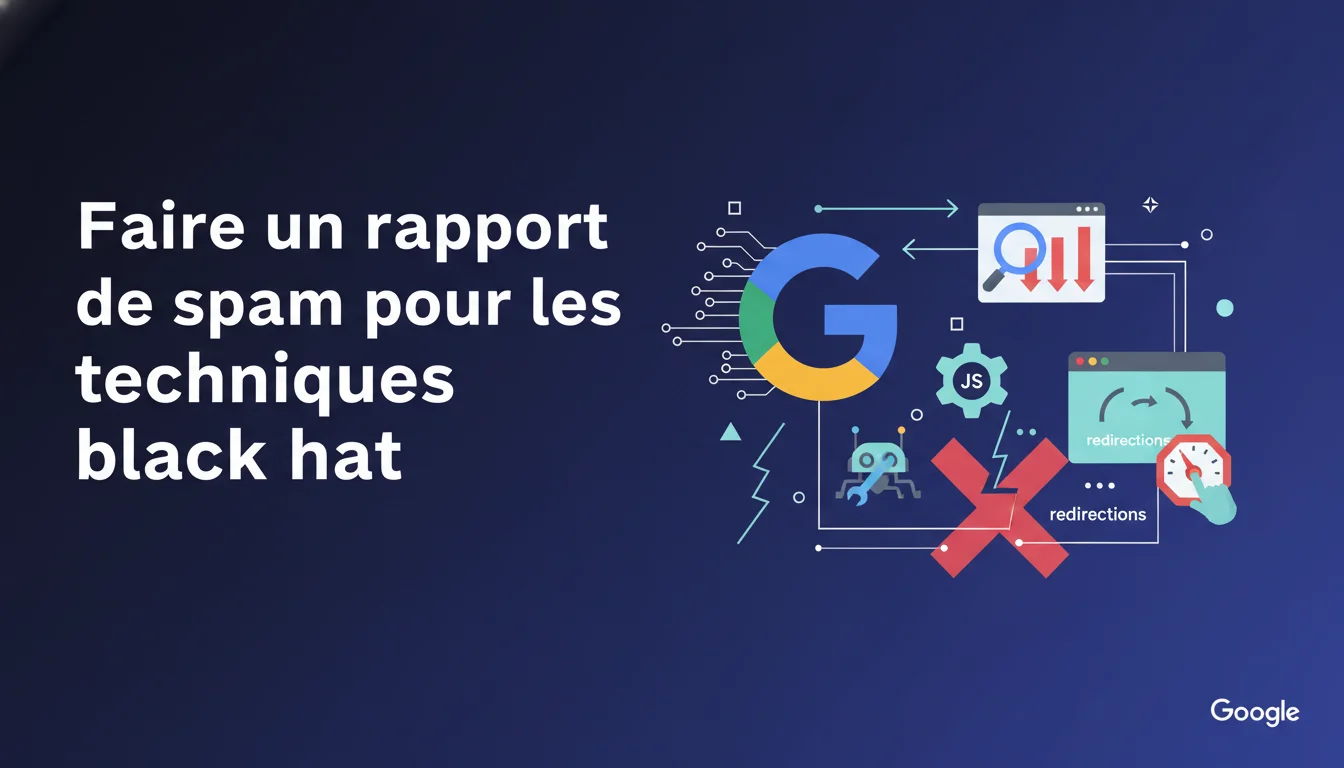
Google explicitly lists five categories of manipulation as priorities in this reporting system. Cloaking refers to showing different content to crawlers and users, a practice algorithmically detectable but still prevalent in certain verticals.
Misleading JavaScript redirects aim to send crawlers to an optimized page while visitors land elsewhere. Link buying encompasses artificial linking schemes, PBNs, and non-compliant monetized exchanges. Doorway pages create multiple entry points targeting variations of queries to funnel to a single destination. Keyword stuffing remains punishable despite its natural decline.
How does the reporting process actually work?
The report form requests specific URLs and a factual description of the observed manipulation. Google does not guarantee any individual response or processing time. Reports feed into two distinct channels: improving the algorithms for automatic detection and identifying cases requiring manual review by the Search Quality team.
This dual use explains why some reports seem to be ignored in the short term. A report may not generate any immediate action against the targeted site but may help fine-tune the signals used by SpamBrain and anti-manipulation systems in future updates.
Why does Google seek this external participation?
The spam ecosystem is constantly evolving with techniques that temporarily bypass algorithmic detection. Reports from experienced users help identify emerging patterns before they reach a critical scale. This is particularly true for specific industry manipulations (local niches, under-resourced languages, technical verticals).
Google implicitly acknowledges that its automated systems do not instantly capture all forms of spam. This hybrid approach of automation + human reporting resembles anti-fraud measures used by social media platforms. However, it raises the question of whether some actors strategically use these reports to target competitors.
- Cloaking, JS redirects, link buying, doorways, and keyword stuffing are the five priority categories of reportable spam.
- Reports contribute to both algorithm adjustments and manual reviews without a guarantee of individual processing.
- The system addresses gaps in automatic detection against emerging or industry-specific manipulations.
- No transparency exists regarding the actual weight of a report or the effective processing times.
- The system may theoretically be abused for negative SEO through false reports.
SEO Expert opinion
Does this approach yield observable results in practice?
The effectiveness of reporting varies drastically by context. In ultra-competitive sectors (finance, healthcare, casinos), manipulative sites sometimes disappear from the SERPs a few weeks after massive and documented reports. Elsewhere, obvious spam techniques persist for months despite repeated reports.
This asymmetry suggests that Google prioritizes certain verticals based on their YMYL sensitivity or the volume of monetizable queries. [To be verified]: The real impact of an isolated report versus a coordinated campaign of multiple reporters remains entirely opaque. No public metrics allow for evaluation of the effective processing rate of reports.
What risks does this practice pose for the reporter?
Theoretically, reporting spam should be neutral or beneficial. In practice, some practitioners fear that a history of erroneous or abusive reports could undermine their Google account credibility and affect the weighting of their future reports. This concern is not supported by any official confirmation.
More worrying: in highly closed niches, reporting may trigger retaliation in the form of negative SEO if the reporter's identity is deducible. Some malicious actors monitor fluctuations in their backlinks or the appearance of disavows to identify likely reporting sources. The Google form is anonymous on the destination side, but reporting patterns can reveal the origin.
Do the targeted categories reflect the true current algorithmic priorities?
The list of five punishable techniques dates from a time when keyword stuffing and doorway pages represented major manipulation vectors. Today, generative AI produces spam at an industrial scale through networks of synthetic sites that are difficult to detect with these classic categories.
Google does not explicitly mention massively generated content by LLMs, cloned site farms with semantic variations, or manipulations of entities through Knowledge Graph poisoning. [To be verified]: Either these techniques are implicitly covered, or the form has not evolved at the pace of new forms of spam. The absence of a dedicated category for AI spam suggests that Google prefers to address this issue solely algorithmically.
Practical impact and recommendations
When does reporting become strategically relevant?
Reporting spam makes sense when you detect a flagrant and documentable manipulation that distorts results in your strategic queries. Prioritize cases where a competitor is using detectable cloaking through tools like OnCrawl or Screaming Frog configured with different user agents.
Situations involving massive PBN networks with identifiable footprints (same IPs, same CMS, same link structure) also warrant a structured report. However, reporting a single suspicious backlink amounts to noise and likely dilutes the effectiveness of the system. Focus on systemic patterns rather than isolated tactics.
How to effectively document manipulation before reporting?
Google probably does not process vague reports like "this site buys links." Build a factual case with technical evidence: source HTML comparisons between Googlebot and standard browser for cloaking, link network captures via Ahrefs or Majestic showing unnatural patterns, screenshots of doorway pages with revealing URL parameters.
For suspicious JavaScript redirects, test with tools like Redirect Path or HTTPStatus by comparing behavior based on the referer. Archive this evidence since Google may take weeks to process a report, during which time the manipulator can change their techniques. A report without verifiable documentation appears more like a competitive complaint than a quality contribution.
Should you systematize this anti-spam vigilance or remain opportunistic?
Implementing weekly monitoring of the top 10 for your strategic queries allows for quick identification of newcomers employing dubious techniques. Automate detection with scripts that compare visible content against the source code retrieved via API, and alert on significant divergences.
This vigilance becomes time-consuming in heavily polluted sectors. Evaluate the ROI time/benefit: If your vertical has 30% spam in the SERPs, cleaning the ecosystem through reports may take months with no guarantee. Sometimes, investing this time in improving your own site yields more predictable results. These anti-spam optimizations, combined with a robust SEO strategy, can prove complex to orchestrate alone. A specialized SEO agency can structure this competitive vigilance, document manipulations according to Google standards, and coordinate a comprehensive approach that combines defense with strengthening your organic positions.
- Document every manipulation with screenshots, user-agent comparisons, and timestamped archives.
- Prioritize reporting systemic patterns rather than isolated tactics.
- Use the form for flagrant and verifiable cases, not vague suspicions.
- Monitor fluctuations post-reporting to assess effectiveness in your sector.
- Automate the detection of content/source discrepancies in your key queries.
- Evaluate the ROI of time invested versus improvement of your own SEO assets.
❓ Frequently Asked Questions
Le signalement de spam est-il vraiment anonyme ou Google peut-il identifier qui rapporte ?
Combien de temps faut-il pour qu'un signalement produise des effets visibles ?
Peut-on signaler un concurrent pour negative SEO si ses techniques sont limites mais pas clairement black hat ?
Les signalements multiples du même site par différentes personnes accélèrent-ils le traitement ?
Quels outils permettent de détecter efficacement le cloaking avant de signaler ?
🎥 From the same video 1
Other SEO insights extracted from this same Google Search Central video · duration 2 min · published on 22/05/2012
🎥 Watch the full video on YouTube →
💬 Comments (0)
Be the first to comment.