
Official statement
Other statements from this video 1 ▾
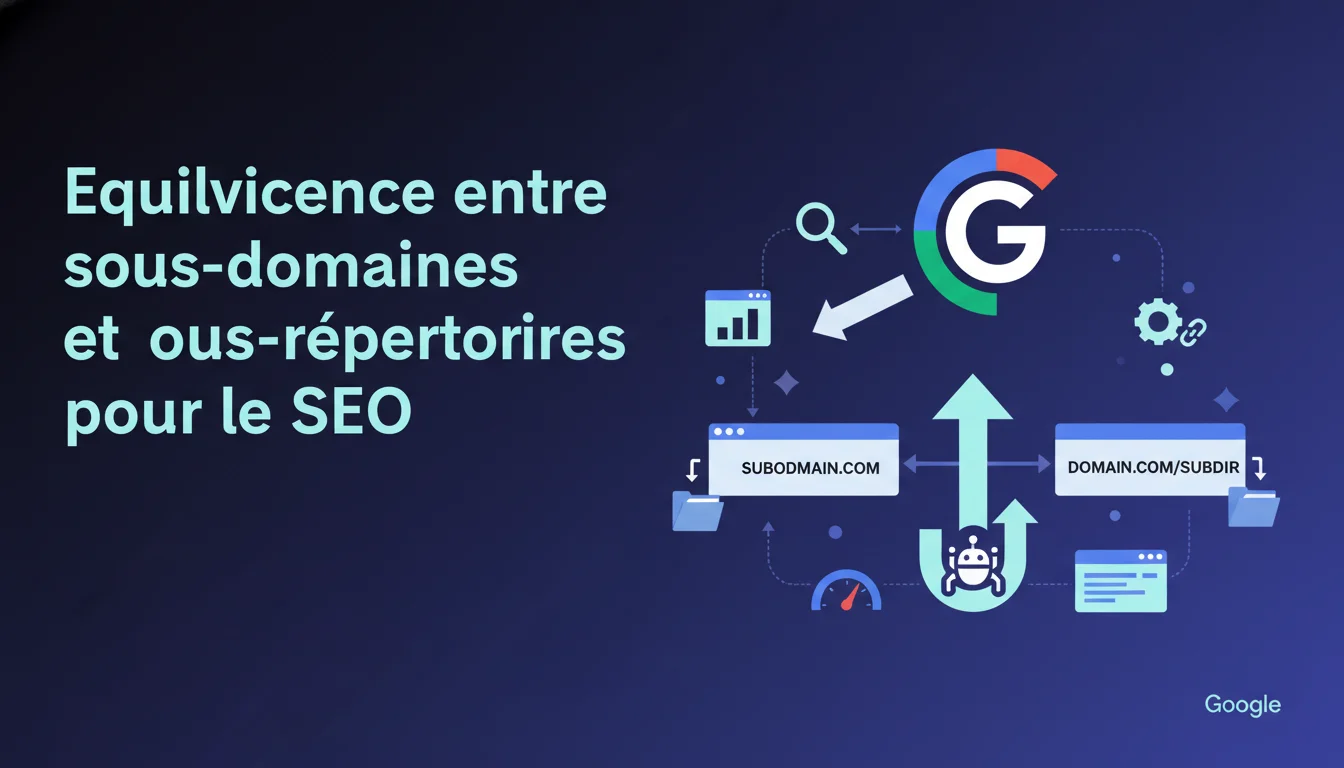
Google claims to treat subdomains and subdirectories equally, leaving the choice to the technical criteria of each site. However, this apparent neutrality hides real practical implications: transmission of PageRank, consolidation of authority, and management of crawl budget. The issue lies less in the algorithm than in how each structure influences the distribution of link equity and the semantic coherence perceived by crawlers.
What you need to understand
What exactly does Google say about this structural equivalence?
The official position is clear: no algorithmic difference between blog.example.com and example.com/blog. Google treats both configurations without systematic preference. The engine relies on content, links, and authority signals rather than the URL structure itself.
This statement answers a recurring question from SEOs for years. The official answer aims to simplify the decision: choose based on your technical constraints, not based on a hypothetical intrinsic SEO advantage. CMS enforcing subdomains? No penalty. Multi-product architecture requiring subdirectories? No particular bonus.
Why does this confusion persist within the SEO community?
Field observations show behavioral differences that fuel the debate. A subdomain can be crawled as a distinct entity with its own crawl budget and authority metrics. This logical separation doesn’t imply an algorithmic disadvantage, but it introduces measurable practical consequences.
Another source of confusion is Google’s older recommendations, which were more nuanced. For a long time, documentation suggested a slight preference for subdirectories in certain contexts. This historical ambiguity has created entrenched practices, often disconnected from the current reality of the engine.
How does Google determine the relationship between subdomain and main domain?
The engine analyzes thematic coherence and link structure signals. A subdomain that is strongly linked to the main domain, sharing a dense internal linking structure, will be understood as an integral part of the site. Conversely, an isolated subdomain, without reciprocal links, may be treated as an independent entity.
This distinction relies on machine learning and semantic analysis. Google examines the content, link anchors, and navigation. A blog.example.com discussing exactly the same topics as example.com, with a common header and cross-links, will be naturally associated. The URL structure then becomes secondary compared to contextual signals.
- Algorithmic equivalence: Google does not favor subdomains or subdirectories by default
- Technical context is key: the choice should stem from CMS, hosting, or team constraints
- Coherence signals: internal linking, thematic consistency, and links determine the domain/subdomain association
- Distinct crawl budget: a subdomain can be crawled separately, without penalty but with practical implications
- Confusing history: Google’s older recommendations have created practices that may be outdated
SEO Expert opinion
Does this statement really reflect the field observations of SEOs?
The neutrality displayed by Google does not always match measured results. Many cases show a dilution of authority when moving to a subdomain, especially when internal linking is weak. A site migrating its blog from /blog to blog.domain.com often sees a drop in rankings, even though Google denies any direct impact.
This contradiction can be explained by indirect effects. A subdomain receives less SEO juice through internal linking if the link architecture is not rethought. PageRank flows differently, and thematic consolidation becomes less clear to the algorithm. Theoretical equivalence masks concrete implementation differences.
In what contexts does this rule not fully apply?
Multi-country or multi-product sites present a particular case. A subdomain fr.example.com benefits from clearer geographic signals than a /fr/, facilitating local targeting in Search Console. Here, the subdomain provides useful management granularity, regardless of the algorithmic equivalence.
Another exception is SaaS platforms with dedicated clients. A client123.platform.com allows for technical and security isolation. Google understands this logic and treats each client subdomain as a distinct site, which can fragment the overall authority of the main domain. [To be verified]: the exact impact of this fragmentation on ranking remains difficult to quantify precisely.
What nuances does Google intentionally omit from this communication?
The statement overlooks the question of historical authority transfer. A main domain that has been around for 10 years with a strong backlink profile does not automatically pass that authority to a newly created subdomain. External links point to the root domain, not to the subdomain. This asymmetry creates a slower start for blog.example.com than for example.com/blog.
Google also avoids mentioning the issues of SERP cannibalization. Two subdomains of the same site may compete for the same keywords, whereas two subdirectories would be more easily adjudicated by the algorithm as parts of a whole. The engine prefers to diversify results by displaying different domains rather than multiple subdomains of the same entity.
Practical impact and recommendations
How to concretely decide between a subdomain and a subdirectory?
Start by auditing your real technical constraints. A CMS enforcing subdomains for hosting or security reasons leaves no choice. In this case, optimize internal linking to compensate for the structural separation. Google’s equivalence means you can succeed with both choices, but it doesn’t mean they are identical in practice.
If you have a choice, favor the subdirectory to maximize authority consolidation. Backlinks to example.com benefit example.com/blog directly through the hierarchical structure. New content immediately benefits from the trust established by the domain. This transmission is less automatic with blog.example.com, even though Google claims to treat both similarly.
What mistakes should you avoid during implementation?
Never create a subdomain without a robust internal linking strategy. The classic mistake: launching blog.example.com with a single link in the footer of the main site. Google will misunderstand the relationship and treat the blog as a separate entity, diluting authority. Each blog page should link back to the main domain and vice versa, with contextual anchors.
Avoid content duplication between subdomain and subdirectory. Some sites maintain /blog AND blog.domain.com simultaneously, creating massive cannibalization. Google will choose a canonical version, often not the one you want. Consolidate to a single structure from the start.
How to check that your structural choice is working correctly?
Use Search Console to analyze the crawl budget allocated to each section. A subdomain receiving disproportionately low crawl indicates a linking or thematic relevance issue. Compare impressions and clicks by URL structure to detect any underperformance.
Monitor the internal PageRank distribution using tools like Screaming Frog or OnCrawl. A subdomain receiving little SEO juice from the main domain requires a redesign of its linking. Domain authority metrics (DA/DR) should remain consistent between subdomain and domain if the strategy is working.
- Audit technical constraints (CMS, hosting, teams) before making a choice
- Favor the subdirectory if no technical constraints apply
- Create dense internal linking between subdomain and main domain if subdomain is necessary
- Avoid any content duplication between parallel structures
- Monitor crawl budget and PageRank distribution in Search Console
- Ensure backlinks benefit the entire site, not just the root domain
❓ Frequently Asked Questions
Un sous-domaine hérite-t-il automatiquement de l'autorité du domaine principal ?
Faut-il déclarer un sous-domaine séparément dans Search Console ?
Un site peut-il mixer sous-domaines et sous-répertoires sans pénalité ?
Le passage d'un sous-répertoire à un sous-domaine nécessite-t-il des redirections 301 ?
Google traite-t-il différemment les sous-domaines wildcard (*.exemple.com) ?
🎥 From the same video 1
Other SEO insights extracted from this same Google Search Central video · duration 1 min · published on 31/10/2012
🎥 Watch the full video on YouTube →
💬 Comments (0)
Be the first to comment.