
Official statement
Other statements from this video 10 ▾
- 2:15 Should you really fix all the structured data warnings?
- 7:17 Should you really avoid mixing different types of products in structured data on the same page?
- 10:19 Why does Google favor JSON-LD for structured data?
- 16:19 Does Googlebot really index images with native lazy-loading?
- 18:16 Are new subdomains automatically eligible for mobile-first indexing?
- 23:55 Is URL removal in Search Console really only temporary?
- 28:09 Why does changing a title take weeks on a large site?
- 32:14 Do Quality Raters really influence your site's ranking?
- 49:16 Should you really be concerned about Googlebot's viewport height?
- 54:20 Is it true that Google can index podcast audio content?
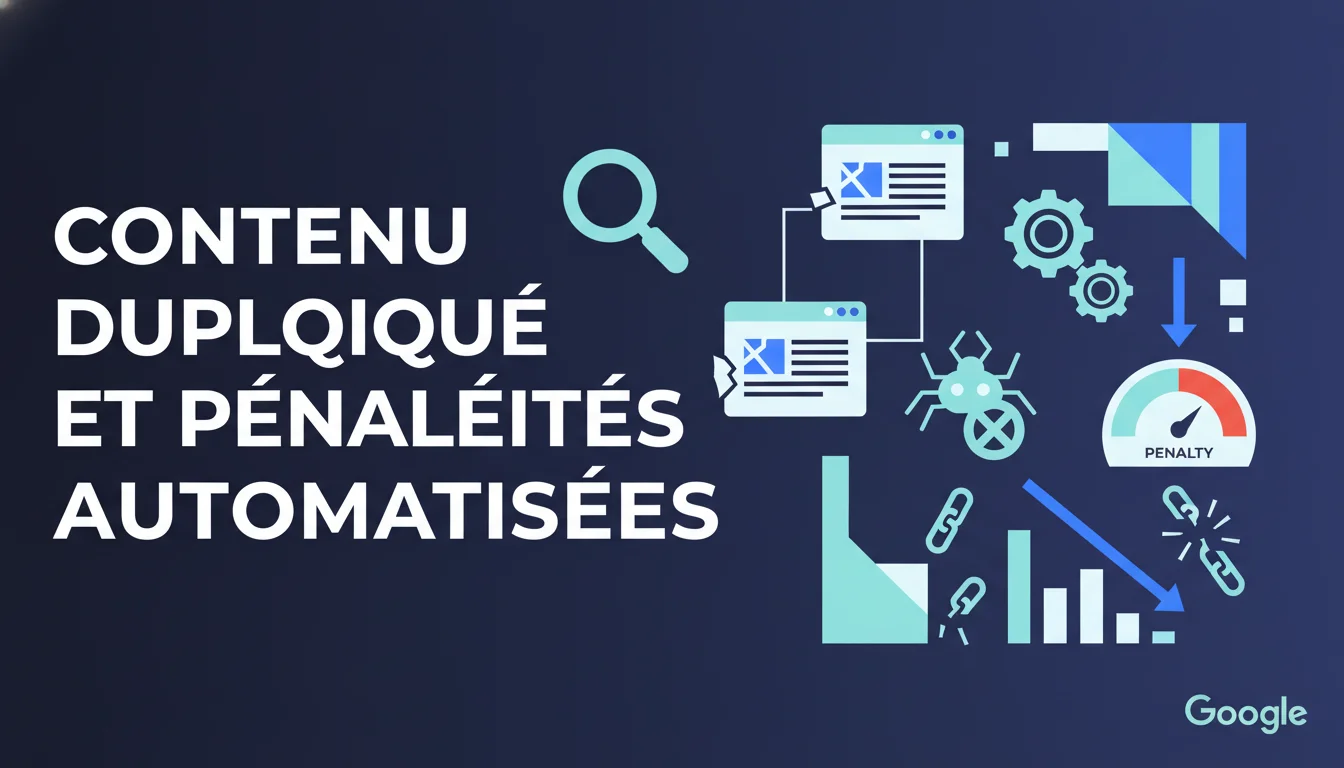
Google claims that its automated penalties for content duplication are generally not directly visible to webmasters in the Search Console. Specifically, unlike manually notified actions, these algorithmic adjustments go unnoticed in official tools. For an SEO professional, this means that a drop in traffic may be linked to duplicate content without any alerts appearing — hence the importance of regularly auditing editorial quality and cannibalization signals.
What you need to understand
What’s the Difference Between Manual Penalties and Algorithmic Adjustments?
A manual penalty is applied by a Google quality rater who manually reviews a site. It clearly appears in the Search Console under "Manual Actions" with an explicit notification and instructions to fix the issue.
Algorithmic adjustments for duplication, on the other hand, are automatically applied by Google's systems — historically Panda, and then components embedded at the core of the algorithm. No notification is sent. The webmaster notices a drop in visibility without knowing exactly what triggered the penalty.
Why Doesn’t Google Notify About These Automated Penalties?
The official reason: these are not penalties in the strict sense, but rather quality reassessments of the content. Google believes its algorithm is simply adjusting rankings based on relevance and originality criteria.
In practice, it's a semantic distinction. For a site that loses 60% of its traffic due to duplicate content detected by the algorithm, the effect is identical to a penalty. Except that no message indicates the diagnosis — you have to figure it out yourself.
How Can I Tell If My Site is Affected by a Duplication Filter?
You need to cross-check several indirect signals: a sudden drop in organic traffic without a technical update, a decline in ranking on pages identified as similar, presence of syndicated content or reused material without added value.
Tools like Screaming Frog, Siteliner, or OnCrawl can help identify similarity rates between pages. If multiple URLs show 80%+ identical content and your performance drops, the link is likely.
- Manual penalties are notified in the Search Console — algorithmic filters are not
- An adjustment for duplication manifests as a gradual or sudden drop in traffic without an official alert
- The absence of a notification does not mean the absence of a penalty: regular content quality audits are essential
- Third-party tools remain indispensable for detecting internal similarity issues
- The distinction "penalty vs adjustment" is semantic — the business impact is the same
SEO Expert opinion
Is This Statement Consistent with Field Observations?
Absolutely. For years, SEO practitioners have observed unexplained traffic drops on sites with duplicate content, without any manual actions being reported in the Search Console. The Panda updates (integrated into the algorithm since 2016) have always operated this way.
The hitch is: Google plays with words. Talking about "penalty" or "adjustment" changes nothing about the final result — a duplicated page loses ranking. The problem is that this opacity leaves webmasters in the dark. [To be verified]: Google has never communicated a precise threshold (tolerated duplication percentage, number of affected pages) to trigger a filter.
What Types of Duplication Actually Trigger a Filter?
Three main categories: internal duplication (product variants, poorly managed pagination, syndicated content), external duplication (scraping, republication without permission), and near-duplicate (very similar content with minor variations).
Experience shows that Google tolerates technical duplication better (e-commerce filters, AMP versions) if canonicals are clean. However, massively duplicating editorial content — even rephrased at 30% — almost systematically triggers a ranking degradation. Let's be honest: many "optimized" sites using low-quality generative AI now fall into this category.
Should I Really Worry If No Notification Appears?
Yes, and it’s even more dangerous than a manual action. A notified penalty tells you why and how to correct it. A silent algorithmic filter leaves you guessing: is it the content? The backlinks? A core update?
In concrete terms, the absence of a notification does not mean everything is fine. It means you need to implement proactive monitoring: quarterly similarity audits, tracking orphaned or cannibalized pages, monitoring crawl and indexing rates. If you wait for a message from Google to react, it’s already too late.
Practical impact and recommendations
How Can I Effectively Audit Duplication on My Site?
The first step: a complete crawl with Screaming Frog or OnCrawl to identify pages with high similarity rates. Set an alert threshold at 70% identical content — beyond that, mandatory investigation.
Next, cross-check with Search Console data: which pages have lost traffic recently? If they match the detected duplicate pages, the diagnosis becomes obvious. Also, use tools like Copyscape or Siteliner to check for external duplication — someone may be scraping your content.
What Corrective Actions Should Be Prioritized?
For internal duplication: consolidate similar content (merging pages), clean up canonicals, and correctly tag paginations (rel="next/prev" or canonical on page 1). For e-commerce product variants, create unique descriptions or strategically use noindex on less-visited combinations.
For external duplication: file DMCA takedown requests for scrapers, contact sites syndicating your content to add a canonical link to the original. If you use content from elsewhere, consistently add 40%+ of original value — superficial rephrasing is no longer sufficient.
How Can I Check That My Corrections Are Paying Off?
The recovery time after corrections varies from 4 to 12 weeks — just enough time for Google to recrawl and reassess rankings. Monitor three metrics: indexation rate (duplicated pages should exit the index or be consolidated), average positions on target queries, and organic traffic by landing page.
If after 3 months no improvement is visible, dig deeper: the problem may stem from keyword cannibalization rather than pure duplication, or from another quality filter (thin content, toxic links). In this case, a comprehensive multi-criteria audit is necessary.
- Crawl your site quarterly to detect new internal duplications
- Set up Search Console alerts for sudden drops in impressions (–30% in 7 days)
- Document each content consolidation with source/target URLs and proper 301 redirects
- Ensure your canonicals correctly point to the version you want indexed — frequent errors
- For e-commerce, prioritize unique product descriptions for at least 70% of the catalog
- Monitor scrapers using Google Alerts for your exact titles in quotes
❓ Frequently Asked Questions
Est-ce que Google pénalise vraiment le contenu dupliqué ou se contente-t-il de ne pas le classer ?
Pourquoi la Search Console ne m'alerte-t-elle jamais sur les problèmes de duplication détectés par l'algorithme ?
Quel pourcentage de similarité entre pages déclenche un filtre anti-duplication ?
Les canonicals suffisent-ils à résoudre tous les problèmes de duplication interne ?
Combien de temps faut-il pour récupérer après avoir corrigé du duplicate content massif ?
🎥 From the same video 10
Other SEO insights extracted from this same Google Search Central video · duration 1h06 · published on 25/06/2019
🎥 Watch the full video on YouTube →
💬 Comments (0)
Be the first to comment.