
Official statement
What you need to understand
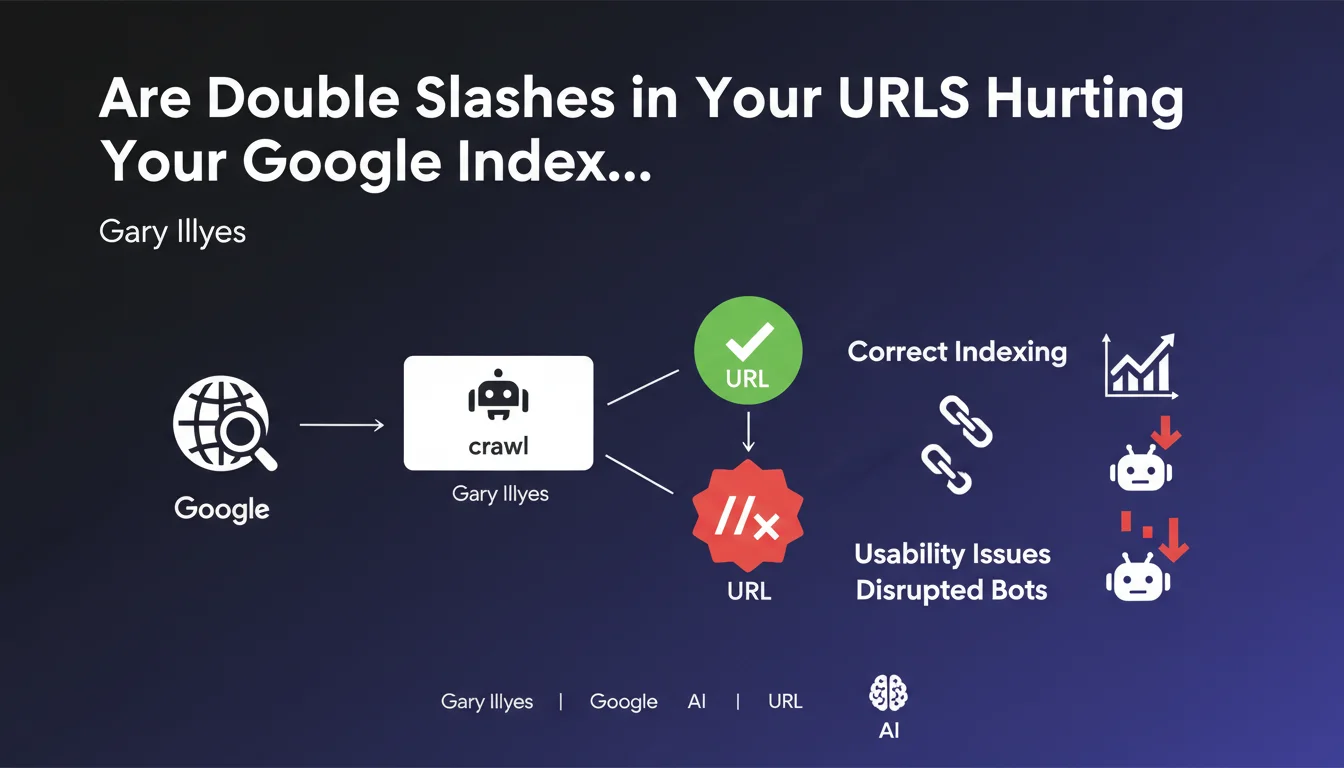
Gary Illyes' statement highlights an often-overlooked technical issue: the presence of double slashes (//) in URLs. These characters, which can appear by mistake in link structures, create ambiguities for crawling bots.
Specifically, a URL like example.com/category//product or example.com/page//article can be interpreted differently depending on the crawler. Some bots may consider these double slashes as invalid separators, while others simply ignore them.
This technical confusion can have direct consequences on your pages' indexation. Bots may abandon the crawl, consider the URL as an error, or create duplicate versions of the same page.
- Double slashes create uncertainty for indexing bots
- They can compromise the crawling and indexation of affected pages
- This issue affects the consistency of the site's URL structure
- The impact affects both user experience and technical SEO
- URL normalization is essential to avoid these problems
SEO Expert opinion
This recommendation is perfectly consistent with what we observe in the field. Double slashes do indeed generate variable indexation problems depending on the site, and Google itself doesn't always handle these URLs uniformly.
However, it's important to clarify: not all double slashes are problematic. Those appearing after the protocol (https://) are obviously normal. The problem only concerns double slashes in the URL path after the domain name.
In some cases, we observe that Google manages to automatically normalize these URLs, but this correction isn't guaranteed. It's better not to rely on the algorithms' leniency and fix the problem at the source.
Practical impact and recommendations
This statement requires immediate technical action to avoid any indexation issues. Here are the concrete measures to implement on your site.
- Audit your current URLs: use Screaming Frog or a similar crawler to detect all URLs containing double slashes in their structure
- Check your source code: identify the scripts, plugins, or functions that generate these double slashes (often in pagination systems, filters, or dynamic URLs)
- Fix the templates: modify your theme files or templates to eliminate the generation of double slashes at the source
- Implement rewrite rules: configure your .htaccess (Apache) or nginx.conf to automatically redirect URLs with double slashes to their normalized version
- Update internal linking: correct all internal links pointing to URLs with double slashes
- Clean up your XML sitemap: ensure that no URL with double slashes appears in it
- Monitor Search Console: regularly check crawl errors and discovered URLs to detect new cases
- Test redirects: validate that your normalization rules work correctly with different URL scenarios
💬 Comments (0)
Be the first to comment.