
Official statement
Other statements from this video 9 ▾
- 4:30 How does Google's mobile-friendly label really change search results?
- 10:07 Does Crawl Budget Really Require Manual Intervention?
- 15:59 Should you really apply nofollow to every UGC and advertising link?
- 21:26 Does HTTPS really boost your Google ranking?
- 25:03 Should you really let Googlebot crawl your CSS and JavaScript?
- 31:17 Should you really wait before submitting a disavow file?
- 33:07 Is Google still threatening sites that buy links with manual penalties?
- 37:56 Has mobile-friendliness really become a crucial ranking factor in SEO?
- 41:22 Is responsive design really the only mobile architecture that Google rewards?
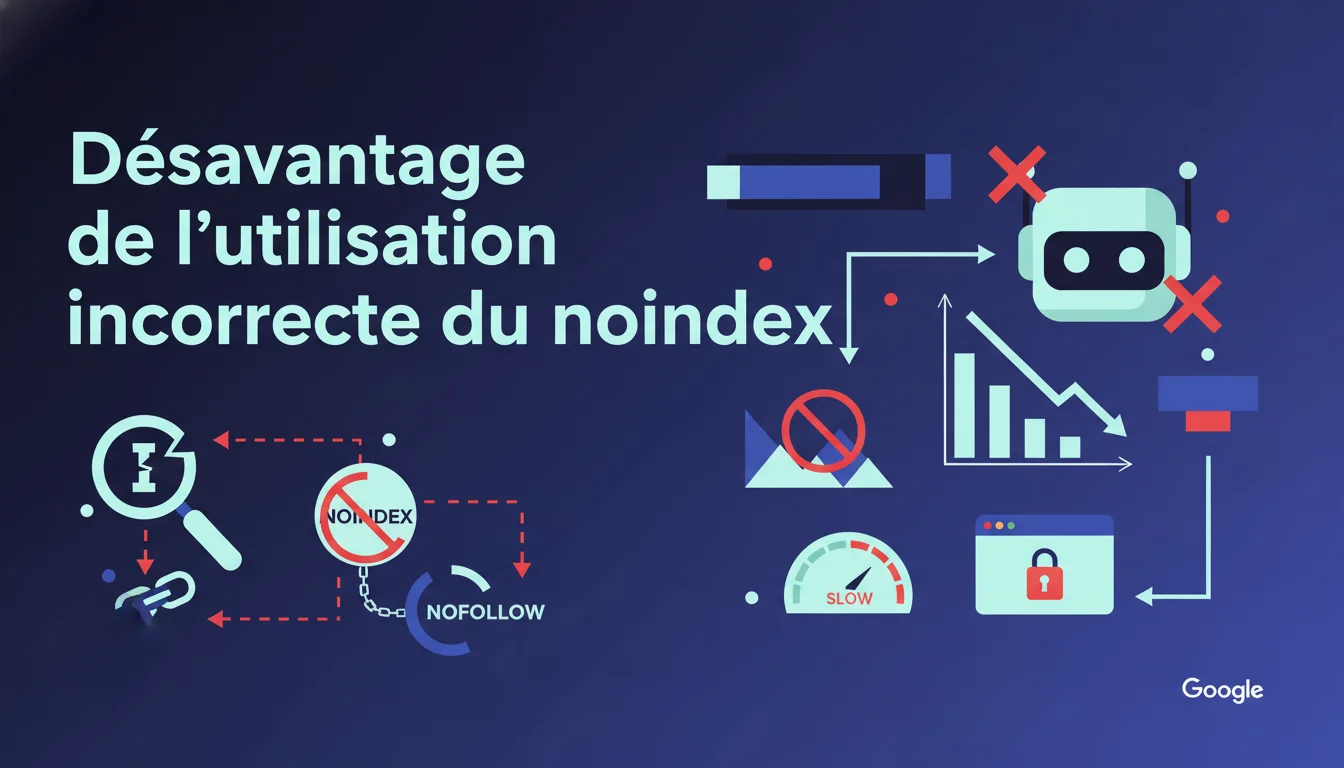
Google confirms that using noindex incorrectly on pages intended to be indexed is a critical mistake. Nofollow, on the other hand, does not control indexing at all: only noindex manages this parameter. For an SEO, this means rigorously auditing your robots directives and clearly distinguishing between crawling, indexing, and PageRank transmission mechanisms.
What you need to understand
What’s the difference between noindex and nofollow?
Noindex is a directive that explicitly asks Google not to include a page in its index. In practical terms, the page will never show up in search results, even if Google can crawl it. It is the ultimate control tool for indexing.
Nofollow, on the other hand, deals with PageRank transmission: it tells the engine not to follow (or transmit value to) links present on the page. However, it does not hinder indexing at all. A page can thus be nofollow and perfectly indexed if no noindex is present.
Why does this confusion persist among practitioners?
Historically, many SEOs believed that nofollow could influence indexing, likely because both directives often coexist in meta robots. Some sites add nofollow thinking they are hiding duplicate content or low-quality pages, when only noindex can accomplish that task.
This error also arises from a misunderstanding of their respective roles: nofollow acts on link behavior, and noindex affects presence in the index. Mixing the two is akin to confusing crawling, indexing, and ranking.
What are the real consequences of getting it wrong?
Applying a noindex to strategic pages (product pages, blog articles, landing pages) excludes them from the index. Result: zero organic traffic on those URLs, even if they are technically accessible and crawlable. The opposite is equally problematic: forgetting noindex on pagination, filter, or tag pages can pollute the index with low-value content.
Improperly used nofollow won’t cause de-indexing, but it can fragment the internal linking and limit PageRank distribution. If you apply nofollow to strategic internal links, you deprive certain pages of SEO juice for no valid reason.
- Noindex controls indexing, not nofollow
- Nofollow controls PageRank transmission, not indexing
- A noindex page can still be crawled, it simply won't appear in the SERPs
- Regularly auditing your robots directives is essential to avoid critical errors
- Using the wrong tool for the wrong purpose can wipe out months of SEO efforts
SEO Expert opinion
Is Google’s clarification sufficient?
Let’s be honest: Google is stating the obvious for any SEO who has read the official docs. The problem is that this statement remains superficial and does not address the gray areas. For instance, what happens if a page toggles between noindex and index frequently? What’s the delay before effective de-indexing?
Google also does not specify how its systems handle directive conflicts: a noindex in meta robots vs an X-Robots-Tag HTTP allowing indexing. In that case, which instruction takes precedence? The documentation says the most restrictive wins, but field observations sometimes show inconsistencies. [To be verified] in edge cases with multiple layers of conflicting directives.
What nuances should be considered in practice?
Nofollow has evolved: since 2019, Google treats it as a “hint” instead of a strict directive. Practically, it can choose to follow a nofollow link if it deems it relevant. This further complicates the scenario: a practitioner can no longer blindly rely on nofollow to completely block value transmission.
Another nuance: noindex through robots.txt does not exist. Blocking a URL in robots.txt prevents crawling, but if the page receives external backlinks, Google can still index it (without crawling). To truly prevent indexing, Google must be allowed to crawl the page and read the noindex in meta or HTTP header.
In what cases is this rule insufficient?
On heavy JavaScript sites, noindex directives in meta may not be seen if server-side rendering (SSR) fails. Google must execute the JS to discover the noindex: if the crawl budget is tight or if rendering fails, the page may remain indexed despite the directive. [To be verified] systematically using the URL inspection tool in Search Console.
Sites with millions of pages (e-commerce, classifieds) also encounter delays: a page marked as noindex may stay visible in the index for weeks if Google does not recrawl it quickly. In these contexts, relying solely on noindex without combining it with a crawl budget and prioritization strategy is risky.
Practical impact and recommendations
What should you do right now?
First step: audit all the meta robots and X-Robots-Tag across your site. Use a crawler like Screaming Frog or Oncrawl to identify pages with a noindex. Cross-reference this list with your strategic pages (those generating traffic or conversions). If a critical page appears as noindex, correct it immediately.
Second action: check for directive conflicts. A page can have a noindex in HTML meta but allow indexing in HTTP header, or vice versa. Test using the URL inspection tool in Search Console to see which directive Google actually retains.
What mistakes should be avoided at all costs?
Never place a noindex on landing pages, active product pages, or pillar articles. This seems obvious, but incidents occur regularly after CMS migrations or template changes. A single mistake can drop organic traffic by 30 to 50% in just a few days.
Also, avoid confusing nofollow and noindex in your technical specifications. If you want to exclude a page from the index, document explicitly “noindex” and not “nofollow” in your tickets or specifications. Developers are not always familiar with these SEO nuances, and a misinterpretation can be costly.
How can I check that my site is compliant?
Set up continuous monitoring: configure alerts in your crawling tool to be notified if a strategic page switches to noindex. Also, check the number of indexed pages in Search Console (Coverage section): a sharp drop may indicate an accidental noindex at the site level.
Test JavaScript rendering with the URL inspection tool to ensure that noindex directives are visible to Googlebot. In complex architectures (React, Vue, Angular), the noindex may be injected client-side and not appear in the initial source code, complicating detection.
- Crawl the entire site to list all noindex pages
- Cross-reference this list with strategic pages (traffic, conversions)
- Check for conflicts between meta robots, X-Robots-Tag and robots.txt
- Test JavaScript rendering for client-side injected noindex directives
- Set up automatic alerts for accidental noindex on critical URLs
- Clearly document directives in technical specifications to avoid development errors
❓ Frequently Asked Questions
Le nofollow empêche-t-il vraiment l'indexation d'une page ?
Peut-on cumuler noindex et nofollow sur une même page ?
Combien de temps faut-il pour qu'une page noindex disparaisse de l'index ?
Que se passe-t-il si je bloque une page en robots.txt tout en la marquant noindex ?
Le nofollow est-il encore efficace depuis qu'il est devenu un hint ?
🎥 From the same video 9
Other SEO insights extracted from this same Google Search Central video · duration 54 min · published on 11/12/2014
🎥 Watch the full video on YouTube →
💬 Comments (0)
Be the first to comment.