
Official statement
Other statements from this video 11 ▾
- 15:50 What happens when you block the Googlebot mobile and risk losing your indexed pages?
- 54:32 Should you stop using the site: command to verify your pages' indexing?
- 120:45 Is faceted navigation really a coverage error trap?
- 356:48 Does Duplicate Content Really Kill Your SEO?
- 482:46 Does lending a subdomain really affect your main domain?
- 569:28 Is it true that linking your AMP and desktop pages correctly can prevent canonicalization issues?
- 619:55 Should you canonicalize XML sitemap files to prevent duplication?
- 695:01 Does the canonical tag maintain its power regardless of the page's age?
- 762:39 How can you manage URL parameters in faceted navigation without wasting your crawl budget?
- 1010:21 Do paid links really hurt your Google rankings?
- 1106:58 Does user feedback on search results really influence your site's ranking?
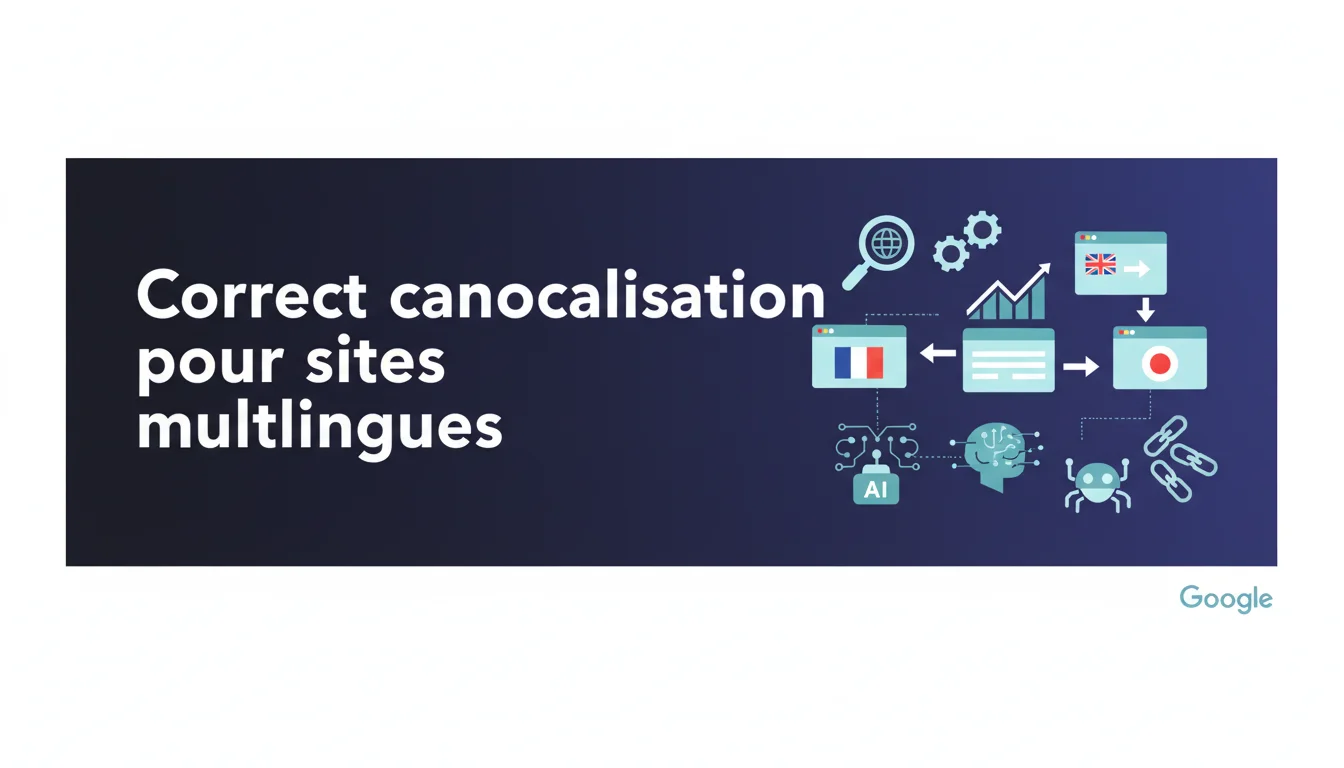
Google requires that each language version of a page points its canonical tag to itself, not to another language. Automatic redirects based on browser detection or cookies create indexing errors that Google cannot resolve. Specifically, your page /fr/ must canonicalize to /fr/, not to /en/ — otherwise, you risk deindexing your language variants.
What you need to understand
Why does Google require self-referential canonicalization for each language?
The logic is simple but often misapplied: each language version of a page constitutes unique content that Google must index independently. When your French page canonicalizes to the English version, you signal to Google that the French version is a duplicate to ignore.
This scenario frequently occurs with misconfigured CMS or developers who think they are "optimizing" by merging all languages into a single version. The result? Your /de/, /es/, /it/ pages disappear from the index, and you lose 70% of your international traffic overnight.
What’s wrong with automatic detection-based redirects?
Redirects via cookies or user-agent (browser detection) pose a major crawling issue. Googlebot crawls from U.S.-based IPs with a specific user-agent — if your server consistently redirects it to /en/, it will never discover your other languages.
Even worse: these redirects create inconsistencies between the crawled HTML and the rendered content. Googlebot accesses /fr/, your server redirects it to /en/, but your hreflang tag still states /fr/ as the French version. Google faces conflicting signals and makes arbitrary choices.
What is the difference between canonical and hreflang in this context?
This is where many people go wrong: hreflang signals language alternatives, while canonical signals the preferred version to index. These two mechanisms work together but have distinct roles.
If /fr/ canonicalizes to /en/ AND has an hreflang to /en/, you are telling Google: "this French page is a duplicate of the English one, only index the English version.” Conversely, with a self-referential canonical and a properly configured hreflang, you say: “index this French page AND offer the English version to English speakers.”
- Golden rule: canonical = same URL (self-referential) for each language
- Hreflang: lists all language alternatives + x-default
- No automatic redirects based on geolocation or browser detection for Googlebot
- Recommended architecture: subdirectories (/fr/, /en/) or subdomains (fr.site.com), never parameters (?lang=fr)
- Mandatory check: test crawl with curl simulating Googlebot to verify the absence of redirects
SEO Expert opinion
Is this guideline consistent with observed behaviors in the field?
Absolutely, and cases of massive deindexing due to cross-canonicalization have been documented for years. I have seen e-commerce sites lose 80% of their European revenue because a developer "optimized" by canonically linking all languages to /en-us/ to "avoid duplicate content".
The problem is that this guideline remains unknown to technical teams that are not SEO specialized. Many modern frameworks (Next.js, Nuxt) offer automatic language detection by default that must be explicitly disabled for Googlebot — and no one does it until they've lost their rankings.
What nuances should be added to this rule?
Google does not specify how to handle partially translated content. If you have 1000 pages in English but only 200 translated into French, what canonical for the 800 untranslated pages? The official documentation remains vague. [To check] in your tests: some observe that canonicalizing an untranslated page to its English version works without penalty, others report issues.
Another gray area: sites with regional variants of the same language (fr-FR, fr-CA, fr-BE). Google advises treating them as distinct languages with hreflang, but can the canonical point to a "master" French version? The official position lacks clarity — caution is advised, prioritize systematic self-referencing.
In what cases does this rule fail or become counterproductive?
Sites with dynamically generated content based on user (not just language) face difficulties. Example: a product page with prices in euros for /fr/ and in dollars for /en/ — if the content varies significantly beyond language, the boundary between "language variant" and "distinct page" becomes blurry.
I have also seen cases where perfect self-referential canonicals did not prevent Google from arbitrarily choosing another language as the main version in the SERPs. This typically happens when backlink signals are unbalanced (90% of links point to /en/, almost nothing to /fr/) — Google may ignore your directives if they contradict external signals too strongly.
Practical impact and recommendations
What should you immediately check on your multilingual site?
First step: crawl your site simulating Googlebot with Screaming Frog or Oncrawl, verifying that each /fr/ URL indeed returns a canonical pointing to itself. Do not rely on what you see in the browser — JS or cookie-based redirects do not apply the same way to Googlebot.
Next, go to Search Console and compare indexed URLs with your sitemaps by language. If you have 500 /fr/ pages in your sitemap but only 120 indexed, it is likely a canonicalization problem or rogue redirects. Export the data, cross-check with your crawl, identify missing pages.
How can you fix a faulty configuration without losing your positions?
If you discover that your /fr/ pages canonicalize to /en/, do NOT change everything at once. Google may interpret the massive change as a restructuring and temporarily demote your URLs while re-crawling everything.
Process in batches of 50-100 pages, starting with the most strategic (top international landing pages). Correct the canonicals, submit the URLs via Search Console to speed up re-crawl, and monitor metrics daily for 2-3 weeks. If positions hold, roll out to the rest of the site.
What critical mistakes should you absolutely avoid in the implementation?
The most common mistake: implementing hreflang without checking canonical. Hreflang never compensates for a bad canonical — if /fr/ canonicalizes to /en/, it doesn’t matter how perfect your hreflang is, Google will not index /fr/.
Another classic trap: relative vs absolute canonical. Always use absolute URLs (https://site.com/fr/page) in your canonical tags, never relative paths (/fr/page). Relative paths create ambiguities that Google sometimes resolves poorly, especially with subdomains or CDNs.
- Check that each /fr/page.html has
<link rel="canonical" href="https://site.com/fr/page.html"> - Disable any automatic redirections based on user-agent or geolocation for crawlers
- Implement hreflang as a complement (HTTP headers or HTML tags), with x-default pointing to a language selection page
- Test with curl simulating Googlebot:
curl -A "Googlebot" https://site.com/fr/pageshould return NO 3xx redirects - Monitor Search Console by language property (create distinct properties for /fr/, /en/, /de/) to track indexing independently
- Audit backlinks by language — a massive imbalance can push Google to ignore your directives
❓ Frequently Asked Questions
Peut-on utiliser une seule canonical vers /en/ si c'est notre langue principale ?
Hreflang suffit-il sans canonical correcte ?
Comment gérer les pages non traduites dans un site multilingue ?
Les redirections 302 temporaires posent-elles le même problème que les 301 ?
Faut-il une canonical même si la page est en noindex ?
🎥 From the same video 11
Other SEO insights extracted from this same Google Search Central video · duration 1249h07 · published on 25/03/2021
🎥 Watch the full video on YouTube →
💬 Comments (0)
Be the first to comment.