
Official statement
What you need to understand
What happens to Core Web Vitals when you redirect a URL?
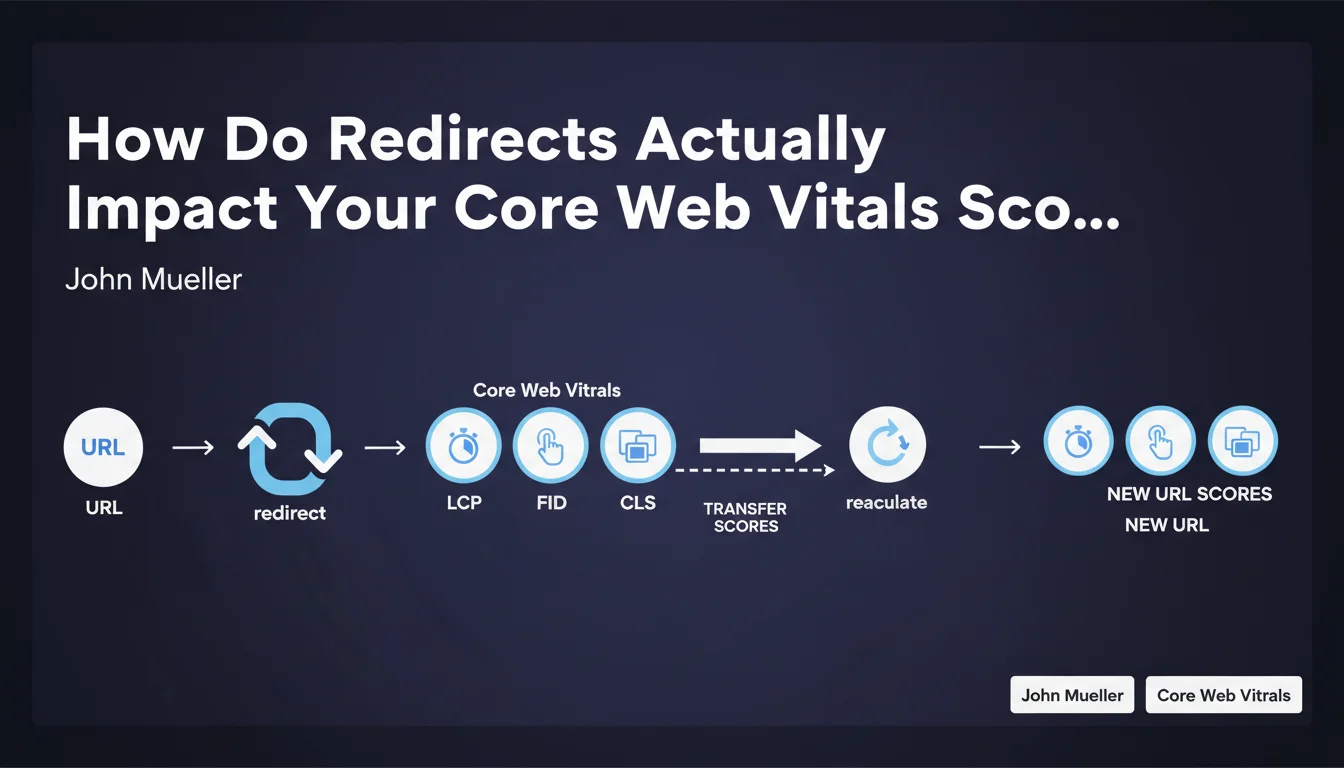
When you implement a URL redirect, Google temporarily transfers the Core Web Vitals scores (LCP, FID, CLS) from the old page to the new destination. This mechanism works similarly to PageRank transfer and other algorithmic signals.
This transfer is, however, temporary. Google will progressively recalculate the performance metrics based on the actual characteristics of the new target page, since each URL has its own loading times and visual behaviors.
Why does Google handle Core Web Vitals this way?
This approach ensures ranking continuity during site migrations or restructuring. Without this initial transfer, a page with good scores would immediately lose its SEO advantage while the new URL accumulates sufficient user data.
Google thus avoids abrupt fluctuations in search results and gives webmasters time to optimize the performance of their new URL before final scores are established.
How long does this metrics transfer last?
The exact duration is not specified by Google, but the process generally follows progressive recalculation logic. The more visits the new page receives and real data it generates, the faster its own metrics will replace the inherited ones.
- Core Web Vitals scores are temporarily transferred during a redirect
- This mechanism works like PageRank transfer
- Metrics are then recalculated based on the new URL's actual performance
- This transition prevents abrupt drops in rankings
- Recalculation timeframe depends on the volume of user data collected
SEO Expert opinion
Does this statement align with practices observed in the field?
Yes, this logic aligns perfectly with behavior observed during site migrations. SEO professionals regularly note that redirected pages maintain their initial rankings before gradually evolving based on their actual performance.
This also confirms that Google treats Core Web Vitals as a global signal attached to the URL, just like authority or topical relevance. This consistency in signal handling facilitates the management of technical restructuring.
What important nuances should be applied to this rule?
Score transfer does not mean you can ignore target page optimization. If the new URL exhibits poor performance, inherited scores will quickly degrade once recalculation occurs.
Additionally, this rule applies to both 301 and 302 redirects, but their behavior may differ slightly. Permanent redirects (301) benefit from more complete transfer since Google considers the change definitive.
In what cases might this logic not fully apply?
If you redirect to a page with radically different content, Google might consider it a new entity and recalculate all signals more quickly, including Core Web Vitals.
JavaScript redirects or meta refresh redirects generally do not receive the same treatment as server-side redirects. These methods can result in partial or complete loss of signal transfer.
Practical impact and recommendations
What should you actually do during a migration or restructuring?
Before implementing your redirects, first optimize the performance of the new target pages. Ensure their Core Web Vitals scores are at least equivalent to, or better than, the old URLs.
Systematically test your new pages with tools like PageSpeed Insights or Chrome DevTools to identify potential LCP, CLS, or FID issues before redirecting. Advance preparation prevents unpleasant surprises.
What critical mistakes must you absolutely avoid?
Never create redirect chains (A→B→C). Each additional hop adds latency and reduces signal transfer efficiency. Always redirect directly to the final destination.
Also avoid redirecting to pages whose weight is significantly higher than the original. An LCP that goes from 1.5s to 4s after redirection will eventually penalize your rankings once recalculation occurs.
How can you effectively monitor this metrics transition?
Use Search Console to track Core Web Vitals evolution after implementing redirects. The dedicated report will indicate whether new URLs maintain good performance or if corrections are needed.
Set up regular monitoring via tools like Lighthouse CI or Real User Monitoring (RUM) solutions to capture actual user experiences on your new pages.
- Optimize target page performance before redirecting
- Use only server-side 301 redirects
- Absolutely avoid multiple redirect chains
- Test Core Web Vitals with PageSpeed Insights on all new URLs
- Monitor evolution in Search Console for 3-6 months
- Maintain or improve page weight and loading times
- Redirect to thematically coherent pages
- Document all redirects in a mapping file
Optimal Core Web Vitals management during redirects requires a methodical approach combining technical audit, preventive optimization, and continuous monitoring. Temporary score transfer offers a window of opportunity, but the actual performance of your new URLs will determine your medium-term success.
These optimizations require advanced technical expertise and deep understanding of Google's mechanisms. For complex migration projects or high-traffic sites, support from a specialized SEO agency can prove invaluable for orchestrating this transition risk-free and maximizing the preservation of your organic visibility.
💬 Comments (0)
Be the first to comment.