
Official statement
What you need to understand
What does this actually mean for SEO in practice?
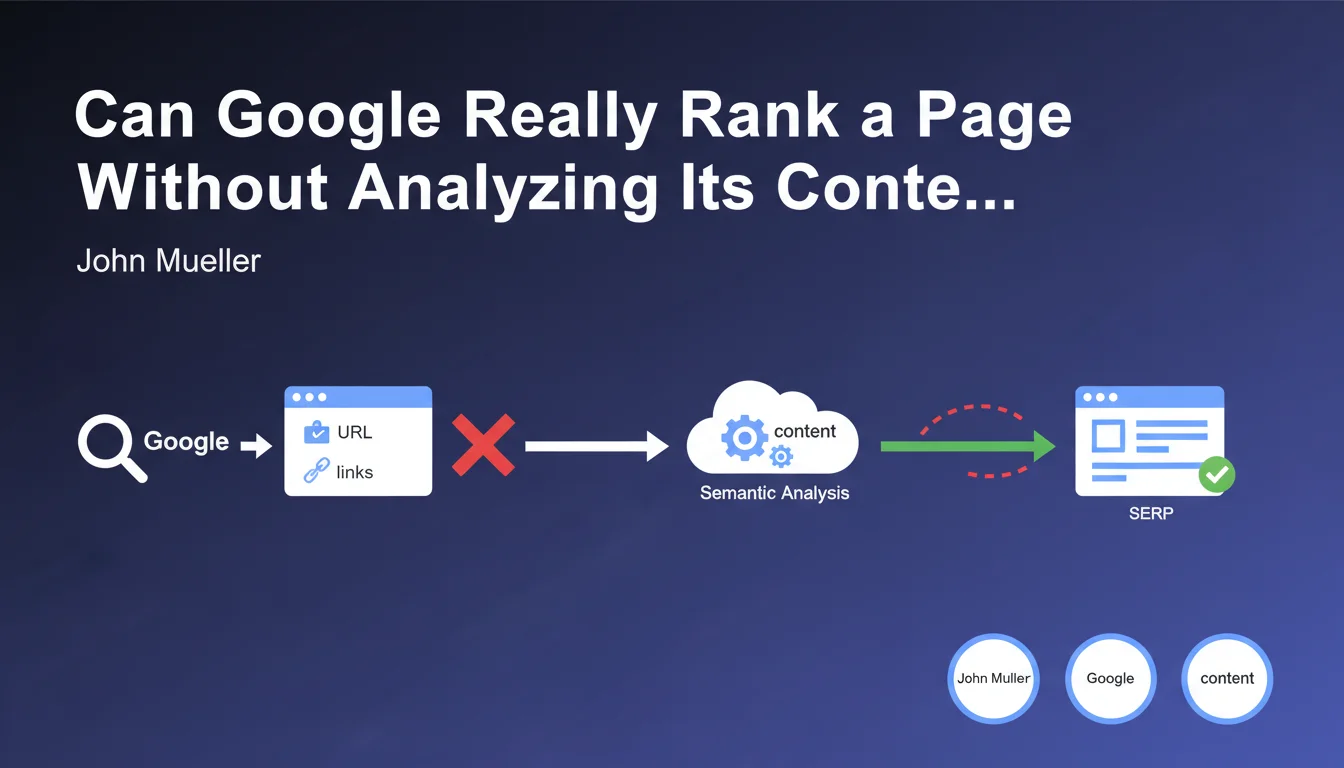
John Mueller has clarified a fundamental point about how Google works: no page appears in search results before its textual content has been analyzed. This means that external signals like inbound links or URL structure alone are not sufficient to obtain ranking.
Google waits until it has semantically understood the content of your page before offering it to users. This semantic analysis is an absolute prerequisite for indexing and ranking.
Why did Google choose this approach over provisional pre-ranking?
One could imagine that Google would quickly display pages based on technical criteria, then refine their position after content analysis. But this approach would present too many risks of irrelevant results.
Google therefore prioritizes reliability over speed. The search engine prefers to wait a few extra moments to ensure that each displayed page actually matches the user's search intent.
What elements are analyzed before ranking?
The content analysis performed by Google includes several essential dimensions. The search engine examines visible text, semantic structure, named entities, and the thematic context of the page.
- The main textual content must be crawlable and indexable
- Semantic analysis systematically precedes positioning in the SERP
- External signals (links, URL) cannot compensate for the absence of content analysis
- This rule applies to all pages, whether new or updated
SEO Expert opinion
Is this statement consistent with what we observe in the field?
In my daily SEO practice over the past 15 years, this statement indeed corresponds to what I observe. New pages always take some time before appearing, even on high-authority sites with excellent internal linking.
I have regularly noticed that technically perfect pages, well-linked, but with dynamically generated content or content that's difficult to interpret, remain invisible in SERPs until Google manages to extract their meaning. This completely validates Mueller's position.
What important nuances should be added to this rule?
The first nuance concerns the analysis time, which varies considerably depending on the site's authority. On an established site with good crawl budget, analysis can be almost instantaneous, while a new site will wait several days.
The second nuance relates to JavaScript content. If your content requires complex JavaScript execution, the analysis will be postponed to the rendering phase, which can considerably delay ranking.
In what cases can this analysis fail or be delayed?
Content analysis can be blocked or delayed in several critical situations. Content in Ajax, poorly configured SPAs, or text hidden behind interactions often cause problems.
Similarly, content that's too thin, massively duplicated, or of very low quality may be technically analyzed but considered irrelevant for indexing. Google then analyzes the content but decides not to rank the page.
Practical impact and recommendations
What should you actually do to optimize content analysis?
The absolute priority is to ensure that your main content is accessible in raw HTML, without JavaScript dependency for its display. Use the URL inspection test in Search Console to verify what Google actually sees.
Make sure your content presents a clear semantic structure with hierarchical headings, distinct paragraphs, and rich vocabulary. The easier your content is to analyze, the faster Google will be able to rank it.
- Verify that the main content is present in the initial HTML source code
- Avoid hiding essential content behind accordions, tabs, or modals that are closed by default
- Use semantically rich vocabulary and clearly identifiable entities
- Structure your content with appropriate HTML5 tags (article, section, etc.)
- Systematically test your pages with the URL Inspection tool in Search Console
What critical mistakes should you absolutely avoid?
The most common error is blocking main content behind complex JavaScript while thinking that links will be enough to generate traffic. Without content analysis, these pages will remain completely invisible.
Another common pitfall: publishing very superficial content while relying on domain authority to obtain quick ranking. Google will analyze the content but deem it insufficient to justify ranking, even on a reputable site.
How can you verify that Google has properly analyzed your content?
Use Search Console to inspect your important URLs and compare the rendering with your actual page. The "More info" tab tells you if any crawling or rendering issues have been detected.
Also monitor the delay between publication and appearance in the index. If your new pages take abnormally long to be ranked despite quality content, this may indicate a content accessibility problem.
💬 Comments (0)
Be the first to comment.