
Official statement
What you need to understand
What does "above the fold" actually mean in practical terms?
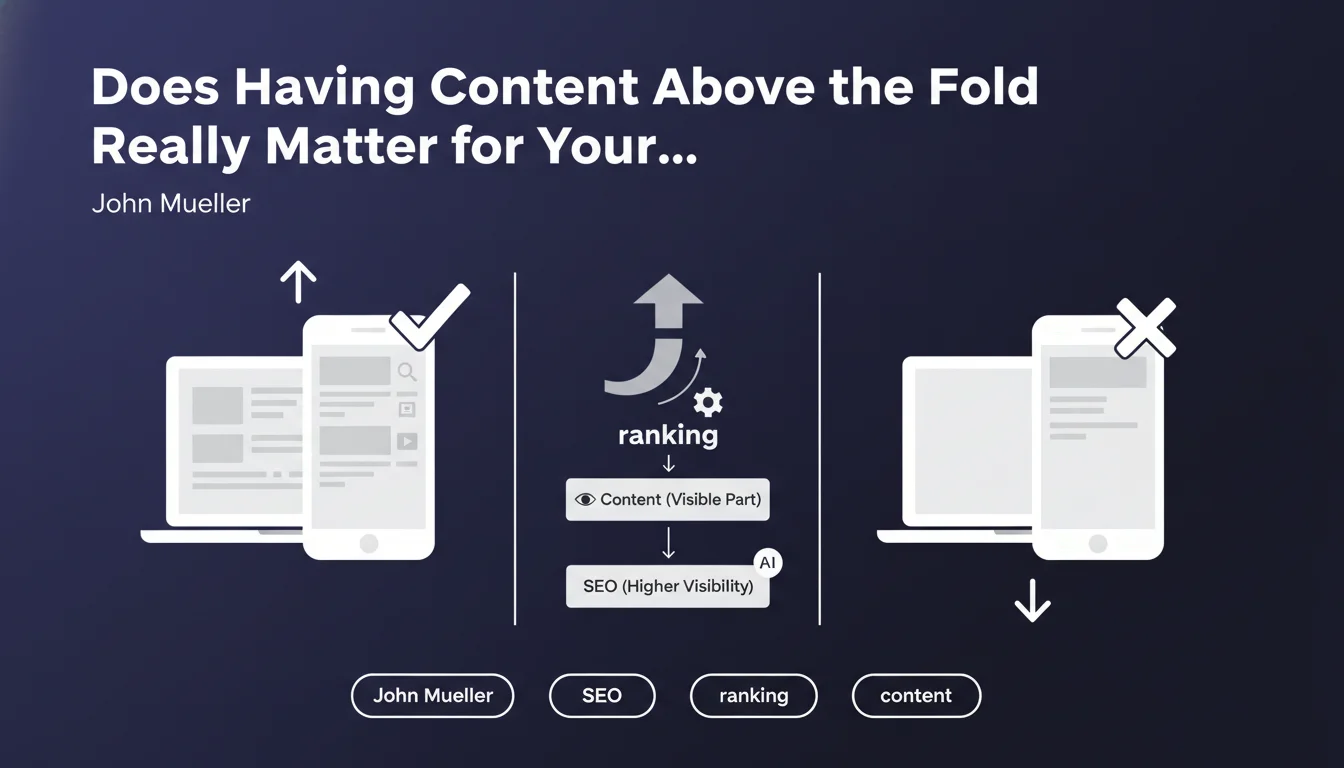
The fold line (or "above the fold") refers to the visible part of a web page without the need to scroll. This concept inherited from print media defines the first visual impression a user will have of your content.
According to Google, it's important that a portion of the main content is immediately visible. This doesn't mean everything must be there, but that users should be able to quickly identify the purpose of the page.
Why does Google place importance on this criterion?
Google's objective is to provide an optimal user experience. If a visitor arrives on a page and only sees a large image, ads, or an oversized menu, they cannot assess the relevance of the content.
This criterion fits into a broader logic where Google penalizes pages that delay access to the main informational content in favor of secondary or advertising elements.
What problematic elements should you avoid?
The main obstacles that push content below the fold include excessive advertising banners, disproportionate header images, and intrusive pop-ups.
- Large decorative images that occupy the entire initial screen
- Massive advertising blocks at the top of the page
- Overly voluminous navigation menus
- Sliders and carousels that delay the display of textual content
- Excessive white space without UX justification
SEO Expert opinion
Is this directive consistent with observed SEO practices?
Absolutely. This statement aligns with other known Google signals, particularly Core Web Vitals and especially Largest Contentful Paint (LCP), which measures how quickly the main content is displayed.
Field tests confirm that pages offering immediately accessible content tend to perform better. This also connects to the Page Layout algorithm launched in 2012, which already penalized pages overloaded with ads above the fold.
What is the true scope of this criterion within the algorithm?
It's a quality signal among hundreds of others. Its individual weight probably remains moderate, but it's part of a set of UX criteria that, combined, have a significant impact.
It's not a factor that, in isolation, will tip your rankings. However, systematically neglecting the initial user experience can create a cumulative handicap that's difficult to compensate for.
In what contexts can this rule be relativized?
Certain types of sites have specific constraints. E-commerce sites can legitimately place an attractive product image at the top, while media sites often favor an illustration photo.
The essential thing is that users immediately understand the subject and value of the page. A clear title, visible introduction, or product description constitutes relevant content, even when accompanied by visual elements.
Practical impact and recommendations
How can I check if my site meets this criterion?
Test your pages on different devices by observing what appears without scrolling. Use Chrome developer tools (F12) to simulate different screen resolutions and mobile devices.
Tools like Google Search Console and PageSpeed Insights provide indicators on user experience. Pay particular attention to visible content metrics and alerts about advertising clutter.
What concrete actions should be implemented?
Start with a visual audit of your main pages. Identify all elements that push down the main content and question their actual necessity.
Reorganize your visual hierarchy so that the title, introduction, or key information is immediately visible. Reduce header height and limit space dedicated to secondary elements.
- Reduce header height to a maximum of 80-120px on desktop
- Place at least 2-3 sentences of textual content above the fold
- Limit header images to 400-500px height on desktop
- Check display on mobile where space is critical (iPhone SE, for example)
- Remove or reduce excessive advertising banners at the top of the page
- Use a compact sticky header rather than a bulky fixed menu
- Test with real users to validate immediate content clarity
- Monitor bounce rates and engagement time as indicators
Should you sacrifice aesthetics for SEO?
Absolutely not. It's about finding an intelligent balance between attractive design and content accessibility. Many high-performing sites combine visual elegance with immediately readable content.
The goal is to avoid excess: a beautiful header image is legitimate, but it shouldn't occupy three screens in height. The layout should serve the content, not overshadow it.
💬 Comments (0)
Be the first to comment.