
Official statement
What you need to understand
Why Is This Question About Attribute Order Being Asked?
Many SEO practitioners wonder whether the order of attributes in HTML tags can influence how Google interprets their pages. This question particularly concerns tags that are critical for SEO, such as canonicals, meta robots, or links.
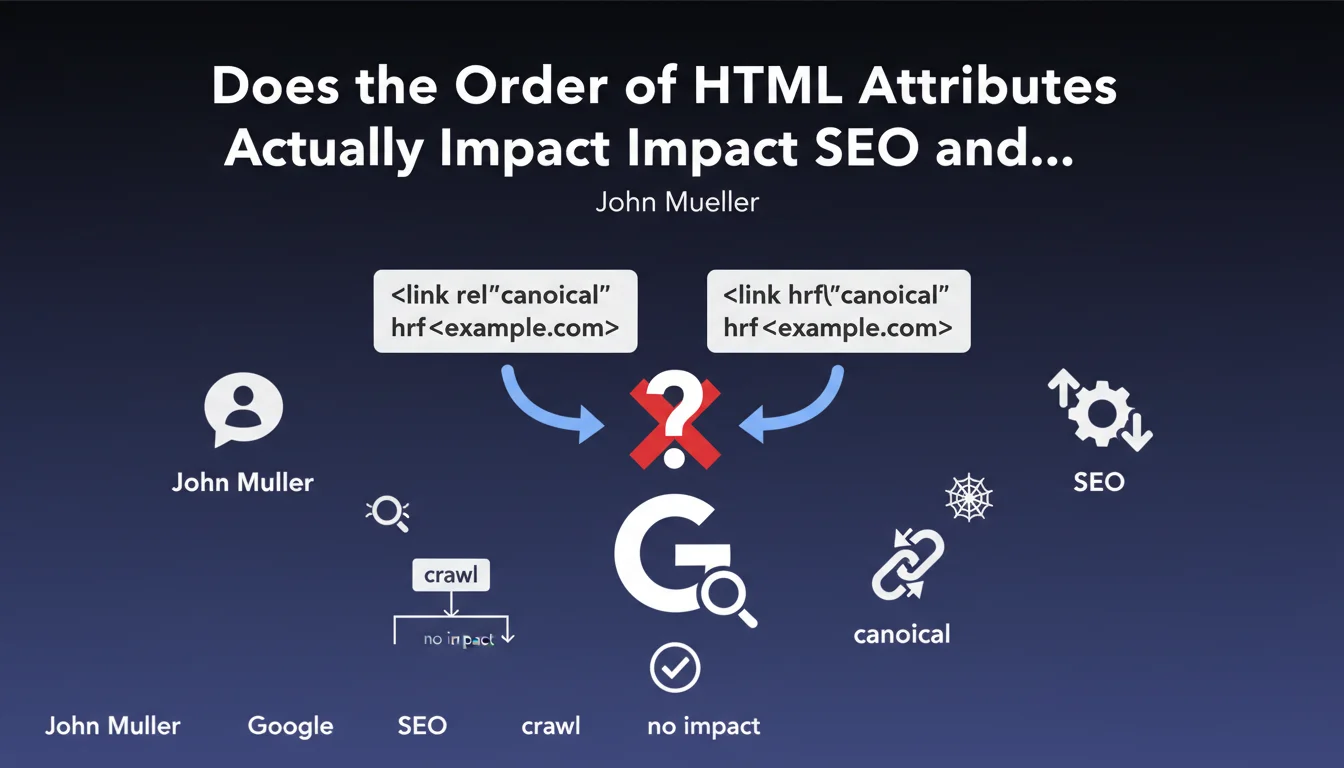
The question specifically concerned the canonical tag: does placing the "rel" attribute before "href" or vice versa change anything for Google? This concern reflects an advanced optimization quest that sometimes touches on technical minutiae.
What Does John Mueller's Response Actually Mean?
The answer is clear and unambiguous: attribute order has no importance whatsoever for Google. Whether you write <link rel="canonical" href="..."> or <link href="..." rel="canonical">, the result is strictly identical.
This rule applies to all HTML tags: meta, link, img, a, and all their attributes. Google's parsers are robust enough to identify and extract the necessary information regardless of the order in which attributes are declared.
What Are the Key Takeaways from This Statement?
- HTML attribute order does not affect Google's interpretation
- This rule applies to all tags: canonical, meta robots, hreflang, og:tags, etc.
- Google's parsers are designed to be resilient to variations in HTML syntax
- You can focus on more impactful optimizations than attribute order
- The presence and validity of attributes are what truly matters
SEO Expert opinion
Is This Statement Consistent with Web Standards?
Absolutely. This confirmation aligns perfectly with the W3C HTML specifications, which stipulate that the order of attributes in a tag is irrelevant. Modern browsers and parsers have respected this principle for decades.
Google uses standard HTML parsers that treat attributes as a set of key-value pairs, not as an ordered sequence. This approach ensures maximum robustness in the face of code variations produced by different CMS platforms, frameworks, or developers.
Why Are Some SEOs Still Asking This Question?
This question reveals a tendency toward over-optimization, where gains are sought in the smallest technical details. It may also stem from a lack of understanding of HTML fundamentals or a desperate search for competitive advantages.
Paradoxically, this type of questioning diverts attention from actual ranking factors: content quality, user experience, performance, domain authority. It's more productive to concentrate efforts on these high-impact levers.
Are There Cases Where Order Could Indirectly Have an Impact?
In the vast majority of cases, no. However, certain poorly designed analysis or validation tools could theoretically exhibit different behaviors depending on attribute order, but this doesn't concern Google.
Practical impact and recommendations
What Should You Actually Do Following This Confirmation?
First action: stop worrying about the order of attributes in your HTML tags. Adopt a convention that seems logical to you and maintain it for consistency, but don't view it as an SEO factor.
Focus your audit efforts on the actual presence of critical tags, their correct syntax, and their appropriate values. Verify that your canonicals point to the right URLs, that your hreflang tags are properly configured, and that your meta robots transmit the correct instructions.
What Mistakes Should You Avoid When Implementing SEO Tags?
Don't waste time standardizing attribute order across your entire site in hopes of an SEO gain. This task would be time-consuming and without real benefit to your visibility in search results.
Also avoid focusing on technical micro-optimizations at the expense of fundamentals. A site with mediocre content but perfectly ordered attributes will never outperform a site with excellent content and randomly ordered attributes.
How Should You Prioritize Your Technical Optimizations for Maximum Impact?
- Verify the presence and syntactic validity of all your critical SEO tags
- Ensure that your canonicals point to the correct URLs without redirect chains
- Check the consistency of your hreflang tags and the absence of conflicts
- Validate that your meta robots don't block indexation of important pages
- Focus on performance, mobile-first, and Core Web Vitals
- Invest in content quality and information architecture
- Monitor your structured data and its validation in Search Console
In summary: HTML attribute order has no impact on SEO. This confirmation frees up time to concentrate on truly impactful optimizations: content quality, site architecture, technical performance, and user experience.
Given the increasing complexity of technical SEO optimizations and the need to prioritize high-impact actions, guidance from a specialized SEO agency can prove valuable. Experts can help you identify genuine growth levers and avoid dispersing your resources on optimizations without added value.
💬 Comments (0)
Be the first to comment.