
Official statement
What you need to understand
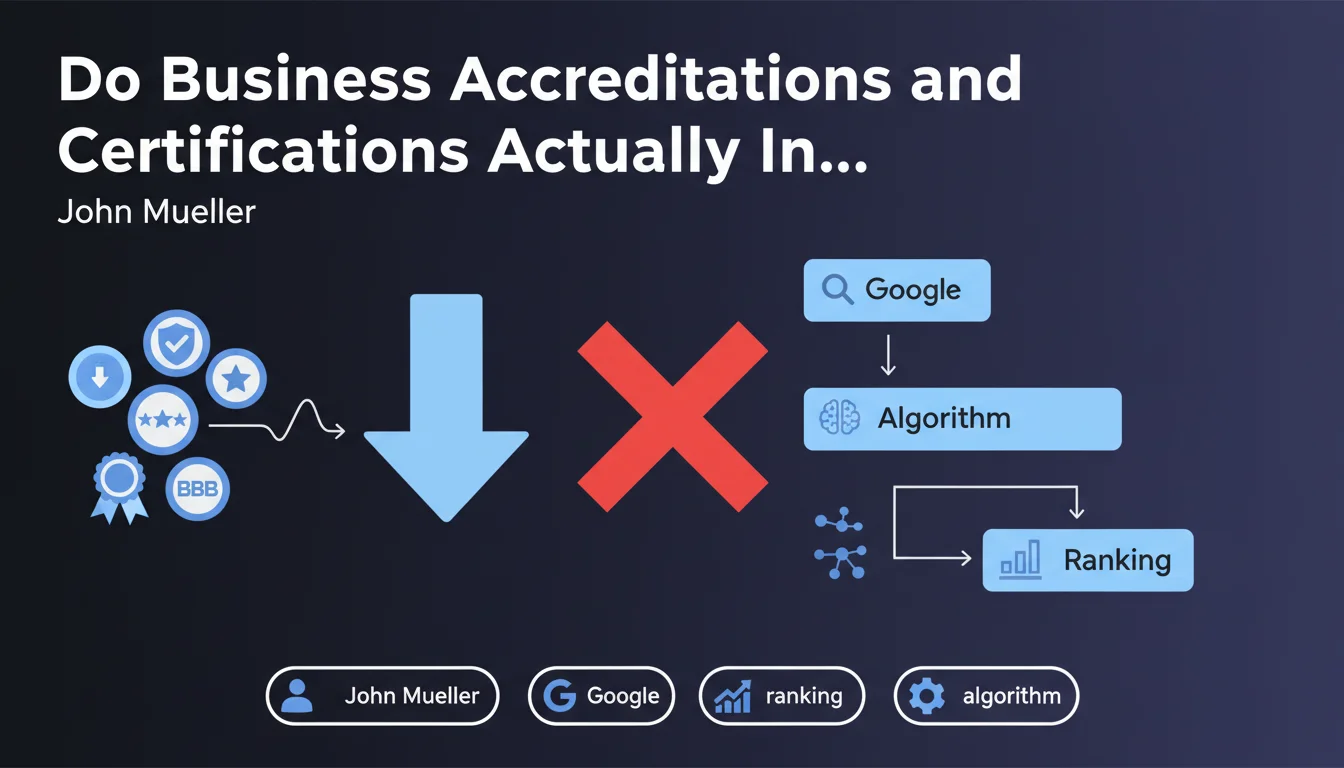
This statement from John Mueller clarifies an important point: accreditations issued by third-party organizations are not direct ranking factors in Google's algorithm. This notably concerns the Better Business Bureau (BBB) in the United States, but extends to all business rating and certification systems, whatever they may be.
The logic behind this position is simple: Google operates on a global scale, while most accreditation systems are national or regional. Integrating these signals would create geographic biases and favor certain markets at the expense of others. Furthermore, the quality and reliability of these accreditations vary considerably from one organization to another, making their use as a ranking signal problematic.
Key points to remember:
- BBB badges, professional certifications, and third-party accreditations have no direct algorithmic impact
- Displaying these accreditations on your site doesn't penalize you, but doesn't give you any SEO advantage
- Google assesses credibility through other signals: EAT, backlinks, content, user behavior
- These accreditations can nevertheless indirectly influence conversion rate and visitor trust
SEO Expert opinion
This position from Google is consistent with its general philosophy: prioritizing signals that it can control, measure, and standardize on a global scale. We indeed observe that sites without any visible accreditation can outrank highly certified sites, confirming that these badges are not algorithmically considered.
However, we must nuance this: while accreditations themselves are not direct factors, they can play a significant indirect role. A trust badge can improve click-through rate, reduce bounce rate, increase time spent on site, and encourage conversions. These behavioral signals can influence rankings. Similarly, being accredited can generate natural mentions and backlinks from the certifying organization or industry directories.
Practical impact and recommendations
Concrete recommendations following this clarification:
- Don't pay for accreditations solely for SEO purposes - The investment won't produce ROI in terms of organic rankings
- Keep legitimate accreditations for conversion - They remain useful for reassuring visitors and improving trust, especially in e-commerce
- Place badges strategically for UX, not for Google - Footer, checkout pages, about us: prioritize user experience
- Focus your SEO efforts on real ranking factors - Quality content, EAT, technical performance, relevant backlinks
- Leverage structured data for customer reviews - Implement schema.org to display stars in SERPs, a real display lever
- Don't neglect the indirect impact - If an accreditation measurably improves your conversions and user signals, it has value
💬 Comments (0)
Be the first to comment.