
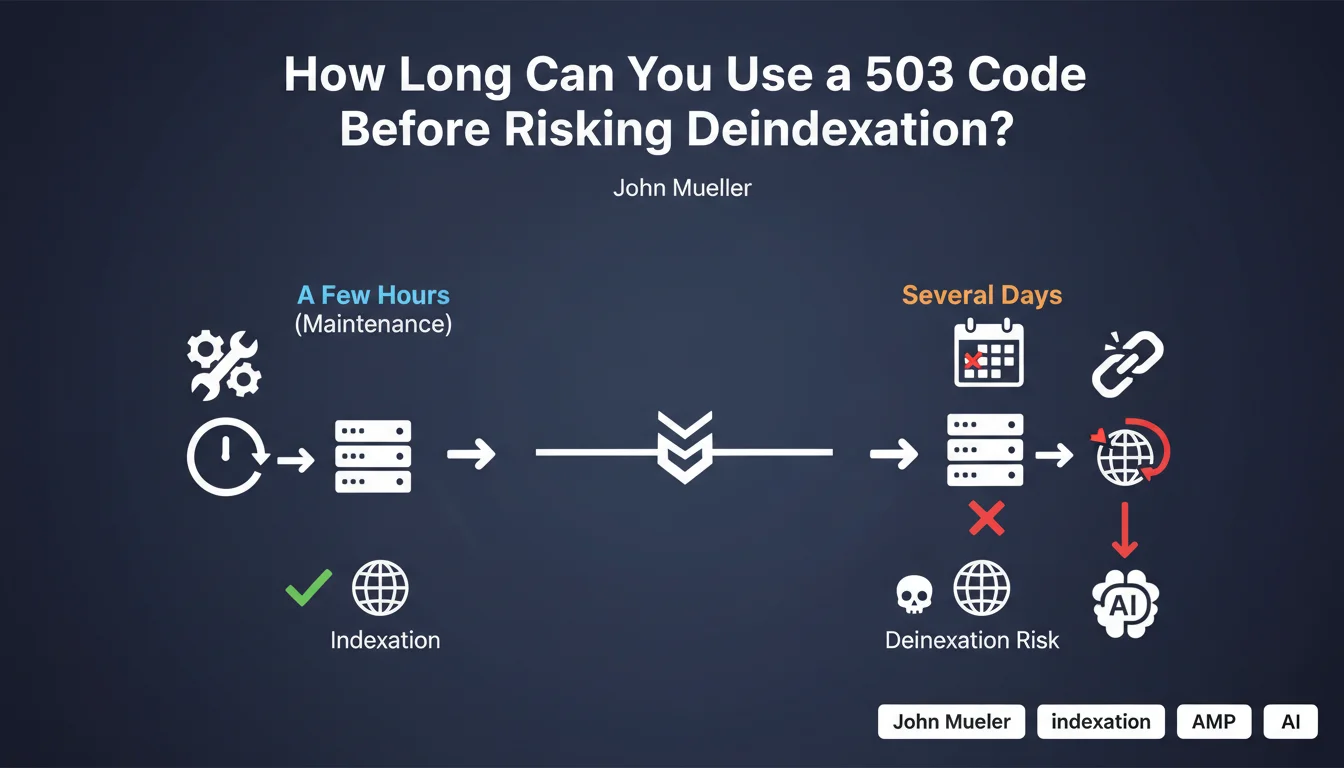
Official statement
What you need to understand
The HTTP 503 code (Service Unavailable) indicates to search engines that a site is temporarily unavailable. It's a crucial technical signal that informs Googlebot to come back later rather than considering the pages as deleted.
Google makes an important distinction regarding the duration of use for this status code. Short maintenance of a few hours is perfectly acceptable and will not impact your SEO. However, prolonged use over several days may be interpreted differently by the algorithm.
When a 503 code persists for too long, Google may consider that the site is experiencing serious structural problems rather than simple temporary maintenance. This perception can trigger progressive deindexation of your pages.
- The 503 code is best practice for short maintenance (a few hours maximum)
- Beyond several days, the risk of deindexation increases significantly
- Google interprets the duration of the 503 as an indicator of the problem's severity
- This code is preferable to a 404 page or server error for planned maintenance
SEO Expert opinion
This recommendation aligns perfectly with field observations from recent years. I've observed that sites using a 503 for 2-3 hours for maintenance experience no penalty. Googlebot naturally returns after a few hours and resumes its crawl normally.
The important nuance concerns frequency and predictability. A site that regularly returns 503 codes, even brief ones, may be considered unstable. Similarly, the notion of "several days" remains vague: our tests show that beyond 24-48 continuous hours, the first pages begin to disappear from results.
There are also special cases such as event-based or seasonal sites that voluntarily close for several months per year. In these situations, the 503 is not the appropriate solution: it's better to keep the site accessible with informative content about the next opening.
Practical impact and recommendations
- Strictly limit your maintenance windows: plan interventions of 2-3 hours maximum with 503 code
- Avoid extended weekends: never leave a 503 code active from Friday evening to Monday morning
- Configure the Retry-After header correctly: tell Google when to come back (example: Retry-After: 3600 for 1 hour)
- Monitor in real-time: set up alerts to detect an unplanned 503 code that persists
- Document your maintenance: keep a history of interventions and their duration to analyze any SEO impact
- Prepare a plan B: if your maintenance risks exceeding 6 hours, consider an alternative solution (accessible staging environment)
- Communicate on Search Console: use the URL inspection tool after maintenance to accelerate reindexation
- Never use 503 to hide content: some try to use this code for pages under construction, which is a strategic mistake
💬 Comments (0)
Be the first to comment.